Chariots de génois
Les chariots de génois sont des chariots de point de tire montés sur rail, utilisés pour contrôler l’angle de tire de l’écoute d’un génois, d’un foc ou d’une autre voile d’avant. La bonne position du chariot influence la tension de chute, la tension de bordure, le vrillage et l’équilibre entre puissance et capacité à remonter au vent. Cette catégorie comprend des chariots de génois fixes, à pion d’arrêt, à plongeur et réglables par palan pour différents systèmes de rails, plages de charge et besoins de réglage, y compris des options d’Antal, Harken et Ronstan. En savoir plus...



Que sont les chariots de génois ?
Les chariots de génois sont des accastillages de pont mobiles qui coulissent sur un rail de génois ou un rail de foc et guident l’écoute de voile d’avant via une poulie, un réa, un guide ou un anneau à faible friction. Leur fonction ne se limite pas à renvoyer l’écoute vers le winch ; ils définissent l’angle de tire de l’écoute et ont donc un effet direct sur la forme de la voile d’avant. Sur un voilier de croisière, un yacht de course ou un croiseur performant, la position du chariot de génois détermine la répartition de la charge de l’écoute entre la chute et la bordure de la voile.
Un chariot de génois est aussi souvent appelé chariot de foc, chariot de point de tire de génois, chariot de voile d’avant, chariot de point d’écoute ou chariot guide-écoute. La terminologie correcte varie selon les fabricants, mais le processus de sélection reste le même : le chariot doit correspondre au profil du rail, à la charge d’écoute attendue, au diamètre du cordage, au mode de réglage et à l’utilisation prévue du bateau.
Comment la position du chariot de génois affecte le réglage de la voile d’avant
Déplacer le chariot de génois modifie l’angle vertical et horizontal de l’écoute vers le point d’écoute. Avancer le chariot augmente la composante verticale de la charge de l’écoute. Cela augmente généralement la tension de chute, réduit le vrillage et donne plus de puissance à la partie supérieure de la voile. Si le chariot est trop avancé, la chute peut devenir excessivement tendue, la voile peut crocher, et les penons inférieurs peuvent décrocher avant les penons supérieurs.
Reculer le chariot augmente la tension de bordure et permet à la chute de s’ouvrir. Cela augmente le vrillage et peut aider à déventer la voile dans la brise plus soutenue ou au reaching. Si le chariot est trop reculé, la chute supérieure peut devenir trop ouverte, la voile peut perdre de la puissance dans ses sections hautes, et les penons supérieurs peuvent se lever avant les penons inférieurs.
Un bon point de départ consiste à régler le point de tire pour que les penons du guindant décrochent de façon homogène du haut vers le bas lorsque le bateau navigue au près. À partir de là, la position du chariot peut être ajustée selon l’état de la mer, l’angle du vent apparent, la taille du génois réduit et l’équilibre recherché entre cap et puissance.
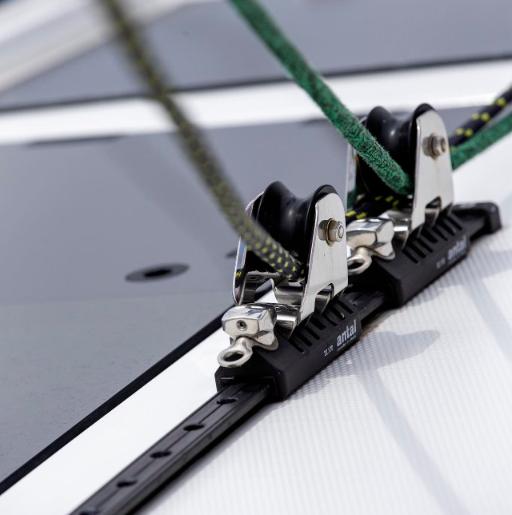
Systèmes de chariots de génois Antal
Chariots de génois à pion d’arrêt, à plongeur et réglables par palan
Les chariots de génois les plus simples utilisent un système à pion d’arrêt ou à plongeur. Ces chariots se positionnent dans des trous le long du rail et sont déplacés manuellement lorsque la charge de l’écoute est réduite. Ils sont mécaniquement simples, compacts et bien adaptés aux bateaux de croisière où le point de tire du génois n’est pas réglé en continu. Pour de nombreux propriétaires remplaçant un chariot existant sur un rail en T standard, un chariot de génois de type plongeur est l’option la plus directe, à condition que la taille et le profil du rail soient corrects.
Les chariots de génois réglables ou à palan utilisent un système de bout de commande, souvent avec un palan 1:1, 2:1, 3:1 ou 4:1. Le bout de commande passe normalement par des embouts de rail et peut souvent être renvoyé vers l’arrière jusqu’au cockpit. Cela permet d’affiner plus fréquemment la position du point de tire et, selon le système et la charge, de régler le chariot en navigation. Les chariots de génois à palan sont particulièrement utiles pour les équipages réduits, la croisière performante, la régate et les voiles d’avant sur enrouleur dont la position du point d’écoute change à mesure que la surface de voile diminue.
Le choix entre un système à pion d’arrêt et un système à palan doit être basé sur la fréquence à laquelle la position du point de tire doit être modifiée. Si le bateau navigue habituellement avec une seule taille de voile d’avant et que les changements de réglage sont occasionnels, un chariot manuel à pion d’arrêt peut suffire. Si le bateau utilise des génois à recouvrement, des voiles d’avant de type code, des voiles partiellement enroulées ou un réglage actif de la voile d’avant, un système réglable offre un bien meilleur contrôle.
| Cas d’utilisation | Type de chariot recommandé | Le mieux adapté à | Points clés à considérer |
|---|---|---|---|
| Configuration de croisière de base | Chariot de génois à pion d’arrêt / plongeur | Voiliers de croisière avec réglage occasionnel | Simple, robuste, généralement réglé avec l’écoute choquée |
| Génois sur enrouleur | Chariot de génois réglable / à palan | Bateaux de croisière et équipages réduits | Permet de modifier la position du point de tire lorsque la voile est réduite |
| Régate / croisière performante | Chariot de génois à palan sur billes | Changements fréquents de réglage sous charge | Friction réduite, meilleur réglage par bout de commande |
| Remplacement sur rail existant | Chariot de génois pour rail en T compatible | Installations plus anciennes ou existantes | Doit correspondre à la largeur du rail, au profil et à l’espacement des trous d’arrêt |
| Mise à niveau complète du système | Nouveau rail, chariots et embouts de commande | Systèmes à plus forte charge ou réglables depuis le cockpit | Nécessite généralement des composants compatibles d’un même système |
Systèmes à rail en T, I-beam, C-track et sur billes
La compatibilité avec le rail est le facteur de sélection le plus important lors du choix de chariots de génois. Les chariots ne sont pas universellement interchangeables entre les marques ou les types de rails. Un chariot pour rail en T de 25 mm, par exemple, ne s’adaptera pas automatiquement à tous les rails de 25 mm si le profil de section, l’épaisseur des ailes, l’espacement des trous d’arrêt ou le type de roulement diffèrent.
Les systèmes traditionnels à rail en T utilisent une section de rail en aluminium simple et un chariot coulissant, souvent avec des garnitures en nylon, acétal ou matériau composite. Ces systèmes sont robustes, relativement bas en profil et largement utilisés sur les voiliers de croisière. Ils conviennent généralement mieux à un réglage manuel qu’à des déplacements fréquents sous forte charge.
Les chariots de génois sur billes sont conçus pour réduire la friction et améliorer le réglage sous charge. Ces systèmes nécessitent normalement un profil de rail sur billes correspondant et des embouts de rail compatibles. Ils sont plus appropriés lorsque le chariot doit se déplacer en douceur pendant un réglage actif, en particulier sur les grands bateaux ou les systèmes de voiles d’avant à forte charge.
Lors du remplacement d’un chariot de génois existant, la première étape doit toujours être d’identifier le fabricant du rail, la largeur du rail, la section du rail et la disposition des trous d’arrêt. Si le rail ne peut pas être identifié, mesurez soigneusement le profil avant de commander. En cas de passage d’un système de base à rail en T et plongeur à un système à palan ou sur billes, il est souvent nécessaire de remplacer le rail complet, les chariots, les embouts de commande et la visserie associée plutôt que de changer uniquement le chariot.
Chariots de génois pour voiles d’avant sur enrouleur
Les génois sur enrouleur rendent le réglage du chariot de génois plus important, et non moins. Lorsqu’un génois est partiellement enroulé, la position du point d’écoute change et le point de tire correct se déplace souvent vers l’avant. Si le chariot reste dans la même position que celle utilisée pour un génois entièrement déroulé, la voile réduite peut présenter un vrillage excessif, un mauvais contrôle de la chute et une répartition de charge irrégulière.
Pour les voiliers de croisière équipés de voiles d’avant sur enrouleur, des chariots de génois réglables peuvent rendre les formes de voile réduite plus efficaces et plus faciles à reproduire. Cela est particulièrement pertinent pour les bateaux naviguant en équipage réduit, où l’équipage ne souhaite pas forcément avancer sur le pont pour libérer manuellement un chariot à pion d’arrêt sous charge. Un système de chariot de génois à palan réglable depuis le cockpit permet de corriger le point de tire au fur et à mesure que la voile d’avant est enroulée ou déroulée.
Charge admissible, taille du réa et compatibilité avec le cordage
Les charges sur les écoutes de génois peuvent être importantes, notamment sur les voiles d’avant à recouvrement, les grands yachts et les bateaux naviguant par vent apparent plus fort. Le choix doit donc être basé sur la charge de travail, la charge maximale, la taille du bateau, la surface de voile, l’angle de tire et l’utilisation prévue. Le chariot, la poulie ou le réa, le rail, les butées d’extrémité, la visserie et la structure de pont font tous partie du chemin de charge.
Le réa ou la poulie du chariot de génois doit également convenir au diamètre de l’écoute et à la construction du cordage. Un réa trop petit augmente la friction et l’usure du cordage. Un guide ou un anneau à faible friction peut convenir pour des applications simples, mais un réa sur billes ou haute charge est préférable lorsque les charges d’écoute sont élevées ou que des réglages fréquents sont prévus.
Pour les systèmes à bout de commande, vérifiez le rapport de palan, le diamètre maximal du bout de commande, la configuration des embouts de rail et si le système est fourni en composants bâbord et tribord. Un rapport de palan plus élevé facilite le réglage mais nécessite plus de bout de commande et davantage d’espace sur le pont.
Choisir les bons chariots de génois
Lors de la sélection de chariots de génois, commencez par l’accastillage existant plutôt que par l’image du produit. Vérifiez le type de rail, la largeur du rail, la marque, le mode d’arrêt du chariot et si le système est spécifique bâbord/tribord. Ensuite, contrôlez la charge de travail, la taille du cordage, la configuration du réa et si le chariot est prévu pour un réglage manuel, à pion d’arrêt ou à palan.
Pour les yachts plus anciens, les chariots de remplacement peuvent être limités par le profil de rail d’origine. Dans certains cas, la solution la plus fiable consiste à remplacer l’ensemble du système de point de tire de génois, notamment si le rail existant est usé, corrodé, mal soutenu ou incompatible avec les chariots actuels. Pour les installations plus récentes ou orientées performance, les systèmes rail-et-chariot appairés de marques telles que Antal, Harken et Ronstan offrent une approche plus prévisible en matière de capacité de charge, de friction au réglage et de compatibilité des pièces de rechange.
Un système de chariot de génois bien spécifié améliore plus que le simple confort d’utilisation. Il permet un réglage reproductible de la voile d’avant, une meilleure forme du génois réduit, un réglage plus sûr et un contrôle plus précis du vrillage sur une plage de vent plus large. Pour les propriétaires techniquement avertis, le bon chariot de génois ne se choisit pas uniquement par la marque, mais par la compatibilité avec le rail, le chemin de charge, les exigences de réglage et la manière dont le bateau est réellement navigué.
Section FAQ sur les systèmes de chariots de génois
À quoi servent les chariots de génois ?
Les chariots de génois contrôlent la position du point de tire de l’écoute de voile d’avant. Déplacer le chariot modifie la tension de chute, la tension de bordure et le vrillage, ce qui affecte directement la forme du génois ou du foc.
Les chariots de génois et les chariots de foc sont-ils la même chose ?
Dans de nombreuses applications, oui. « Chariot de génois » et « chariot de foc » sont souvent utilisés pour des chariots de point de tire d’écoute similaires, bien que le produit correct dépende du type de rail, de la charge et de la configuration de la voile d’avant.
Les chariots de génois peuvent-ils être réglés sous charge ?
Certains oui, mais pas tous. Les chariots à pion d’arrêt et à plongeur se règlent normalement avec l’écoute choquée. Les chariots de génois à palan ou sur billes sont conçus pour un réglage plus facile en navigation, selon la charge et la configuration du système.
Comment savoir quel chariot de génois convient à mon rail ?
Identifiez le fabricant du rail, la largeur du rail, le profil du rail et la disposition des trous d’arrêt. Les chariots de génois ne sont pas universellement interchangeables, même lorsque la largeur nominale du rail semble similaire.
Les génois sur enrouleur ont-ils besoin de chariots de génois réglables ?
Les chariots de génois réglables sont utiles pour les voiles d’avant sur enrouleur, car la position du point d’écoute change à mesure que la voile est réduite. Déplacer le point de tire aide à conserver une tension de chute correcte et une bonne forme de voile.

To install this Web App in your iPhone/iPad press
 and then Add to Home Screen.
