LOOP Products
L’accastillage de voile Loop Products est conçu autour de solutions de gréement souples, légères et à faible encombrement pour les yachts modernes. La gamme comprend des manilles textiles en Dyneema, Loop Blocks, cosses, cosses d’emmagasineur, cadènes, guides, dogbones et boucles épissées pour des applications où l’accastillage métallique conventionnel peut être plus lourd, plus bruyant ou moins tolérant pour l’accastillage de pont, les espars, les voiles et les systèmes de lignes de contrôle. En savoir plus ci-dessous.
|
|
|
|
|
|
|
|
|
|
|
|
|
|
|
|
|
|
|
|
|
|
|
|
|
Loop Products : accastillage de pont souple pour applications de voile techniques
Loop Products est une marque spécialiste de l’accastillage voile, axée sur l’équipement de pont lié au cordage, les fixations souples et les composants compacts de transfert de charge. Au lieu de s’appuyer uniquement sur des manilles, axes et ferrures métalliques fixes traditionnels en acier inoxydable, Loop Products utilise des connexions textiles modernes, des composants en aluminium anodisé dur et des boucles à base de Dyneema pour créer un accastillage léger, résistant, compact et pratique dans les environnements de navigation à fortes charges.
Pour les navigateurs qui modernisent leur gréement courant, leur plan de pont ou leurs systèmes d’emmagasineur, Loop Products est particulièrement pertinent lorsque la réduction du poids, l’articulation et le contact souple sont importants. Les applications typiques incluent la fixation de poulies au pied de mât, la création de points de tire amovibles pour les écoutes, le remplacement de manilles métalliques à certains emplacements, la réalisation de systèmes de lignes de contrôle à faible friction, la connexion de câbles d’emmagasineur, l’organisation des renvois de pont et la réduction des contacts métal dur autour des espars, des voiles et des œuvres mortes.
Cela rend la gamme Loop Products utile pour les voiliers de croisière performants, les bateaux hauturiers, les bateaux de course, les multicoques et les propriétaires techniciens qui recherchent des solutions de gréement propres et efficaces sans ajouter de masse ni de complexité inutiles.
Principale gamme Loop Products disponible chez Upffront
La gamme Loop Products chez Upffront couvre plusieurs grandes familles d’accastillage. Les manilles textiles Loop Products sont utilisées comme connecteurs textiles flexibles pour les poulies, écoutes, lignes de contrôle, drisses et fixations temporaires. Les Loop Blocks et Power Blocks offrent des solutions compactes à réa lorsque la fixation souple peut s’aligner naturellement avec la charge. Les cosses Loop, anneaux à faible friction et cosses d’emmagasineur sont utilisés pour les surliures, les déviations de lignes de contrôle et les terminaisons de câbles d’emmagasineur. La gamme comprend également des cadènes, guides, bagues de pont, dogbones de voile, boucles épissées et mousquetons textiles.
Cette large combinaison de produits signifie que Loop Products ne doit pas être considéré simplement comme une marque de manilles textiles. Il est préférable de le comprendre comme un système d’accastillage de pont souple : un ensemble de composants pouvant être combinés pour résoudre les problèmes courants de gréement avec moins de métal, moins de poids et un meilleur alignement des charges.
Manilles textiles Loop Products et connecteurs forte charge
Manilles textiles Loop Products comptent parmi les points d’entrée les plus courants dans la gamme. Une manille textile remplace une manille métallique conventionnelle dans les applications adaptées à l’aide d’une boucle en Dyneema et d’un nœud de verrouillage ou d’un système de fermeture. Les principaux avantages sont un faible poids, une construction sans corrosion, un fonctionnement silencieux, la réduction des dommages sur le pont et la capacité à s’articuler naturellement sous des angles de charge changeants.
Lors du choix d’une manille textile Loop Products, la spécification clé n’est pas simplement le diamètre. Vous devez également vérifier la charge de travail, la charge de rupture, la longueur ouverte, la longueur fermée, le diamètre du cordage, la géométrie de fixation et l’état de surface de la ferrure contre laquelle elle prendra appui. Les manilles textiles ne doivent pas être chargées sur des arêtes vives, ébavurées ou non protégées. Si le point de fixation présente une patte inox étroite, un trou rugueux, un angle vif ou une forte charge ponctuelle, un connecteur métallique, une cosse, un dogbone ou une interface de protection peut être plus approprié.
Loop Products propose également des options de manilles textiles forte charge pour les applications plus exigeantes. Celles-ci doivent être choisies à partir des données de charge du fabricant plutôt qu’en se fiant uniquement à leur taille visuelle. Les manilles textiles forte charge peuvent être utiles lorsque l’objectif est de réduire le poids tout en conservant une capacité de charge élevée, mais elles exigent toujours une installation correcte, une charge bien alignée et une inspection régulière.
Manilles textiles Loop Products simples ou doubles
Une manille textile simple standard convient souvent pour des fixations simples de poulies, des lignes de contrôle et des connexions souples à usage général. Une manille textile double peut être utile lorsqu’un meilleur partage de charge ou un meilleur alignement est nécessaire. Comme les deux côtés de la boucle peuvent contribuer au chemin de charge, une configuration double peut se positionner plus proprement autour de certaines poulies, cadènes ou certains anneaux.
Cependant, le choix entre simple et double doit être fait en fonction de l’application réelle. Tenez compte de la surface d’appui, de l’articulation requise, de l’espace disponible, de la direction de la charge et de la fréquence à laquelle la connexion doit être ouverte. Pour une connexion fréquemment réglée ou exposée, la facilité de manipulation et d’inspection peut être tout aussi importante que la résistance maximale.
Loop Blocks et poulies à liaison souple
Loop Blocks sont des poulies compactes fixées par une boucle souple plutôt que par une manille métallique conventionnelle. Cette construction est utile dans les zones où la poulie doit s’aligner librement avec la charge, où les chocs sur le pont doivent être réduits, ou lorsqu’un renvoi amovible est nécessaire. Les applications courantes incluent les renvois en pied de mât, barber-haulers, tweakers, renvois de ris, points de tire temporaires pour écoutes, déviation de lignes de contrôle et systèmes de pont à faible encombrement.
Comparé à une poulie métallique fixe, un Loop Block peut réduire les contacts durs avec le pont ou l’espar et peut permettre un angle de renvoi plus propre. Comparé à un anneau à faible friction, une poulie à réa est normalement préférée lorsque le cordage bouge fréquemment ou fait l’objet de réglages importants, car le réa tournant réduit la friction. Un anneau à faible friction ou une cosse convient souvent mieux pour des déviations plus simples et plus statiques où la compacité et le faible poids sont prioritaires.
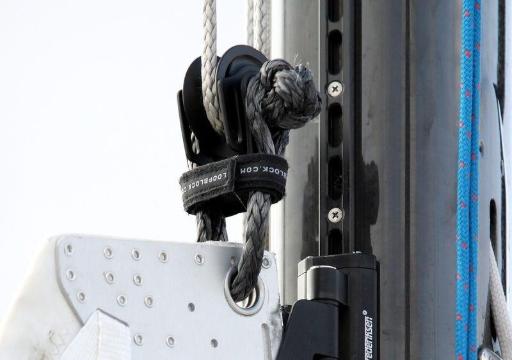
Pour le choix, vérifiez le diamètre du réa, le diamètre maximal du cordage, le type de roulement, la charge de travail admissible et la méthode de fixation. Les versions à billes sont généralement choisies pour les lignes faiblement chargées et fréquemment réglées où le rendement compte. Les conceptions à aiguilles ou à palier lisse peuvent être plus appropriées pour des charges statiques ou semi-statiques plus élevées, selon la spécification du produit.
Cosses Loop, cosses d’emmagasineur, anneaux et dogbones
Les cosses et anneaux Loop Products sont utilisés pour créer des renvois de cordage compacts à faible friction et des points de surliure. Ils sont particulièrement utiles dans les systèmes de lignes de contrôle où le cordage n’a pas besoin d’une poulie complète, mais nécessite tout de même une surface d’appui propre et un rayon de courbure contrôlé. Les usages typiques incluent les cascades, palans, barber-haulers, inhaulers, lazy jacks, systèmes de ris et points de fixation souples.
Cosses d’emmagasineur Loop Products sont plus spécifiques. Elles sont utilisées dans les systèmes d’emmagasineur pour Code 0, gennaker et câbles torsionnels où l’interface entre l’emmagasineur, le câble torsionnel et la fixation de voile doit être dimensionnellement correcte. Lors du choix d’une cosse d’emmagasineur, vérifiez attentivement trois éléments : la largeur de mâchoire de l’emmagasineur, le diamètre de l’axe et le diamètre du câble torsionnel. Une incompatibilité dans l’une de ces dimensions peut provoquer un mauvais alignement, un montage difficile ou une charge ponctuelle excessive.
Les dogbones constituent une autre partie importante du système Loop Products. Ce sont des toggles compacts utilisés avec des boucles, strops et fixations souples. Un dogbone peut fournir un point de fermeture sûr tout en gardant une connexion courte, propre et facile à inspecter.
Comment choisir le bon composant Loop Products
Le bon article Loop Products doit être choisi en fonction du cas de charge, et pas seulement de la famille de produits. Commencez par identifier la fonction : fixation, déviation, surliure, connexion d’emmagasineur, renvoi temporaire ou ferrure de pont permanente. Vérifiez ensuite la charge de travail attendue, le diamètre du cordage, le rayon de courbure, l’espace disponible et le type de mouvement impliqué.
Pour un cordage mobile soumis à des réglages réguliers, un Loop Block peut être la solution la plus efficace. Pour une déviation compacte et majoritairement statique, une cosse ou un anneau à faible friction peut être plus adapté. Pour remplacer un connecteur métallique, une manille textile peut très bien convenir si les surfaces d’appui sont lisses et si le chemin de charge est correct. Pour les systèmes d’emmagasineur, utilisez une cosse d’emmagasineur dédiée et confirmez la compatibilité dimensionnelle avant l’installation.
L’inspection est également importante. L’accastillage souple en Dyneema doit être contrôlé pour l’abrasion, les coupures, le glaçage, la dégradation UV, la contamination, le déplacement des nœuds et l’usure localisée. Tout connecteur souple présentant un dommage structurel doit être remplacé. C’est particulièrement important sur le gréement courant fortement chargé, les bateaux hauturiers et les systèmes où une défaillance créerait un problème de sécurité.
FAQ Loop Products
Que fabrique Loop Products pour les voiliers ?
Loop Products fabrique de l’accastillage de pont souple et des ferrures de yacht liées au cordage, notamment des manilles textiles, Loop Blocks, cosses, cosses d’emmagasineur, cadènes, anneaux, guides, dogbones, boucles épissées, bagues de pont et mousquetons textiles.
Les manilles textiles Loop Products sont-elles fabriquées en Dyneema ?
Oui, les manilles textiles Loop Products utilisent des constructions de cordage haute performance à base de Dyneema selon le modèle. Vérifiez toujours la fiche technique de chaque produit pour le type de fibre, le diamètre, la charge de travail et la charge de rupture.
Les manilles textiles Loop peuvent-elles remplacer les manilles en acier inoxydable ?
Elles peuvent remplacer des manilles métalliques dans de nombreuses applications adaptées, mais pas partout. Elles fonctionnent mieux sur des surfaces d’appui lisses et arrondies avec un bon alignement de charge. Évitez les arêtes vives, les fortes charges ponctuelles et les ferrures susceptibles de couper ou d’user le cordage par abrasion.
Quelle est la différence entre un Loop Block et un anneau à faible friction ?
Un Loop Block utilise un réa tournant, il est donc normalement préférable pour les cordages qui bougent fréquemment ou nécessitent un réglage efficace. Un anneau à faible friction ou une cosse est plus simple, plus léger et plus compact, mais génère davantage de friction qu’une poulie à réa.
Comment choisir une cosse d’emmagasineur Loop ?
Adaptez la cosse d’emmagasineur à la largeur de mâchoire de l’emmagasineur, au diamètre de son axe et au diamètre du câble torsionnel. Ces dimensions sont essentielles pour un alignement correct et un transfert de charge fiable dans les systèmes d’emmagasineur de Code 0 et de gennaker.
Les produits Loop Products nécessitent-ils un entretien ?
Ils nécessitent une inspection plutôt qu’un entretien complexe. Rincez à l’eau douce lorsque c’est approprié, gardez-les à l’écart des arêtes vives et contrôlez régulièrement l’abrasion, les coupures, les dommages dus aux UV, le glaçage, les coutures endommagées ou les modifications du nœud de verrouillage ou de la géométrie de la boucle.

To install this Web App in your iPhone/iPad press
 and then Add to Home Screen.
