Garmin
Garmin est un fabricant reconnu d’électronique marine, avec une forte spécialisation dans l’intégration des systèmes et les réseaux de données à bord. Dans les applications de voile, les composants Garmin NMEA 2000 et les appareils portables de navigation offrent des solutions fiables pour la distribution des données et la surveillance à distance des systèmes. Ces produits sont généralement utilisés pour compléter les installations d’électronique marine existantes, en garantissant une communication cohérente entre les instruments, les capteurs et les écrans de bord. En savoir plus ci-dessous.
|
|
|
|
|
|
|
|
Composants Garmin NMEA 2000 pour systèmes de voile
Au cœur de nombreuses installations électroniques de voile modernes se trouve le réseau NMEA 2000, un protocole de communication standardisé utilisé pour connecter les instruments, capteurs et appareils de navigation. Garmin propose une gamme de composants essentiels nécessaires à la création et à la maintenance de ce réseau.
Le matériel Garmin NMEA 2000 disponible comprend :
- Câbles de dorsale et de dérivation (différentes longueurs)
- Connecteurs en T (pièces en T)
- Kits de démarrage complets
Ces composants sont utilisés pour créer une topologie dorsale-et-dérivations, où chaque appareil se connecte à une ligne de données centrale. Cette structure permet à plusieurs appareils de partager en temps réel des données telles que le vent, la profondeur, la position GPS et le cap.
Structure et fonctionnement du réseau NMEA 2000
Un réseau NMEA 2000 correctement installé est essentiel pour des performances système fiables. Les composants Garmin respectent les spécifications standard des connecteurs Micro-C, garantissant la compatibilité avec d’autres équipements certifiés NMEA 2000.
Un réseau type comprend :
- Un câble de dorsale sur toute la longueur du système
- Des pièces en T pour chaque appareil connecté
- Des câbles de dérivation reliant les appareils à la dorsale
- Une alimentation et des résistances de terminaison à chaque extrémité de la dorsale
Les câbles de dérivation Garmin (disponibles en longueurs de 30 cm, 2 m et 10 m) permettent une installation flexible selon l’agencement à bord. Les câbles plus courts sont généralement utilisés pour les instruments montés à la barre, tandis que des longueurs plus importantes peuvent être nécessaires pour les connexions au pied de mât ou aux tables à cartes.
Le kit de démarrage Garmin NMEA 2000 fournit les composants essentiels requis pour assembler un réseau de base, ce qui le rend adapté aux nouvelles installations comme aux extensions de système.
Compatibilité et intégration
Les composants Garmin NMEA 2000 sont conçus pour être entièrement compatibles avec les réseaux NMEA 2000 standard du secteur, ce qui signifie qu’ils peuvent être utilisés avec des équipements d’autres fabricants tels que B&G, Raymarine ou NKE.
D’un point de vue technique :
- Tous les composants utilisent des connecteurs et des spécifications de tension standardisés
- La communication des données suit les protocoles PGN (Parameter Group Number)
- L’extension du réseau est modulaire et évolutive
Cela rend le matériel réseau Garmin adapté aussi bien aux nouvelles constructions qu’aux installations en rétrofit, où le maintien de la compatibilité avec les systèmes existants à bord est essentiel.
Considérations d’installation pour les systèmes NMEA 2000
Lors de l’installation de composants Garmin NMEA 2000, plusieurs facteurs techniques doivent être pris en compte afin d’assurer la stabilité du système :
Configuration de la dorsale
La dorsale doit être installée comme une ligne continue avec des résistances de terminaison aux deux extrémités. Une terminaison incorrecte est une source fréquente de défaillance du réseau.
Longueurs de câble
Les câbles de dérivation ne doivent généralement pas dépasser 6 mètres par appareil, conformément aux spécifications NMEA 2000. Le choix de longueurs de câble adaptées aide à minimiser la perte de signal.
Alimentation électrique
Le réseau doit être correctement alimenté, généralement via un nœud d’alimentation dédié. Les chutes de tension sur les longues dorsales doivent être évitées.
Intégrité des connexions
Tous les connecteurs doivent être correctement étanchés et sécurisés, en particulier dans les environnements marins exposés où l’humidité peut affecter les performances.
L’utilisation de composants de la même marque, tels que les câbles Garmin et les pièces en T, contribue à garantir une qualité de connexion constante et à réduire les problèmes potentiels de compatibilité.
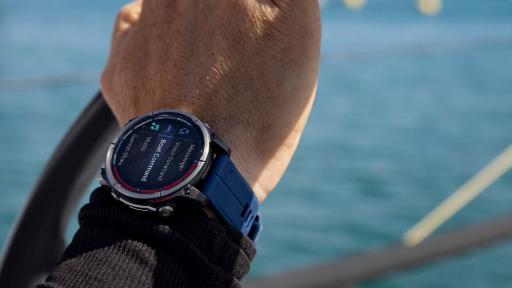
Smartwatch Garmin
Garmin quatix® – Intégration de smartwatch GPS de voile
En plus des composants réseau, la gamme quatix® de Garmin offre une interface portable pour les données de bord et la surveillance de la navigation. La quatix® 8 est conçue spécifiquement pour un usage marin, intégrant la fonctionnalité GPS à la connectivité des systèmes de bord.
Du point de vue de la voile, les principales capacités techniques comprennent :
- Suivi de position et surveillance de route basés sur le GPS
- Intégration avec les systèmes de bord via une connectivité sans fil
- Affichage des données de navigation clés telles que la vitesse, le cap et les waypoints
- Fonction de contrôle à distance pour les appareils Garmin compatibles
L’utilisation d’un appareil portable permet aux membres d’équipage d’accéder aux données de navigation sans être physiquement devant le traceur, ce qui peut être particulièrement utile pendant les manœuvres ou lors des déplacements à bord.
Cas d’usage dans les applications de voile
Les produits Garmin de cette catégorie sont généralement utilisés dans les scénarios suivants :
Installation ou mise à niveau du réseau
- Construction d’une nouvelle dorsale NMEA 2000
- Extension d’un réseau d’instruments existant
- Remplacement d’un câblage endommagé ou vieillissant
Intégration système
- Connexion des capteurs de vent, de profondeur et GPS
- Liaison de plusieurs écrans ou instruments
- Garantie d’un flux de données cohérent entre les appareils
Mobilité à bord
- Surveillance des données de navigation via des appareils portables
- Accès à distance aux informations GPS et de route
- Assistance à la navigation en équipage réduit lorsque la mobilité est importante
Pourquoi les composants NMEA 2000 sont importants
Dans les systèmes de voile modernes, la fiabilité du réseau de données est aussi importante que les appareils eux-mêmes. Des connexions de mauvaise qualité ou une installation incorrecte peuvent entraîner :
- Perte de données intermittente
- Lectures d’instruments incohérentes
- Défaillances de communication du réseau
L’utilisation de composants correctement spécifiés, tels que les câbles et connecteurs Garmin NMEA 2000, aide à maintenir l’intégrité du signal et garantit un fonctionnement stable sur l’ensemble du système.
Questions fréquemment posées - Garmin
Qu’est-ce qu’un câble de dérivation Garmin NMEA 2000 ?
Un câble de dérivation connecte un appareil individuel (tel qu’un instrument ou un capteur) à la dorsale principale NMEA 2000 via une pièce en T.
Les composants Garmin NMEA 2000 sont-ils compatibles avec d’autres marques ?
Oui, les composants Garmin respectent les spécifications standard NMEA 2000 et peuvent être utilisés avec d’autres électroniques marines certifiées.
Que contient un kit de démarrage Garmin NMEA 2000 ?
Il comprend généralement des câbles de dorsale, des connecteurs en T, des résistances de terminaison et les composants d’alimentation nécessaires pour créer un réseau de base.
Quelle peut être la longueur d’un câble de dérivation NMEA 2000 ?
Les directives standard recommandent un maximum de 6 mètres par câble de dérivation afin de préserver l’intégrité du signal.
À quoi sert la Garmin quatix® en voile ?
La smartwatch quatix® fournit la navigation GPS, l’affichage des données de bord et l’accès à distance aux systèmes Garmin compatibles.

To install this Web App in your iPhone/iPad press
 and then Add to Home Screen.
