
Technora appears increasingly often in the specifications of modern performance sailing ropes, particularly in the covers of high-load halyards, sheets and control lines. It is commonly blended with polyester, and sometimes appears alongside other high-performance fibres such as Dyneema and Kevlar.
But what exactly is Technora, and what does it add to a rope?
The answer is primarily about what happens on the outside of the rope. In many modern performance constructions, a Dyneema or other high-modulus core provides most of the strength and low-stretch characteristics, while the cover has the very different job of surviving contact with winches, clutches, jammers, sheaves and deck organisers.
This is where Technora becomes particularly useful.
What is Technora?
Technora is a high-performance para-aramid fibre manufactured by Teijin Aramid. It belongs to the same broad family of fibres as Kevlar and Twaron, although its chemistry and properties are different.
For sailing ropes, its most relevant characteristics are high strength, excellent abrasion and fatigue resistance, very low creep and particularly good resistance to heat.
The last two properties are important when considering rope covers.
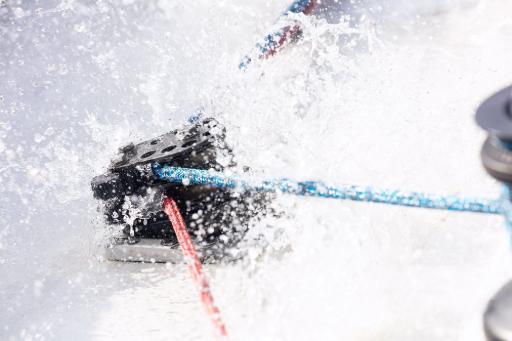
A loaded halyard held in a clutch is subjected to considerable compression, while sheets and halyards moving over winches and through deck hardware experience repeated abrasion. If a heavily loaded rope slips across a surface, friction can also create significant localised heat.
Technora is well suited to this environment. Unlike thermoplastic fibres, aramids do not simply soften and melt as temperatures increase, and Technora can tolerate substantially higher temperatures than HMPE fibres such as Dyneema.
That doesn't make Technora inherently a "better" rope fibre than Dyneema. The two materials are generally being asked to do different jobs.
Why Put Technora in the Cover?
Think of a modern performance rope as two related structures.
The core is primarily responsible for carrying tensile load and controlling elongation. This is why Dyneema is so widely used in performance halyards and sheets: it provides extremely high strength for its weight with very low stretch.
The cover has to protect that core and provide a workable interface between the rope and the yacht's hardware.
It therefore needs a useful combination of abrasion resistance, heat resistance, grip, flexibility and handling characteristics.
Technora's contribution is particularly valuable where the rope experiences high loads combined with friction and repeated mechanical wear. This makes Technora rope constructions especially relevant to halyards passing through high-load clutches and sheets regularly worked around winches.
Heat and abrasion are closely related here. A small amount of movement under high load can generate considerable frictional heat, while the same section of cover may repeatedly be compressed or rubbed against hardware.
Technora helps engineer the cover for this demanding environment.
PremiumRopes TN Racing
Why Are Technora Covers Usually Blended?
If Technora has such useful properties, why not simply make the entire cover from it?
Because a good rope cover is a compromise between different requirements.
Polyester remains an excellent cover material. It is durable, relatively economical and has good handling characteristics. Dyneema offers exceptional strength-to-weight performance and can improve abrasion characteristics in appropriate constructions, but has relatively limited tolerance of high temperatures. Kevlar and other aramids bring another combination of strength, heat resistance and abrasion characteristics.
Technora can therefore be mixed with other fibres to produce a cover designed around a particular application.
Importantly, the presence of Technora alone does not determine how a rope will perform. The proportion and type of fibres, yarn construction, braid geometry and interaction between core and cover all matter.
The same applies to grip. Technora can contribute to the grip characteristics of a performance cover, but grip isn't simply an intrinsic property of one fibre. Cover construction, surface texture, rope diameter and the design and condition of the winch or clutch all influence how securely a rope is held.
This is why terms such as Technora rope or Technora cord need some qualification. Technora may form only one part of a deliberately engineered blended cover around a completely different load-bearing core.
Technora Rope Covers in Practice
Gottifredi Maffioli Powertech 78 is a good example because its construction is clearly specified. It uses Maffioli's Novabraid 78 high-modulus core with a cover comprising 50% Technora and 50% high-tenacity polyester.
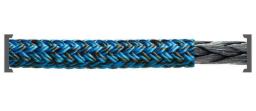
Rather than trying to maximise the amount of Technora, the cover combines its heat and abrasion resistance with the handling and durability characteristics of polyester.
Powertech is particularly well suited to performance halyards, where low stretch needs to be combined with a cover capable of handling concentrated loads in clutches and repeated use around winches. It can also be used as a performance sheet where similar requirements exist.
Premiumropes TN Racing follows the same general principle, using a high-modulus Stirotex core with a Technora/polyester cover. Premiumropes doesn't specify the proportions of the cover blend, but does highlight abrasion resistance and grip in heavily loaded clutches, jammers and winches – exactly the environment where a Technora blend makes sense.
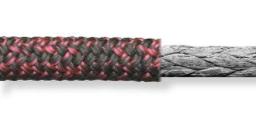
Robline Admiral Pro provides another example of Technora being incorporated into the cover of a high-performance sailing rope. Again, the precise blend isn't published, reinforcing the point that knowing a rope contains Technora is only part of understanding its construction.
When Does Technora Make Sense?
Not every sailing rope needs Technora.
For many cruising applications, a good polyester-covered Dyneema rope provides an excellent balance of performance, durability and cost. Technora becomes more interesting as loads increase and the interaction between rope and hardware becomes more demanding.
A useful way to think about it is in terms of duty cycle rather than simply whether a yacht is a cruiser or racer.
Is the rope heavily loaded in a clutch? Does the same section repeatedly pass around a winch? Is it regularly adjusted under load? Has the existing cover suffered from glazing, slipping or accelerated wear?
If so, a Technora-blended cover may offer a worthwhile advantage.
The important point is that modern performance rope selection isn't simply about breaking load or core material. The core may carry the load, but the cover has to survive the yacht.
Technora's combination of heat resistance, abrasion resistance and mechanical durability makes it a particularly useful tool for engineering covers that can do exactly that.

 and then Add to Home Screen.

Technora in Performance Sailing Ropes: Why It Matters