
Rope clutches have a harder job than they used to. A line that once held a polyester halyard at a few hundred kilograms may now be a Dyneema-cored halyard generating far higher loads on the same diameter — and the clutch has to hold that line without chewing through an expensive cover. The Spinlock XTX is one answer to that problem: a mid-load rope clutch that replaces the traditional metal cam with a textile ‘soft-grip’ braid.
This is an update to our 2023 look at the XTX, going into more detail on how it sits alongside the core Spinlock rope clutches — the XAS, XCS and XTS. Spinlock is one of the leading names in rope clutches and jammers, and the XTX is its textile-grip option in this class.
How the Spinlock XTX rope clutch works
Most rope clutches grip the line by pressing a toothed or ridged cam down onto the cover, pinching it against a fixed lower jaw. It is a proven arrangement, but the holding force is concentrated at a relatively short section of rope, which is exactly where a loaded, expensive cover can suffer. The Spinlock XTX takes a different route.
Soft-grip braid instead of a cam
Rather than a cam, the XTX uses a braided fibre sleeve — Spinlock’s “Softgrip” braid — that tightens around the rope, similar in principle to the constrictor-style textile clutches used on grand-prix boats. Each braid is matched to a specific line diameter, so the grip is sized to the rope rather than designed to accommodate a broad range of diameters.
The Spinlock XTX Softgrip braid spreads its hold along the cover rather than pinching at a point.
Kinder to the cover — and to running-rigging budgets
Because the braid grips over a length of the rope rather than at a single cam contact, the load is distributed across a larger section of cover. In practice this means less concentrated pressure and abrasion on the line, which is one of the Spinlock XTX’s main attractions: reduced rope wear, and therefore potentially longer service life from what is often the most expensive part of a running-rigging package. On boats where halyards and control lines are replaced on a cycle, a clutch that is gentler on covers can meaningfully lower lifetime rigging costs.
It is worth distinguishing the Spinlock XTX approach from the ceramic-coated cam available for the XCS. The ceramic option is designed to improve engagement and maintain consistent holding on modern performance ropes, with the hard coating resisting the tendency for heavily loaded lines to polish the gripping surfaces smooth. The Spinlock XTX tackles the problem differently: rather than making a conventional gripping surface more effective, it removes the hard cam altogether and distributes the holding force along a textile braid.
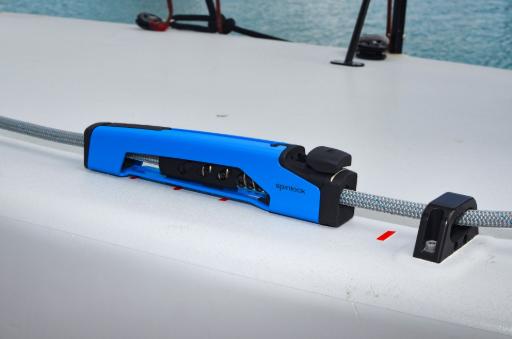
Spinlock XTX Clutch
Grip that builds with load
The Spinlock XTX’s textile grip is self-energising, working on much the same principle as the familiar Chinese finger trap. As the braid is pulled lengthways it contracts around the rope inside it, so the greater the load on the line, the more firmly the braid grips. This allows holding power to build with load without relying on the concentrated pressure of a conventional cam.
A large internal spring pre-tensions the braid around the line, allowing the clutch to take up the load as soon as it is engaged rather than waiting for the sleeve to extend before it starts to grip. Releasing is done on a winch: pull the toggle for a controlled slip, or latch it fully open to let the line run free, then push the button to re-engage. As with any clutch, a heavily loaded line should be eased on a winch rather than simply releasing the clutch under load.
Release is handled by a single rear toggle and button.
How the Spinlock XTX compares with the XAS, XCS and XTS rope clutches
The Spinlock XTX does not replace the cam-based rope clutches; it sits alongside them as a more specialist option for applications where rope protection, holding load and weight are important considerations. The XAS is the compact, light-load workhorse; the XTS and XCS step up the holding load, with the XCS also offering a ceramic-cam option. Here is how the four rope clutches line up.
Comparing the Spinlock rope clutches on load and weight
|
Range |
Line size |
Max holding load |
Grip |
Release |
Single-unit weight* |
Length |
|
4–12 mm |
450–575 kg |
Alloy cam |
Handle |
270 g |
134 mm |
|
|
6–14 mm |
700–1000 kg |
Alloy cam |
Handle |
545 g |
~155 mm |
|
|
6–14 mm |
700–1200 kg |
Cam (ceramic-coated option) |
Handle |
630 g |
156 mm |
|
|
8–12 mm |
800–1200 kg |
Softgrip textile braid |
Handle + remote |
360–375 g |
264 mm |
*Standard single unit, excluding fasteners. Figures from current Spinlock product data; loads quoted at maximum line diameter for the range.
Spinlock XTX Line Sizes and Holding Loads
The Spinlock XTX covers 8–12 mm lines, with holding load rising from around 800 kg on the 8 mm version to 1200 kg on the 12 mm. We stock the 8, 10 and 12 mm versions, which cover the vast majority of halyard applications. Technically, Spinlock also produces diameter-specific Softgrip braids for 9 and 11 mm lines, but availability is limited and these sizes are therefore supplied on request.
That puts the Spinlock XTX’s top end in the same holding-load territory as the XCS, and above the XTS. There is, however, an important difference when choosing a size. The cam-based clutches accommodate a range of rope diameters, whereas the XTX Softgrip braid is diameter-specific. It is therefore important to match the Spinlock XTX to the actual finished diameter of the line rather than simply choosing a clutch with a sufficiently broad nominal size range.
Spinlock XTX Weight Compared with XCS and XTS
This is where the Spinlock XTX stands out among mid-load rope clutches. A 12 mm XTX holds up to 1200 kg for 375 g. The XCS holds the same 1200 kg but weighs 630 g, and the XTS holds less — up to 1000 kg — at 545 g. For the same or better holding load, the Spinlock XTX is roughly 40% lighter than the equivalent cam-based rope clutches — a real consideration on a boat where weight on deck matters.
Length, height and fitting an existing clutch bank
The obvious trade-off is length. At 264 mm the Spinlock XTX is noticeably longer than the cam-based rope clutches — roughly 70% longer than an XTS — because the braid needs a run of rope over which to develop its grip. The upside is that it is still shorter than the ~300 mm constrictor-style clutches it competes with, and it is actually lower in profile at 57.5 mm high than the XCS at 85 mm.
Crucially for retrofits, the Spinlock XTX keeps the same 36 mm body width and mounting pattern as the standard XTS and XCS clutches, so a single XTX can be dropped into a gap in an existing Spinlock clutch bank without re-drilling the whole coachroof. The one thing to check before ordering is that you have the additional fore-and-aft deck length required for the longer body.
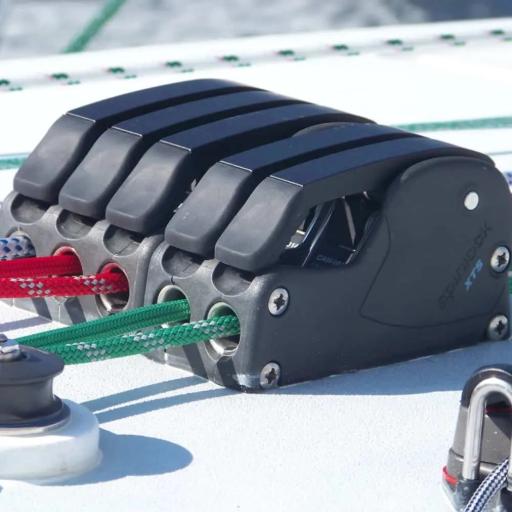
Spinlock XTS rope clutches
Spinlock XTX Remote Release and Servicing
Remote operation
A genuine functional difference over the handle-released XAS, XCS and XTS is that the Spinlock XTX can be set up for remote operation. The rear toggle can be led away from the clutch so the line can be released from a distance — useful for short-handed crews, for clutches tucked under a spray hood, or for banks that are awkward to reach from the working position. None of the cam-based Spinlock rope clutches offer this facility.
Servicing without leaving the deck
The Spinlock XTX is designed to be maintained in situ. Removing the rear cover lets the whole braid assembly lift out in one piece for inspection and cleaning, then drop back in — no need to unbolt the unit from the deck. Since the braid is the wearing part, being able to inspect and replace it relatively easily is central to keeping the clutch performing correctly over its service life.
Choosing the right rope clutches for your boat
There is no single “best” answer — it depends on the line, the load and the installation. For more modest loads and budgets, the XAS or a standard XTS cam clutch remains a sensible, compact choice. The XCS provides higher-load options and, with its ceramic cam, a particularly positive grip on modern performance ropes.
The Spinlock XTX takes a different approach. If reducing concentrated wear on expensive rope covers is a priority, its textile Softgrip system has a clear advantage over a conventional hard cam. Add its relatively low weight and remote-release capability and it becomes particularly interesting for high-load Dyneema-cored halyards and control lines — provided you have the deck length to accommodate it.
As with any clutch, however, it should be considered as one part of the complete deck layout. Lead angles, organisers, rope construction and actual rope diameter can all affect how well the system holds and releases. If you are unsure which of the Spinlock rope clutches suits your setup, it is worth talking it through against your actual lines and expected loads.
The Spinlock XTX is available in black, blue, orange, white and yellow. For higher holding loads beyond the clutch ranges, the same brand’s Spinlock rope jammers take over, while you can browse every option across brands on our full rope clutches category.
If you have any questions about the Spinlock XTX or about matching rope clutches to your running rigging, please contact us and talk to one of our rigging team — or click below to see the full Spinlock XTX rope clutch range and the rest of the Spinlock clutches:

 and then Add to Home Screen.

Spinlock XTX Rope Clutches: The Soft-Grip Alternative to the XAS, XCS and XTS