Sailing shackles
Explore our Sailing Shackles category, offering a wide selection of essential shackles designed for rigging and sailing applications. Our selection includes D shackles, snap shackles, main halyard shackles, snap hooks, bow shackles, and carabiners, providing secure, durable connections for various marine tasks. Choose from top brands like Tylaska, Selden, Antal, Allen Brothers, and Petersen Stainless Steel for optimal performance. Read more...



Sailing shackles are critical load-bearing connectors used throughout running and standing rigging systems. Correct selection depends on load requirements, geometry, and application, whether for halyards, sheets, blocks, or deck hardware. This category includes a wide range of stainless steel and soft shackles from leading manufacturers, with options designed for high strength, low weight, and secure load handling in demanding marine environments.
Sailing shackles form a fundamental part of onboard load transfer systems, connecting sails, lines, and hardware under dynamic and often cyclic loading. Selecting the correct shackle requires an understanding of load paths, articulation requirements, and material performance in a marine environment.
Sailing Shackles: Types and Application-Specific Selection
The primary distinction in sailing shackles is geometry. Bow shackles (anchor shackles) provide a larger internal radius, allowing for multi-directional loading and reducing point loading on attached components. These are typically used for sheets, furling systems, and connections where articulation is required.
D shackles (chain shackles) are designed for in-line loading, offering higher strength for a given size due to reduced bending moments across the pin. These are commonly used in halyard terminations or fixed load paths.
Snap shackles introduce a quick-release mechanism, making them suitable for applications requiring frequent connection and disconnection, such as spinnaker sheets or control lines. However, they introduce additional mechanical complexity and should be selected with careful consideration of working load and release reliability under load.
Halyard shackles are used to connect halyards to sail headboards, furling swivels, or halyard attachment points where secure retention and low-profile geometry are important. For most applications, a halyard shackle should be compact, correctly load-rated, and shaped to avoid point loading on the sail or fitting.
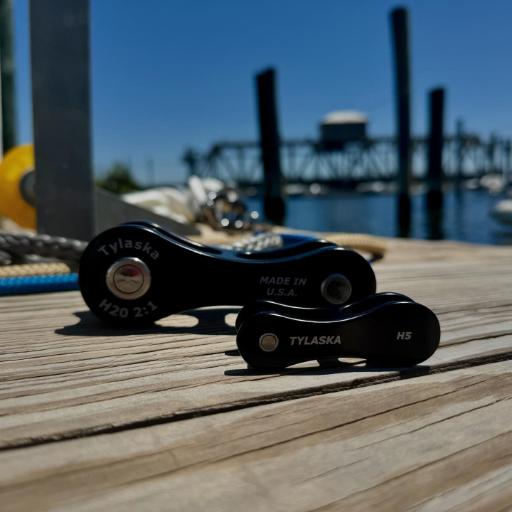
Tylaska Halyard Shackles
Soft Shackles vs Stainless Steel Shackles
The increasing adoption of soft shackles, typically manufactured from HMPE fibres such as Dyneema®, reflects a shift towards weight reduction and simplified load paths. Soft shackles offer high strength-to-weight ratios and eliminate metal-to-metal contact, reducing wear on lines and hardware.
However, their performance is dependent on correct sizing, splice quality, and protection from chafe. In high abrasion areas or where consistent geometry is required, stainless steel shackles, typically manufactured from 316 or precipitation-hardened alloys, remain the preferred solution due to their resistance to deformation and surface wear.
Sailing Shackles Load Ratings and Safety Considerations
Correct sizing of sailing shackles should always be based on Safe Working Load (SWL) rather than breaking load. The SWL incorporates a safety factor to account for dynamic loading, shock loads, and fatigue. For running rigging applications, load estimation should consider peak loads generated during manoeuvres such as gybes or reefing.
Pin security is another critical factor. Screw pin shackles require proper tightening and, in many cases, secondary securing (e.g. seizing wire or thread-locking compounds) to prevent loosening under vibration. Captive pin designs reduce this risk and are often preferred in critical applications.
Materials and Corrosion Resistance in Sailing Shackles
Most marine shackles are manufactured from AISI 316 stainless steel, offering good corrosion resistance in saltwater environments. For higher load applications, materials such as 17-4PH stainless steel provide increased strength but may require more careful corrosion management.
Galvanic compatibility should also be considered when connecting shackles to dissimilar metals, particularly in mast and deck hardware systems.
Selecting Sailing Shackles for Different Rigging Systems
Application-specific selection of sailing shackles is essential for efficient and reliable rigging:
- Halyards and mast applications: compact D shackles or soft shackles to minimise weight aloft
- Sheets and furling systems: bow shackles or snap shackles for improved articulation
- Control lines and frequently adjusted systems: snap shackles for handling efficiency
- Performance setups: soft shackles to reduce weight and simplify connections, with appropriate chafe management
This category includes sailing shackles from Tylaska, Wichard, Ronstan, Ubi Maior, and Kong, covering a wide range of technical requirements across cruising and performance sailing applications, with a focus on reliable load handling and mechanical efficiency.

To install this Web App in your iPhone/iPad press
 and then Add to Home Screen.
