Mainsheet traveller systems
Mainsheet Traveller Systems provide controlled lateral adjustment of the mainsheet attachment point, allowing the boom angle to be changed without relying only on mainsheet tension. Correctly specified traveller cars, tracks and end controls improve mainsail trim, reduce weather helm and allow more precise depowering in variable wind conditions. This category includes traveller cars, track components and control options from Antal, Barton, Harken and Ronstan. Read more...


Mainsheet Traveller Systems for Accurate Mainsail Trim
A mainsheet traveller is one of the most important control systems for accurate mainsail trim. While the mainsheet controls leech tension, boom height and, to some extent, twist, the traveller controls the lateral position of the mainsheet attachment point. Moving the traveller car to windward or leeward changes the boom angle relative to the centreline without making the same direct change to sheet tension. This is why Mainsheet Traveller Systems are used on performance cruising yachts, racing yachts, sportsboats and many dinghies where accurate mainsail power control is required.
A complete mainsheet traveller system normally consists of a traveller track, traveller car, mainsheet attachment point, control sheaves, end controls, cam cleats, end stops and control lines. Some systems use simple pin-stop adjustment, while higher-load or more performance-orientated systems use ball bearing or recirculating ball bearing cars with multi-purchase controls. The correct configuration depends on the boat, the mainsail area, the mainsheet position on the boom and whether the system must be adjusted frequently under load.
How a Mainsheet Traveller Controls Boom Angle and Sail Power
The key purpose of the traveller is to control mainsail angle of attack. In lighter upwind conditions, the car may be positioned to windward to bring the boom close to the centreline while maintaining appropriate leech tension. As the wind increases, dropping the traveller to leeward allows the boat to depower while retaining mainsheet tension and leech control. This helps reduce excessive heel and weather helm without immediately opening the leech as much as easing the mainsheet alone.
For technically minded owners, this distinction is important: the traveller is primarily a boom-position control, while the mainsheet and vang have a greater influence on twist and vertical boom control.
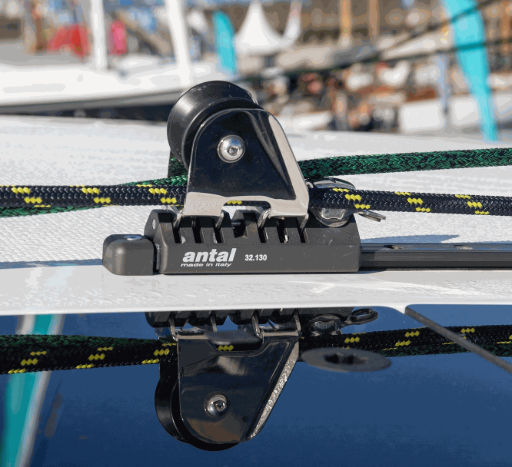
Antal Mainsheet Traveller Systems
Choosing the Correct Mainsheet Traveller Car and Track
Selecting the correct traveller car and track should start with load, not just boat length. LOA is a useful guide, but it is not enough on its own. A 35ft cruiser with end-boom sheeting may impose very different loads from a 35ft performance yacht with a large mainsail and mid-boom sheeting. Mid-boom systems normally create higher mainsheet and traveller car loads because the sheet attaches closer to the gooseneck, reducing mechanical leverage on the boom. Multihulls, high-stability yachts and boats with powerful square-top mainsails also require particular attention to working load and safety margin.
When choosing between different Mainsheet Traveller Systems, check the manufacturer’s maximum working load for the car, track and end controls. The car must be rated for the expected mainsheet load, and the control system must be configured so that the traveller can be moved when the sail is loaded. A low-friction car with insufficient control purchase can still be difficult to adjust in a gust. Conversely, too much purchase may add rope length and friction where fast traveller movement is required.
Mainsheet Traveller Systems Load Ratings and Control Purchase
Mainsheet traveller system sizing should consider the working load of the complete system, not only the car. Track section, end controls, sheaves, cam cleats, fasteners and the surrounding deck structure all contribute to system reliability. A traveller car with an adequate load rating can still be compromised if the track, end stops or fasteners are underspecified.
Common traveller control purchases include 2:1, 3:1, 4:1 and 6:1 arrangements, depending on boat size, mainsheet load and cockpit layout. More purchase reduces the force required to move the car, but it also increases the amount of control line in the cockpit and slows the adjustment. The correct choice depends on whether the traveller is adjusted occasionally for cruising trim or actively during racing and performance sailing.
| Traveller purchase | Typical use | Advantage | Trade-off |
|---|---|---|---|
| 2:1 | Small boats or low-load systems | Simple and fast | Higher hand load |
| 3:1 | Small to medium systems | Better control with limited rope | Less common layout |
| 4:1 | Medium yachts and performance cruisers | Good balance of power and speed | More rope in cockpit |
| 6:1 | Higher-load systems | Easier adjustment under load | Slower adjustment, more friction and line length |
Traveller Car Compatibility with Existing Track Systems
Compatibility is one of the most important issues when replacing traveller components. Traveller cars are not universal. The car must match the track profile, width, bearing arrangement and load range. A Harken traveller car should not be assumed to fit a Ronstan, Antal or Barton track, even if the nominal track width looks similar.
When replacing an existing traveller car, measure the track width across the top, identify the track section, check the hole spacing and look for any brand or series markings on the original hardware. If the existing track is worn, damaged, distorted or no longer supported, replacing the complete traveller system may be more reliable than fitting a new car to an old track.
Ball Bearing, Pin-Stop and Recirculating Traveller Cars
The choice between pin-stop, plain bearing, ball bearing and recirculating ball bearing cars depends on how the boat is sailed. Pin-stop systems can be simple and robust, but they are usually adjusted less frequently and are not ideal where the car needs to move easily under mainsheet load.
Ball bearing traveller cars reduce friction and are better suited to active trim. Recirculating ball systems are commonly used where high load capacity and smooth movement are required over a compact car length. For cruising boats, low maintenance and predictable operation may be the priority. For racing boats, low friction, rapid adjustment and control-line ergonomics are usually more important.
Mainsheet Traveller Systems Control Layout and Cockpit Ergonomics
Control layout also matters. Some traveller cars include fixed or pivoting sheaves mounted on the car. Others rely on end controls with integrated sheaves and cam cleats. Cleats may be mounted at the track ends, on the car itself, or led remotely to the helm or trimmer position.
A windward sheeting traveller car allows the control line to be trimmed from the windward side, which can be useful on race boats and shorthanded yachts where the trimmer is working from the high side. On larger yachts, traveller controls may be led underdeck or aft to a central trimming position to keep the cockpit cleaner and reduce trip hazards.
Straight and Curved Mainsheet Traveller Track Options
Track geometry should also be considered. Straight traveller track is common, but some cockpit or coachroof installations require curved track. Not every traveller car is designed to run on a curved section, and minimum bend radius must be checked before specifying the system.
The track must also be properly supported and fastened into a structure capable of taking the vertical and lateral mainsheet loads. End stops and end controls are safety-critical components; they are not simply accessories. A failed end stop or underspecified fastener can allow the car to leave the track under load.
Mainsheet Traveller Systems Maintenance and Troubleshooting
For maintenance, mainsheet traveller systems should be rinsed regularly with fresh water, especially after saltwater sailing. Avoid using grease or oil unless the manufacturer specifies it, as lubricants can attract dirt and abrasive salt crystals into the bearing path. Inspect control lines, sheaves, cam cleats, fasteners, track fixing points and car bearings as part of routine deck hardware checks.
If the car is difficult to move under load, the cause may be contamination, worn bearings, damaged sheaves, incorrect lead angle, insufficient purchase or an undersized system. A traveller that only moves freely when unloaded may indicate that the car, purchase system or bearing arrangement is not suitable for the real working load.
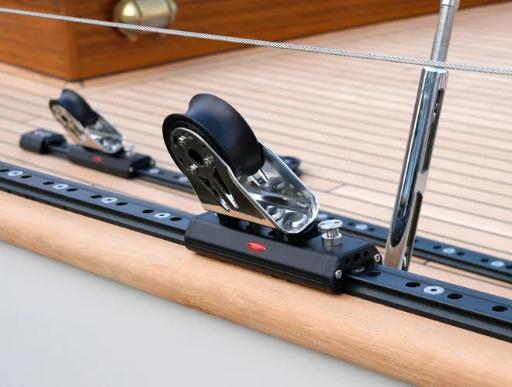
Ronstan Mainsheet Traveller Systems
Mainsheet Traveller Systems from Antal, Barton, Harken and Ronstan
Upffront offers a range of Mainsheet Traveller Systems and traveller components from Antal, Barton, Harken and Ronstan, covering small-boat, cruising and higher-load applications. The correct choice depends on the existing track, required working load, mainsheet geometry, cockpit layout and how actively the traveller will be used.
If replacing a single component, confirm track compatibility before ordering. If upgrading the system, start with load calculation and control layout, then select the appropriate traveller car, track and end controls as a complete working system.
Mainsheet Traveller Systems FAQ
How do I choose the correct mainsheet traveller system?
Choose a mainsheet traveller system based on mainsail area, mainsheet attachment point, boat stability, track location, working load and control layout. Boat length is useful as an initial guide, but it should not be the only sizing factor. Mid-boom sheeting, large mainsails, multihulls and high-stability yachts usually require higher-load traveller cars and stronger track systems.
Will a new traveller car fit my existing track?
Only if the car matches the exact track profile, width and manufacturer series. Traveller cars are normally track-specific, so a car from one brand should not be assumed to fit another brand’s track. Measure the track carefully and identify the existing system before replacing only the car.
What is the difference between a traveller and the mainsheet?
The mainsheet controls mainsail leech tension, boom height and twist. The traveller controls the lateral position of the mainsheet attachment point, allowing the boom angle to be adjusted without the same direct change in sheet tension. Both controls work together for accurate mainsail trim.
What purchase ratio do I need for traveller controls?
Smaller boats may use simple 2:1 or 3:1 traveller controls, while larger yachts or higher-load systems may require 4:1 or 6:1 purchase. More purchase reduces control-line load but increases rope movement and system complexity. The best option depends on the traveller load and how quickly the car needs to be adjusted.
Should I replace the complete traveller system or only the car?
Replace only the car if the track is in good condition, correctly identified and compatible with the new car. Replace the complete system if the track is worn, damaged, obsolete, incorrectly sized or if you are upgrading to a higher-load or lower-friction traveller arrangement.

To install this Web App in your iPhone/iPad press
 and then Add to Home Screen.
