Top down adapters
Top down adapters are a quick, simple way to convert a standard code zero furling drum for top down applications. Top down adapters are specifically designed to convert a code zero drum for top down furling. They are simply a free flying bearing around a pin/jaw connector between the furling drum and the torsional cable. This essential swivel allows the tack of the sail to fly freely whilst the torque from the furling drum travels up the full length of the torsional cable where the sail starts to furl. Read more...



The Role of a Top Down Adapter in Modern Furling Systems
In a free-flying downwind configuration, a top down adapter acts as the mechanical interface between torsion cable and sail head swivel. While Code 0 sails frequently furl bottom-up due to their structural luff cables and high halyard tension, asymmetric spinnakers and cruising gennakers require furling to initiate at the head.
Top down adapters allow torque generated at the drum to be transmitted through the anti-torsion cable so that rotation begins at the sail head. This ensures the upper leech and luff sections wrap first, progressively collapsing the sail from top to bottom. Without a correctly specified top down adapter, furling loads can remain concentrated at the tack, leading to uneven roll-up or incomplete furling.
For cruising yachts between 30 and 70 feet, and for short-handed offshore programmes, top down adapters are fundamental to safe and repeatable downwind sail handling from the cockpit.
Mechanical Function of a Top Down Adapter
A top down adapter is typically installed between the torsion cable termination and the head swivel. Its geometry allows initial independent rotation so that torsional energy builds at the head before the tack engages fully.
Across different manufacturers, top down adapters share several core engineering features:
- Controlled rotational decoupling at furl initiation
- Low-friction bearing systems or composite bushings
- High-strength anodised aluminium bodies
- Stainless steel load-bearing components
- Optimised articulation to minimise side loading
Under load, the top down adapter must transmit torsional force efficiently while avoiding distortion or binding. This becomes particularly important on sails with significant shoulder projection, where aerodynamic load must reduce sequentially from the head downward.
From a rigging perspective, correct specification of a top down adapter depends on:
- Working load limit (WLL) of the furling system
- Torsion cable diameter and stiffness
- Sail area and yacht displacement
- Halyard lead angle and masthead sheave geometry
Mismatch between torsion cable and top down adapter can result in torsional lag, shock loading or delayed sail engagement.
Brand-Specific Engineering Approaches
Karver
Karver top down adapters are designed to integrate with KSF and KF furlers. Their approach emphasises low weight and precise machining tolerances. In larger models, high-load bearing assemblies and hard anodised aluminium construction are standard. These systems are commonly specified on performance cruising yachts and race-oriented platforms where torsional efficiency is critical.
Bamar
Bamar offers modular top down adapters compatible with RLG and gennaker furlers. Engineering is typically conservative in load rating, favouring structural robustness for offshore cruising use. For bluewater applications, this approach provides predictable long-term performance under cyclic load.
Harken
Harken integrates the top down adapter concept within its Reflex furling architecture. Bearing reliability and smooth torque transmission are key design priorities. Harken top down adapters are widely used on cruising yachts flying asymmetric sails from fixed or retractable bowsprits.
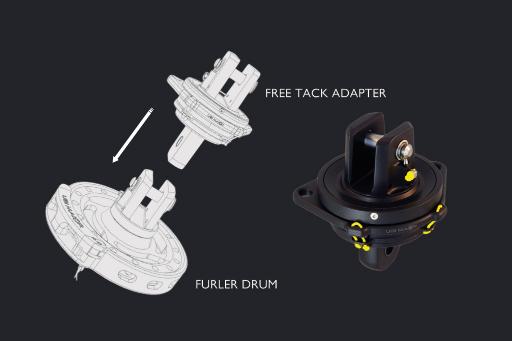
Ubi Maior
Ubi Maior top down adapters are frequently selected for larger yachts and high-load environments. The emphasis is on structural capacity and refined articulation geometry, particularly where halyard tension and sail area generate elevated torsional loads.
Selden
Selden incorporates top down adapters into its GX and CX furling ecosystems. Compatibility with Selden torsion cables and spars is a practical consideration for production cruising yachts. Installation simplicity and system integration are central to the design philosophy.
Facnor
Facnor top down adapters are typically paired with FX and FlatDeck furlers. Their engineering focuses on functional integration and controlled furl initiation without unnecessary mechanical complexity.
Applications of Top Down Adapters
Top down adapters are primarily specified for:
- Asymmetric spinnakers
- Cruising gennakers
- Light-air reaching sails
- Free-flying downwind sails without structural luff reinforcement
In short-handed offshore sailing, a correctly installed top down adapter allows the sail to be furled progressively without crew moving forward of the mast. This reduces exposure on the foredeck and improves overall risk management in building breeze.
For performance cruising yachts equipped with retractable bowsprits, top down adapters form part of a modular furling solution that supports rapid sail deployment and controlled recovery.
Integration with Torsion Cables and Furling Drums
The effectiveness of a top down adapter depends heavily on torsion cable performance. Modern anti-torsion cables use high-modulus fibres such as Dyneema® or Technora®, engineered to minimise elongation and torsional deformation.
When top down adapters are combined with correctly sized furling drums and head swivels, the system delivers:
- Immediate torque response
- Reduced twist lag in the cable
- Predictable furl progression
- Lower peak shock loads during initiation
Correct halyard alignment is essential to prevent wrap and maintain consistent rotation. Even the most robust top down adapter cannot compensate for poor lead geometry at the masthead.
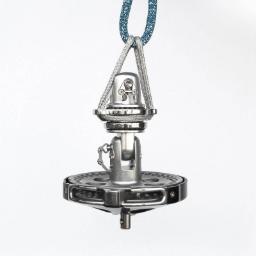
Facnor Top Down Adapter
Selecting the Correct Top Down Adapter
When specifying a top down adapter, technically minded boat owners should consider:
- Maximum working load relative to sail area
- Compatibility with existing furling hardware
- Cable termination type (soft eye, thimble, splice)
- Bearing configuration (bushed or ball bearing)
- Material pairing and corrosion resistance
Across larger displacement yachts, top down adapters should be selected with appropriate safety margins to account for dynamic loading during furl initiation in gusting conditions.
Inspection and Long-Term Reliability
Like all load-bearing rigging components, a top down adapter requires periodic inspection. Attention should be given to:
- Bearing smoothness under rotation
- Corrosion between stainless and aluminium interfaces
- Deformation at attachment points
- Free articulation under working load
Top down adapters operating in offshore environments benefit from regular freshwater rinsing and manufacturer-approved maintenance procedures to preserve bearing efficiency and structural integrity.
Conclusion on Top Down Adapters
A top down adapter is a mechanically essential component in modern asymmetric furling systems, while top down adapters as a category form the backbone of controlled head-first furling technology. By ensuring progressive torque transfer and predictable sail collapse, they enable safer and more efficient downwind sail management.
With engineered solutions available from Karver, Bamar, Harken, Ubi Maior, Selden and Facnor, boat owners can specify top down adapters that match sail plan, torsion cable characteristics and overall load profile for reliable offshore performance.

To install this Web App in your iPhone/iPad press
 and then Add to Home Screen.
