Winch handles
Winch handles are essential for transferring crew input into controlled sheet, halyard and control-line load through a sailing winch. The correct winch handle depends on handle length, locking mechanism, grip format, material and cockpit layout. This category includes manual, locking, non-locking and powered winch handle options for cruising yachts, race boats and short-handed sailing applications. Read more...


Choosing the right winch handle for sailing winches
A winch handle is a simple component, but the wrong choice can make trimming slower, heavier or less controlled. When selecting winch handles, the key technical variables are leverage, rotation speed, locking security, grip ergonomics and compatibility with the winches fitted onboard.
For most sailing yachts, the decision starts with handle length. A longer handle gives more leverage because the crew applies force further from the winch centreline. This reduces physical effort under load but requires a larger sweep radius. A shorter handle rotates through a smaller circle, which can make it faster when taking up slack or trimming in light air, but it provides less mechanical advantage when the load increases.
Cockpit layout also matters. On coachroof winches, cockpit coamings, sprayhoods, clutches or nearby hardware may restrict the available swing radius. In these cases, an 8 inch / 200–203mm winch handle can be useful. For primary sheet winches, halyards and general cruising use, a 10 inch / 250–254mm handle is often the more practical all-round option.
8 inch vs 10 inch winch handles
The two most common sailing winch handle lengths are approximately 8 inch and 10 inch.
An 8 inch winch handle is typically chosen where speed and clearance are more important than maximum power. It is useful on smaller yachts, race boats, cabin-top winches, and for fast line handling when the load is relatively low. The shorter swing radius allows quicker rotation and reduces the chance of the handle fouling nearby deck hardware.
A 10 inch winch handle gives more leverage and is usually preferred for higher-load applications. It is well suited to genoa sheets, mainsheets, halyards, reefing lines and cruising yachts where controlled power is more important than outright grinding speed. For many boat owners, a 10 inch locking handle is the safest general-purpose choice, with an 8 inch handle carried as a secondary option for tight spaces or rapid trimming.
Locking and non-locking winch handles
The next choice is whether to use a locking or non-locking handle. A locking winch handle secures into the winch socket and reduces the risk of the handle lifting out, especially when working at an angle, sailing offshore or operating in rough conditions. This is usually the preferred configuration for cruising and short-handed sailing.
A non-locking winch handle is faster to insert and remove, which can be useful for racing crews who move handles quickly between winches. The trade-off is retention. If the handle is dropped or knocked out of the socket, it can be lost overboard or become a hazard in the cockpit.
Modern locking systems vary by brand. Some use a standard thumb button, while others use quick-release or one-handed mechanisms. Lewmar OneTouch winch handles use a full-length release lever for one-handed locking and removal. Ronstan Quick-Lock handles are designed to insert into the winch socket without first pressing a button or rotating a knob. Harken lock-in handles use a thumb-switch release, while plain non-locking options remain relevant where fast insertion is the priority. Harken also states that its handles fit international standard winch sockets, with 203mm handles offering faster grinding and 254mm handles giving more comfortable leverage for many sailors.
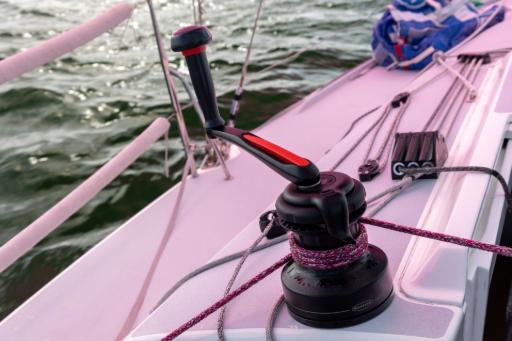
Ronstan Quick-Lock Winch Handles
Grip types: single, double, power, speed and palm grips
Grip design affects how efficiently force is transferred into the winch. A single grip is simple, compact and suitable for general trimming. A double grip or palm grip gives better control when grinding with two hands, especially on loaded sheets or halyards. A power grip improves hand position for torque transfer, while a speed grip is intended for fast rotation when line speed is more important than maximum load.
For short-handed cruising, grip comfort is not just a convenience issue. If one person is trimming, steering or moving between winches, the handle needs to be easy to locate, secure in the hand and quick to release. For racing, low friction in the grip and fast repositioning can be more important than maximum comfort over long grinding periods.
Winch handle materials
Winch handles are commonly available in aluminium, stainless steel, composite, carbon, chromed bronze, bronze and plastic constructions.
Aluminium winch handles are widely used because they offer a good balance between weight, stiffness, durability and cost. Stainless steel and chromed bronze handles suit users who prioritise robustness and a traditional feel, although they may be heavier than aluminium or composite designs. Composite and plastic handles can reduce weight and, in some designs, improve resistance to impact or corrosion. Carbon winch handles are generally selected where weight saving and stiffness are priorities, particularly on performance yachts.
Material selection should be matched to use case. A cruising yacht may prioritise durability and secure locking. A race boat may prioritise weight, speed of use and low-friction grip rotation. A short-handed or offshore boat should normally prioritise retention, ergonomics and ease of operation under load.
Manual, electric and powered winch handle options
Manual winch handles remain the standard solution for most sailing winches. However, powered options such as electric winch handles and drill-driven winch adapters can reduce physical effort when hoisting, reefing or trimming under load. These are especially relevant for short-handed cruising, larger yachts or sailors who want assistance without converting every winch onboard to an electric winch.
A powered handle should still be treated as part of a complete winch system. It does not remove the need for correct line handling, suitable winch sizing or safe load management. Manual winch handles should normally remain onboard as a backup, even where electric winches or powered handles are used. Upffront’s winch handle category includes manual handles as well as powered options such as Ewincher and iWinch-related products.
Winch handle compatibility
Most modern sailing winch handles are designed around standard winch sockets, but compatibility should still be checked. Older winches, worn sockets, damaged locking plates or unusual winch designs can affect fit and locking security.
If a handle does not engage correctly, the issue may not be the handle itself. The winch socket may be worn, the locking mechanism may be contaminated with salt or dirt, or the handle may not be seated fully. For safety, any handle that does not lock positively should be inspected before being used under significant load.
Key winch handle brands
Upffront supplies winch handles from specialist marine hardware brands including Harken, Lewmar, Ronstan, Andersen, Antal, Barton and Ewincher. Harken offers aluminium and composite handles with lock-in, plain and OneTouch-style options. Lewmar OneTouch handles focus on one-handed locking and release. Ronstan Quick-Lock handles are designed around fast automatic insertion and intuitive release. Andersen stainless steel handles are a robust choice for cruising applications, while Antal offers aluminium handles with Speedylock and different grip formats. Barton provides practical manual handle options, and Ewincher covers electrically assisted winch handle use for short-handed or higher-load sailing.
The best choice is not simply the most expensive handle. It is the handle that gives the correct balance of leverage, speed, locking security, grip control and cockpit clearance for the way the boat is sailed.
Winch handle FAQ Section
What size winch handle do I need?
For most cruising yachts, a 10 inch / 250–254mm winch handle is the best general-purpose choice because it gives more leverage. An 8 inch / 200–203mm handle is useful where faster rotation or cockpit clearance is more important than maximum power.
Are winch handles universal?
Most modern winch handles are designed to fit standard sailing winch sockets, but older winches, worn sockets or damaged locking plates can affect compatibility. Always check that the handle seats and locks correctly before using it under load.
Is a locking winch handle better?
For cruising, offshore sailing and short-handed use, a locking winch handle is normally preferred because it reduces the risk of the handle lifting out of the winch. Non-locking handles can be faster for racing crews who need rapid insertion and removal.
What is the difference between a power grip and speed grip?
A power grip helps transfer force efficiently when grinding under load. A speed grip is better for rapid rotation when taking up slack or trimming in lighter loads.
Should I carry more than one winch handle onboard?
Yes. Most yachts should carry at least two winch handles: one primary 10 inch locking handle for loaded work, and a secondary handle for backup, tight spaces or simultaneous trimming on another winch.

To install this Web App in your iPhone/iPad press
 and then Add to Home Screen.
