
If you are fitting a cable steering autopilot, a sprocket drive is often the simplest route: it suits any boat whose steering already has a rotating shaft in it. Instead of pushing on the rudder stock, it turns that shaft through a short chain and a pair of sprockets, the same way the wheel does.
That makes it the natural choice on yachts with cable or rod steering, where the space around the rudder stock is cramped, hard to reach, or already full of quadrant, cables and stops. Jefa make two versions: a 200 Nm, 12 V unit for boats of roughly 30 to 50 ft, and a 300 Nm, 24 V unit for roughly 45 to 75 ft. Both weigh 7 kg and are rated for continuous, 24-hour operation.
This article explains where the sprocket drive sits among Jefa's other autopilot drives, what is inside it, and the one installation decision that matters most: the sprocket ratio.
Choosing a cable steering autopilot drive: where the sprocket drive fits
The right drive depends less on boat length than on where you can connect to the steering. Jefa's four mechanical drive families each connect at a different point:
Drive | Connects to | Typical boat size | Best suited to |
|---|---|---|---|
Tiller arm or quadrant at the rudder stock, via a push-pull ram | 20 to 45 ft (up to 100 KgM rudder torque) | Smaller boats with good access and space beside the rudder stock | |
Direct | Tiller arm or quadrant at the rudder stock, via a rotary output lever and draglink | 30 to 70 ft (three sizes) | Boats with room near the stock that want to drive the rudder independently of the steering cables |
Transmission | A prepared Jefa bevel gearbox or RG reduction box in the steering line | 30 to 90 ft (200 Nm and 300 Nm) | Boats with Jefa transmission (shaft) steering, specified with autopilot preparation when the steering is ordered |
Any rotating shaft in the steering system, via chain and sprockets | 30 to 75 ft (200 Nm and 300 Nm) | Cable or rod steering, especially where the rudder stock area is tight or inaccessible |
The linear and direct drives work at the rudder end. They need a solid foundation close to the stock, correct geometry to the tiller arm, and proper rudder stops. On many production boats that space is limited or already crowded.
The transmission drive is the tidiest installation of all, but it only bolts to Jefa's own gearboxes, and those gearboxes must be ordered with a mounting point for the drive built in (Jefa call this autopilot preparation). In practice, it is an option to choose when the steering is first specified, rather than an add-on for most existing boats.
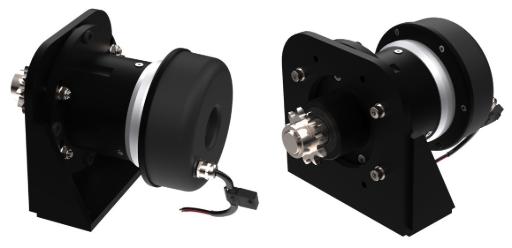
The sprocket drive fills the remaining gap. If the steering has a shaft that turns when the wheel turns, a second sprocket can be fitted to it and chained to the drive. That shaft might be in the pedestal, or on an idler or jackshaft in the steering run. The drive itself is compact, at 241 mm long and 178 mm in diameter, so it can usually be tucked in near the steering rather than out at the stern.
The trade-off is load path. With a linear or direct drive, autopilot loads go straight to the rudder. With a sprocket drive, they pass through the steering system's chain, cables or rods. Those components need to be in good condition and sized for the job, which matters more on the 300 Nm unit.
Inside a cable steering autopilot sprocket drive
The sprocket drive has three main parts: a flat-wound motor, a three-stage planetary gearbox, and an electromagnetic clutch. The same layout is used in Jefa's transmission drive.
Motor.
A flat-wound (pancake) DC motor has a wide, thin rotor made only of copper windings, with no iron in it, so it is very light. A conventional motor has a heavy iron core that behaves like a small flywheel, making it slow to start, stop and reverse. The light pancake rotor reacts almost instantly, and its large diameter gives strong torque from a standstill. That suits an autopilot, which starts, stops and reverses constantly. In practice that means the motor follows the autopilot's speed-control signal closely, including soft starts and stops. Jefa quote a motor efficiency of 72.5%, compared with about 50% for a conventional brushed DC motor.
Gearbox.
To reach a sensible rudder speed, motor speed has to come down by 486:1. Jefa do this with three planetary stages rather than a worm gear or a planetary-plus-spur combination. In a planetary set the load is shared across three gear teeth instead of one, and the forces stay on the centre line of the unit. The result is a smaller, stronger and more efficient reduction, at the cost of more gears per stage.
Clutch.
The drive must disconnect from the steering whenever you hand-steer. Instead of a friction-plate clutch, Jefa use two spring-loaded pins that lock the outer ring gear of the last planetary stage. The clutch is engaged only when powered, so the drive is disconnected when the pilot is off or loses power. It draws 1.4 A at 12 V (0.7 A at 24 V) and does not wear like a friction clutch. One practical detail: when the pilot is switched off under load, the pins only release once the helmsman takes up the load on the wheel. That prevents the rudder from suddenly kicking over in your hands.
Getting the speed right for a cable steering autopilot: sprocket ratio and hard-over time
The sprocket ratio sets how fast the autopilot can move the rudder, and it is the most important choice in a sprocket drive installation. It is measured as hard-over time: the time to drive the rudder through 72° (36° each side) at full pilot speed.
Jefa recommend a hard-over time of 12 to 15 seconds. With a modern pilot that has variable speed control, aim for 12 seconds, as the pilot can always slow the drive down.
- Too fast (under 10 seconds): the pilot becomes nervous and starts "hunting", swinging the rudder either side of the course.
- Too slow: the pilot cannot react quickly enough when reaching in a big sea.
The method is simple. Count the turns of the shaft the drive will turn, from lock to lock, scaled to 72° of rudder travel. If the rudder travels further than 72°, multiply the turns by 72 and divide by the measured angle.
The drive is supplied with an 11-tooth, 5/8" pitch sprocket. Standard output speed is 8 rpm for the 200 Nm unit and 6.5 rpm for the 300 Nm unit.
- On the 200 Nm drive, the break-even point is about 1.5 turns. Fewer turns than that need a larger sprocket on the steering shaft to slow the drive (for example, 15 teeth for 1 turn). More turns need the drive to speed up, so the drive sprocket becomes the larger of the two.
- On the 300 Nm drive, the break-even point is about 2.5 turns, and Jefa's table runs up to a 26-tooth shaft sprocket for 1 turn lock to lock.
Measure before you order. The sprockets are specified per boat, so take these measurements before buying and include them with your order:
- Turns of the driven steering shaft from lock to lock
- Total rudder travel in degrees, if it is not 72°
- Diameter and keyway of the shaft the drive will turn, so the hub sprocket can be bored and keyed to fit
Without these, you risk receiving the wrong sprocket combination and a pilot that is too nervous or too slow.
Jefa supply stainless hub sprockets with 11, 13 and 15 teeth, bored and keyed to the shaft. They also offer weld-on plate sprockets from 11 to 26 teeth and non-magnetic 5/8" stainless chain. The drive flange has slotted holes for tensioning the chain.
200 Nm 12 V vs 300 Nm 24 V cable steering autopilot drives
The two units share the same body, motor type, gearbox and clutch design. The difference is output torque, voltage and the size of boat they suit. Each is available in one voltage only.
200 Nm 12 V | 300 Nm 24 V | |
|---|---|---|
Part number | DU-WS300-24 | |
Boat size | 30 to 50 ft | 45 to 75 ft |
Max rudder torque | Up to 165 KgM | Up to 400 KgM |
Max output torque | 200 Nm (about 40 kg on the rim of a 1 m wheel) | 300 Nm (about 50 kg on the rim of a 1 m wheel) |
Standard output speed | 8 rpm | 6.5 rpm |
Clutch current | 1.4 A at 12 V | 0.7 A at 24 V |
Wiring (clutch / motor) | 0.75 mm² / 2 mm² | 1.5 mm² / 4 mm² |
Steering type | Cable or rod, with a rotating shaft | Cable or rod, with a rotating shaft |
On the 12 V unit, Jefa give an average consumption of about 1.5 A in normal sailing. That assumes a well-trimmed boat, where the drive works mostly at low load and does not run continuously. If the drive is regularly working near its maximum, the sail plan or trim is the thing to look at, not the autopilot.
Cable steering autopilot electronics compatibility and installation
The sprocket drive is only the mechanical end of the system. It works with most major autopilot course computers, but the rudder torque you actually get depends on how much current the course computer can deliver.
Course computer | Max output | 200 Nm 12 V: max rudder torque | 300 Nm 24 V: max rudder torque |
|---|---|---|---|
Garmin GHP 12 sailboat | 40 A | 165 KgM | 390 KgM |
Simrad AC12 / B&G Triton Low Current | 12 A | 120 KgM | 390 KgM |
Simrad AC42 / B&G Triton High Current | 30 A (12 V), 20 A (24 V) | 165 KgM | 390 KgM |
Raymarine ACU-200 | 15 A | 158 KgM | 390 KgM |
Raymarine ACU-400 | 30 A | 165 KgM | 390 KgM |
B&G H5000 Pilot (software 1.1.84 or later) | 30 A (12 V), 20 A (24 V) | 165 KgM | 390 KgM |
NKE Gyropilot 2 RVP | 25 A | 165 KgM | Not listed |
Jefa do not recommend pairing the drive with Furuno NavPilot, because it lacks proportional speed control and dynamic braking. Both features matter on a sailing yacht. Speed control gives soft starts and stops. Dynamic braking shorts the motor when it is idle, so the drive holds the rudder angle instead of being pushed back towards centre. Without them, a light-running steering system with a large wheel tends to overshoot and hunt.
A few installation points worth knowing before you buy:
- Rudder feedback is essential. Jefa will not approve, or warrant, a system without one. Integrated feedback units are available for Garmin/NKE (10 kΩ), Raymarine (5 kΩ) and B&G NAC-2 (5 kΩ) pilots. Garmin installs also need a dedicated cable and plug kit.
- Integrated feedback needs fewer than 2.5 turns. It only works if the drive's output shaft turns no more than 2.5 times lock to lock, so check this when choosing the sprocket ratio.
- Wiring is simple. Two thin wires go to the course computer's clutch output and two heavier wires go to its motor output.
- Mounting. The drive mounts parallel to the chain. Where that is not possible, an optional bracket allows flat mounting.
- Test the whole steering system. The 300 Nm unit in particular can produce far more force than a person at the wheel. After installation, Jefa advise blocking the rudder and running the drive to confirm every part of the steering can take the load.
Is a sprocket drive right for your cable steering autopilot?
A sprocket drive is worth considering if you sail a 30 to 50 ft yacht with cable or rod steering, and you can find a rotating shaft in the steering to drive. It is especially useful when the rudder stock is hard to reach. If you have Jefa transmission steering, the transmission drive is usually the better fit. If you have good space at the rudder stock, a linear or direct drive keeps autopilot loads out of the steering cables.
The Jefa Sprocket Autopilot Drive 200 Nm 12 V (DU-WS200-12) is available now from Upffront. If you are not sure which drive suits your steering, or need help with the sprocket ratio, send us your boat details and steering layout to: [email protected] and we will help you specify it.

 and then Add to Home Screen.

Cable Steering Autopilot: When a Sprocket Drive Is the Right Choice