
A modern chartplotter can calculate laylines, model tide and log every shift. So why are racing sailors strapping a plastic dial to their wrist? We look at how the TackingMaster works, what it does well, and where it fits alongside your electronics.
The modern cockpit is full of screens. Masthead sensors send wind data to an instrument processor, which works out true wind and passes it to the chartplotter. Tactical software now offers routing suggestions that would have needed a navigator and a pencil twenty years ago. AI-assisted weather routing is becoming part of the conversation even at club level.
Against that backdrop, a device with no battery, no Bluetooth and no firmware updates looks like an odd thing to write about. But the TackingMaster, from Danish design company ID/FX, deals with a problem electronics have not fully solved: getting the right number into the head of the person who needs it, at the moment they need it, without anyone looking away from the race.
How the TackingMaster Works
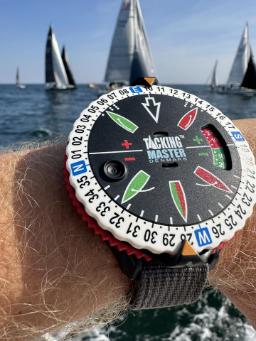
The TackingMaster is a wrist-worn rotating calculator that works with any compass. It ships with a Velcro wrist strap and a belt pouch. It has three main parts:
- Compass Ring. You set this to the mean wind direction before the start.
- Mark Ring. You set this to the bearing of the windward mark. It then shows the downwind mark bearing, which reach is dominant, and the gybe bearing.
- Wind Dial. This carries the close-hauled boat markers, the start-line bias sectors and a shift window. A small "jog" handle turns it as the wind moves.
The manual's worked example shows how this comes together. With a mean wind of 025° and a 45° tack angle, the dial shows the starboard tack heading at 340° and port at 070°. A windward mark at 035°, 10° right of the wind, gives a leeward mark at 215°. The gybe bearing reads 205°, which tells you starboard is the dominant reach.
All of those numbers come from the dial at a glance. No mental arithmetic is needed while you are hiking, trimming or calling a cross.
Using the Tacking Master on the Water
Start-line bias. Take a bearing along the line and read it against the plus/minus sectors on the dial. In the manual's example the square line sits at 295°/115°. A measured 300° falls in the red plus sector, which means the port end is favoured by 5°.
Lifts and headers. This is the core job. Suppose your starboard heading moves from 340° to 355°. You click the Wind Dial clockwise until the starboard close-hauled marker reads 355°. The window then shows a 15° shift in green, which tells you the wind has gone right. If the heading drops to 325° instead, the window shows 15° in red. Either way, the new port tack heading is on the dial too, so you know what to expect if you tack.
The downwind leg. The same shift changes the run. After the 15° right shift, the Mark Ring shows that the leeward leg has gone from starboard-dominant to 5° port-dominant, with the gybe now at 220°. After the left shift it becomes 25° starboard-dominant, with the gybe at 190°. You can work this out before you round the top mark, not after.
Reading the trend. Your original Compass Ring and Mark Ring settings never move. Only the Wind Dial does, so the colour in the window becomes a running record of the breeze. If it keeps building in one colour, the shift is persistent. If it swings between red and green, the wind is oscillating. That difference shapes the whole beat, and it also gives the crew something concrete to talk through after the race.
Other angles. The 45° markers are joined by one-, two- and three-dot markers for 50°, 40° and 35° tack angles. Reaching markers sit at 135° true wind angle, with 10° reference lines. That covers most keelboats and dinghies, from a cruiser-racer pointing at 45° to a high-performance boat closer to 35°.
Why the TackingMaster Still Makes Sense Alongside Modern Electronics
It is where your eyes already are. A plotter at the nav station or a display on the mast is useful, but it is not on your wrist. The helm or tactician can glance down between waves, read a heading and look back up. Nobody needs to go below, and nobody needs to scroll through a menu.
It works on boats without the kit. Plenty of competitive sailing happens on dinghies, one-designs and club keelboats where class rules or budgets leave out integrated wind instruments. A compass and a TackingMaster give you much of the same tactical picture.
It cannot fail electronically. No battery, no water ingress, no NMEA error, no lost satellite fix. On a cruising boat, it makes a sensible backup for estimating headings when the instrument system goes down.
It makes you understand the numbers. This may be its most useful feature. Electronic tactical software gives you an answer. A manual dial shows you how the answer is built: wind direction, tack angle and mark bearing, all moving together. Sailors who learn shifts this way tend to read the breeze better, and they trust their instruments more critically too.
What the Tacking Master Does Not Do
It is fair to be clear about the limits. The Tacking Master works from compass headings, so it is only as good as your compass and your ability to hold a steady course long enough to read one. It does not account for tide, current or leeway, so the headings it gives are through the water, not over the ground. It does not replace a proper wind instrument for measuring true wind speed or angle. And it relies on you to spot a change in heading and click the dial. A one-off gust or a wave throwing the bow off is not a shift.
Bottom Line: Where the TackingMaster Fits
The TackingMaster does not try to compete with a tactical computer. It does one job: it turns a compass heading into a clear picture of the wind, the next tack and the next leg. And it does that on your wrist, without power. For dinghy and one-design sailors it can do much of what a wind instrument would. For crews on fully instrumented boats it is a fast cross-check, a backup and a useful training aid.
In a sport that keeps adding screens, there is still a good case for a tool you can understand completely at a glance.
If you have any questions about Tacking Master Device please feel free to contact us or click below to view the TackingMaster tactical navigation device at Upffront:

 and then Add to Home Screen.

TackingMaster: No Batteries. No Bluetooth. No Problem. The art of analogue tactics