
An Andersen winch is a well-established choice in the sailing market, particularly for owners looking for durable, stainless-steel sailing winches with strong long-term service potential. Designed and manufactured in Denmark, Andersen winches have built a reputation for high-quality construction, reliable operation and long service life.
But selecting the right winch is not simply a case of choosing the largest model that fits the deck. Winch sizing depends on sail plan, line loads, deck layout, crew strength, sailing style and the existing systems onboard.
If you are looking to replace or upgrade an Andersen winch, this guide explains the key variables involved and how to approach the selection process in a technically sensible way.
Sailing Winch Applications Onboard
Before selecting a new winch, it is important to understand the different winch applications onboard and how the loads vary between them.
Primary or Genoa Sheet Winches
The primary winches are normally the largest winches onboard. This is because large upwind genoas are typically the most highly loaded sails, and genoa sheets are often led directly to the winch on a 1:1 basis.
If the boat has a self-tacking jib with a 2:1 purchase, the sheet load at the winch is reduced. In that case, the primary winch may be smaller than it would be on a conventional overlapping genoa setup.
Spinnaker Sheet Winches
Spinnaker sheet winches are generally smaller than the primary winches because downwind sail loads are significantly lower than upwind genoa loads.
This does not mean they are lightly loaded, especially on larger yachts or performance boats, but they are normally sized below the primary winches.
Mainsheet Winches
Mainsheet systems are often split port and starboard, spreading the load across two winches. In addition, most mainsheet systems include a purchase system, which reduces the line load before it reaches the winch.
For this reason, mainsheet winches are usually smaller than the primary winches, although the correct size will depend heavily on the mainsheet system geometry and the sail plan.
Halyard Winches
Halyard loads vary depending on the sail. The genoa halyard is generally the highest loaded, followed by the mainsail halyard and then the downwind spinnaker halyard.
For coachroof-mounted halyard winches, it is normally sensible to size the winch for the highest expected halyard load. Halyard layouts may change over time, but a good Andersen winch is likely to remain onboard for many years.
On older or larger boats with dedicated halyard winches, more specific optimisation may be possible.
Runner Winches
Runner winches are designed to oppose the upwind load in the forestay and help keep the genoa luff straight. They can be relatively highly loaded.
However, like mainsheet systems, runners normally include at least a 2:1 purchase. This means the line load reaching the winch is significantly reduced. Runner winches are often similar in size to mainsheet winches.
Reefing Winches
A dedicated reefing winch will generally be one of the smallest winches onboard. Reefing loads are important, but the winch is usually not required to match the power of a primary, mainsheet or runner winch.
Andersen Winch Selection Guide
Boats vary enormously. They may be long or short, heavy or light, narrow or beamy, monohull or multihull, conservative cruiser or high-performance design.
Because of this variation, all winch manufacturer selection guides should be treated as generalised guidance rather than absolute rules. Andersen winch selection data is useful, but it still depends on assumptions.
The key is to assess where your boat sits relative to those assumptions.
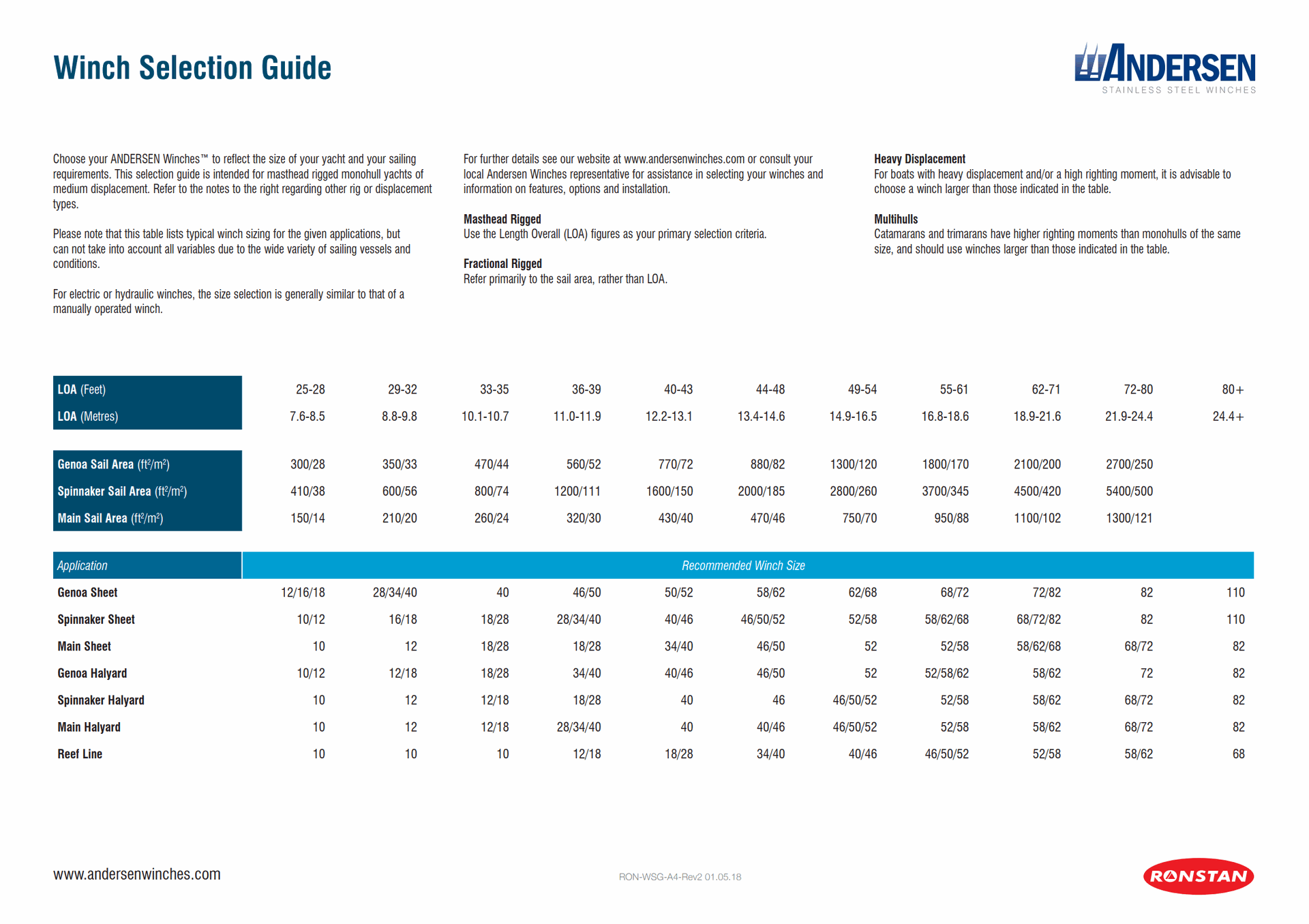
Andersen Winch Sizing Variables
Andersen use two primary selection variables:
- Length overall, or LOA
- Sail area
Their recommendations are based on a “masthead rigged monohull of medium displacement”.
Sail area has a direct impact on line loads, so it is important to calculate your sail areas correctly before using any selection guide. For guidance on how to calculate sail areas, see our detailed blog on sail area calculation.
For a given boat length, Andersen will have used average rig geometry data for their standard boat type to estimate maximum sail areas. From there, they recommend suitable Andersen winch sizes for the main onboard applications.
However, even with these assumptions, the selection guide can only provide a range of possible winch sizes.
For example, a spinnaker winch on a 37ft masthead-rigged monohull of medium displacement could be a size 28, 34 or 40. That represents a range of roughly +/-20% for a boat of the same length, rig geometry and displacement category.
This is a useful reminder: winch selection is not an exact calculation based on LOA alone.
So Which Andersen Winch Should You Select?
Manufacturer selection guides are based on simplified assumptions. In the real world, the number of variables involved makes it very difficult for a boat owner to produce a definitive winch selection from first principles.
Fortunately, most boat owners already have existing winches onboard. This gives a practical and reliable starting point.
If the existing winches have performed well, the default approach is usually to replace them with the same size and type of winch. If you are switching brand, the logical starting point is to choose an Andersen winch with equivalent size and power.
Understanding Winch Size and Power
The industry-wide winch naming convention makes comparison relatively straightforward. The winch size number generally relates to the maximum power ratio of the winch.
Power is a function of gearing ratio and drum diameter. While there are subtle differences between gear transitions on 2-speed Andersen winch and 3-speed winches, the broad comparison remains useful.
For example, a Lewmar 40 and an Andersen winch 40 have the same maximum power ratio. This makes equivalent sizing between brands a sensible starting point when replacing older winches.
Should You Go Up One Andersen Winch Size?
Before buying a replacement winch, ask a simple practical question: Do I have enough power?
There are several reasons you may want to consider moving up one winch size:
- The crew is getting older
- You sail with a lighter or less physical crew
- You sail short-handed offshore
- You are increasing sail area
- You want easier trimming in higher-load conditions
- You are refitting the boat for longer-term cruising
Going up one size can make the boat easier to handle, especially when sailing short-handed. However, it should still be considered in relation to deck space, line handling, installation footprint and the existing winch layout.
Andersen Winch Selection: Practical Conclusion
There are too many variables involved to reduce winch selection to a single definitive formula. Boat length, displacement, sail area, rig geometry, sheet purchase, deck layout, crew strength and sailing style all influence the correct choice.
In most cases, this is not a major problem because the existing winch package gives you a clear reference point. If the current winches work well, replace like-for-like or choose an Andersen winch with equivalent size and power.
If the current winches feel underpowered, or if the boat is being modified for short-handed sailing, offshore cruising or a larger sail plan, moving up one winch size may be worth considering.
For ambitious refit or new-build projects, the best answer is to speak to an expert. A proper recommendation should consider the physical yacht parameters, sail plan, deck layout, sailing style and crew capability.
If you have any questions about Andersen winches, please email us at [email protected] or click the link below to see our full Andersen winch range:

 and then Add to Home Screen.

Andersen Winch - making the right choice