
When purchasing a furling system, there are several other considerations that need to be taken into account to ensure you have a fully operational furling system. Some are basic / essentials and others are optional extra’s.
Tack Fitting for Furling Systems
Most drums come with either a D-shackle or snap shackle, however not all, so please check what comes as standard with your drum. If you plan to store the drum with the sail, then a snap shackle will the simplest and most efficient solution. However, if you plan to position your drum and leave it on deck for use with multiple sails then a standard D-shackles would be adequate.
There are other options, specifically for use in conjunction with locks – see section below.
Head Fitting and 2:1 Halyard Options in Furling Setups
Most swivels will come with a D-shackle as standard. The primary consideration is whether you want to go for a 2:1 halyard setup.
The advantages of 2:1 halyard are:
- Reduces the effective weight of pulling up the sail
- Reduces the compression in the mast
- Reduces load on fittings
- Less load in the halyard clutch
- Allows the use of a smaller halyard
Disadvantages:
- 50% increase in halyard length
- More halyard to pull through for the hoist
- More halyard to store when hoisted
- Replacing the halyard requires a trip up the mast
Some swivel manufacturers provide dedicated/integral 2:1 block options, however, it is possible to just lash a suitably sized block to the D-shackle.
Drum Lock / Ratchet for Controlled Furling
Continuous furling line systems using torsion cables are not designed for partial furling under load. However, uncontrolled back-spin during furling is a common and frustrating issue.
Losing grip on the furling line mid-furl can result in rapid unspooling of the sail — particularly in apparent wind — which may create both handling and safety concerns.
For this reason, drum locks or ratchets are increasingly specified with modern furling systems.
- Some furling manufacturers supply removable drum locks as standard.
- Others require a modified drum design.
If controlled furling under load is important to your sailing program, this decision should be made at the outset.
Furling line
Essential, but easy to forget! Your continuous furler needs a continuous furling line – a loop of 6mm, 8mm or 10mm line.
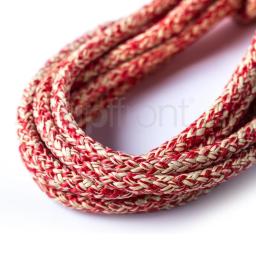
Regardless of whether you are racing or cruising, a quality furling line with a tight cover is essential to ensure smooth running of the furling unit at all times. A loose cover building up at the entrance to the furling unit, causing a jam, can mean losing places at the bottom mark while racing but also creates a potentially dangerous situation if you cannot furl away a sail, just when you need to.
In addition to choosing a decent furling line there are several setup choices you need to make.
Foredeck vs Cockpit Furling Control
The furling system layout should reflect crew numbers and boat size.
Foredeck or cockpit operation
- On smaller boats where the unit can easily be furled by hand it is quite common to use a shorter furling line with a crew member furling from the foredeck
- For short-handed sailing or on larger boats, the furling line is generally lead back to the cockpit where it can be put on a primary winch.
Shock cord take-up
- Both foredeck and cockpit systems are often set-up with a shock cord take-up to keep the line neat when not in use
- This consists of a simple piece of shock cord and a snatch block (allowing the furling line to run through it) which is tied back on at the mast base or pushpit.
Lead blocks
- Cruising boats will often run their furling line along the stanchion bases and there are a variety of double fairleads available on the market.
- However, these units tend to come on/off with the sail and whilst the drums are setup for quick/simple removal of the furling line from the drum many prefer to run the furling line direct, without lead blocks and use the shock cord to keep it clean.
Furling Locks
An increasingly popular option, as more product variety becomes available on the market, is a furling lock. Locks have several advantages:
- Reduced compression in the mast
- Smaller halyard / hoist line
- Less load and wear on halyards, sheaves and clutches
- Fixed / consistent hoist height
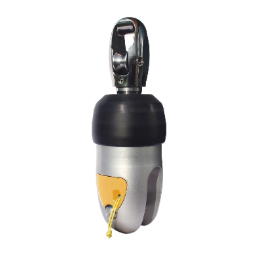
Karver KFH5 - Furling lock (Image courtesy of Karver)
The main perceived concern about using locks is getting the sail stuck aloft, however, technology has moved on considerably in recent years and race boats and superyachts can have many years of trouble free use. In addition, with a furling lock, a problem with lowering the sail is not a particular issue, assuming the sail can be furled.
Without a furling lock, the halyard is used to provide varying halyard tension. With a lock in use, an additional 2:1 or 3:1 purchase system is required between the drum and the deck to achieve the required load in the system. All the furling unit manufacturers have fittings for the bottom of the drum to allow for 2:1 or 3:1 purchases.
Final Thoughts on Configuring a Furling System
A furling system is only as reliable as its weakest component. When specifying furling hardware, consider:
- Intended sailing style (racing, cruising, short-handed)
- Load levels
- Deck layout
- Line management
- Maintenance access
Careful configuration of the furling drum, swivel, halyard arrangement, furling line and associated control systems will result in a furling setup that operates smoothly, safely and repeatably. If you have any questions about code zero and gennaker accessories, please feel free to email us at [email protected], or click the link below to see our full range:

 and then Add to Home Screen.

Furling system: options & furling accessories