
An electric Harken winch is one of the most practical upgrades for cruising and performance cruising yachts. Whether you are hoisting a fully-battened mainsail, tensioning halyards or trimming heavily loaded sheets, moving the hard work from crew to motor can make sailing safer, easier and more consistent.
For most sailors considering a powered Harken winch, the answer will usually be found in the Radial electric range. Harken also offers more specialist powered products, such as UniPower and Rewind winches, but these are aimed at more specific applications. The Radial electric range remains the mainstream choice for many sailing yacht installations.
The challenge is not usually deciding whether to buy an electric winch. The challenge is making sure the complete system is specified correctly before the order is placed.
How a Harken Winch Electric System Works
One of the key features of a Harken winch electric system is how the motor drives the winch.
Rather than using an offset motor and additional drive gears to transfer power into the winch, the Harken motor connects directly to the central drive shaft and works through the winch’s existing gear train. This means the motor benefits from the same mechanical advantage as a crew member using a winch handle.
Fast trimming takes place through the lower-powered first gear, while heavily loaded sheets and halyards benefit from the higher mechanical advantage of second gear. The result is an efficient system that makes full use of the winch’s gearing while helping to keep motor size and power consumption under control.
For most cruising and performance cruising applications, this is exactly why the Radial electric Harken winch range is such a common choice.
Decoding Harken Winch Part Numbers
If you have ever looked at a Harken winch part number and wondered whether somebody fell asleep on the keyboard, you are not alone.
Take a typical example:
- 46.2STEC12H
While it looks cryptic, the code tells you almost everything about the winch:
- 46 = winch size
- .2 = two-speed gearbox
- ST = self-tailing
- E = electric
- C = chrome finish
- 12 = 12V motor
- H = horizontal motor orientation
Harken uses the part number to identify the winch size, number of gears, self-tailing configuration, power type, drum finish, voltage and motor configuration.
The real value of understanding the coding is not necessarily choosing the winch size in the first place. By the time most owners reach the ordering stage, they usually already know the size of Harken winch required for the boat.
Instead, the part number becomes a useful final sense check. Before confirming an order, you can quickly verify that the correct finish, voltage and motor orientation have been specified. On products where a single character can change the entire configuration, that is worth doing.
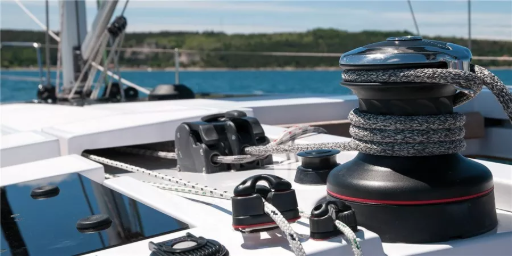
Harken Radial Electric Winch
Why the Harken Winch Part Number Matters
A Harken winch order should never be checked only by product title. The part number gives a more precise view of the actual specification.
This is particularly important when comparing:
- aluminium, chrome and bronze drum finishes
- 12V, 24V and 48V electrical systems
- horizontal and vertical motor orientations
- two-speed and three-speed configurations
For owners, yards and electricians, the part number is a useful way of making sure everyone is talking about the same physical product before the winch is shipped.
Choosing the Right Voltage for a Harken Winch
For many years, the choice was simple. Most yachts used 12V systems, while larger yachts often adopted 24V systems.
Today, 48V electrical systems are becoming increasingly common on new builds and major refits, particularly where lithium battery banks, higher electrical loads and longer cable runs are part of the overall design.
The engineering logic is straightforward.
Higher voltage means lower current for the same power output. Lower current means less voltage drop, reduced losses in long cable runs and the ability to use smaller, lighter cables.
For a retrofit project, the decision is usually dictated by the yacht’s existing electrical system. If the boat is 12V, the Harken winch will almost certainly be specified as 12V. If the boat is 24V, the winch will usually be 24V.
For new builds and major refits, however, 48V is increasingly worth considering as part of the wider electrical architecture. The key point is that the winch voltage should be specified as part of the complete system, not as an isolated hardware choice.
12V, 24V or 48V Harken Winch Systems
For most owners, the voltage decision comes down to the boat rather than the winch.
A 12V system is common on smaller cruising yachts and many existing boats. A 24V system is more common on larger yachts where current draw and cable sizing become more significant. A 48V system is normally a new-build or major-refit decision, because it affects the wider electrical installation.
The important point is that the Harken winch, motor, control box, circuit breaker and cable sizing all need to be considered together.
Horizontal or Vertical Motor Orientation?
Once voltage has been decided, motor orientation is often the next major decision.
The smaller Harken 35.2 and 40.2 electric winches are available only with horizontal motors. From size 46.2 upwards, both horizontal and vertical motor configurations are available.
This choice has very little to do with performance and almost everything to do with installation space.
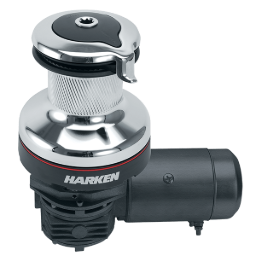
Horizontal Electric Harken Winch
A horizontal motor extends sideways beneath the mounting surface. A vertical motor extends directly below the winch.
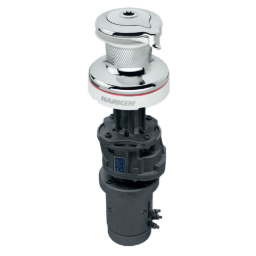
Vertical Electric Harken Winch
Neither arrangement is inherently better than the other. The correct choice depends entirely on the space available beneath the deck.
On one yacht, a vertical motor may fit neatly between structural members, while a horizontal motor would interfere with a locker. On another, a deep vertical installation may be impossible because of a bulkhead, berth, headliner or moulded interior component below.
When planning a Harken winch installation, it is important to consider both horizontal and vertical clearance beneath the winch location. Structural beams, bulkheads, lockers, wiring runs, plumbing and existing equipment can all influence which motor configuration is practical.
In many installations, the surrounding structure becomes the deciding factor rather than the motor itself.
Check the Space Before Choosing the Motor
Motor orientation should be checked before the Harken winch is ordered, not during installation.
A good specification process should include:
- the deck location of the winch
- the underside structure below the mounting position
- available vertical depth
- available sideways clearance
- access for installation and future servicing
- cable routing from the breaker and control box
- any lockers, linings, pipework or electrical equipment in the area
This is especially important on retrofit projects, where the boat was not originally designed around an electric winch motor.
Harken Winch System Components: What Is Included and What Is Not
Perhaps the biggest misunderstanding around Harken electric winches is what is included as standard.
Many owners assume that the control electronics must be purchased separately. In reality, every new Harken electric Radial winch is supplied with the appropriate dual-function control box.
This matters because the control box is voltage-specific. When ordering a Harken winch, the specified voltage determines not only the motor, but also the control box supplied with it.
However, receiving the control box does not mean you have everything required for installation.
Each electric winch still requires a circuit breaker and operating switches. These must be specified separately.
For most installations, Harken’s standard 80A breaker is appropriate. Some larger 12V installations require the higher-capacity 135A breaker.
This is one of the details that is often overlooked until installation begins.
Analogue Switches or Harken Digital System Switch?
Once the power side of the installation has been specified, the final choice is usually how the Harken winch will be controlled.
Traditional analogue switches remain popular. They are simple, reliable and widely used throughout the marine industry.
Harken’s Digital System Switch takes a more sophisticated approach. Instead of directly switching power, the waterproof button sends a coded signal which must be verified before the system activates. Harken highlights this as a safety advantage because wiring faults or water ingress are less likely to result in unintended operation.
The switches are sealed, illuminated for low-light use and available in both composite and stainless steel finishes. For new builds and premium refits, they are becoming an increasingly common option.
Harken Winch Specification Checklist Before Ordering
Specifying a Harken winch is often simpler than it first appears, but it helps to think of the installation as a complete system rather than a single component.
Before placing an order, confirm:
- winch size
- two-speed or three-speed configuration
- drum finish: aluminium, chrome or bronze
- system voltage: 12V, 24V or 48V
- horizontal or vertical motor orientation
- included dual-function control box
- correct circuit breaker
- analogue switches or Digital System Switch
- space below deck for the motor
- cable routing and access for servicing
The good news is that the dual-function control box is already included with every new electric Radial Harken winch. The remaining task is to ensure that the supporting components have been specified correctly.
Get those details right at the ordering stage and the installation process becomes significantly smoother, with fewer surprises once the winch arrives and the electrician starts pulling cables.
For most sailors, that is the difference between buying an electric winch and buying a complete Harken winch system.
Need Help Specifying a Harken Winch?
Choosing the right Harken winch is not just about selecting the correct size. Voltage, motor orientation, breaker rating and switch type all affect the final installation.
If you are planning an electric winch upgrade, contact Upffront for help specifying the right Harken winch system for your boat. We can help you check the key configuration details before you order, so the winch, motor, control box, breaker and switching all match the installation.
View the Harken winch range or contact us for technical advice before ordering:

 and then Add to Home Screen.

Harken Winch Buying Guide: How to Specify the Right Electric System