
Modern rope clutches have a difficult job. A rope clutch fitted to a cruising yacht thirty years ago might have been expected to hold a polyester halyard carrying a few hundred kilograms of load. Today, the same diameter rope could be a high-performance Dyneema-cored halyard capable of generating several times that load.
As rope technology has evolved, clutch technology has had to evolve alongside it. Few manufacturers illustrate this better than Antal. The Antal clutch range spans everything from compact cruising clutches through to high-load jammers capable of holding several tonnes.
At first glance, the range can appear complicated, with multiple product families covering many of the same rope diameters. Once you understand the three core gripping technologies behind the Antal rope clutch range, however, the logic becomes much clearer.
The Three Antal Clutch Technologies
Antal clutches can be understood through three main gripping systems:
- Traditional Cam technology
- V-Grip technology
- DV-Grip technology
Each technology is designed for a different balance of rope diameter, holding load, rope protection, release behaviour and installation space.
1. Traditional Cam Antal Rope Clutch Technology
Used only on:
The Antal clutch CAM 611 uses a conventional flat cam pressing the rope against a matching lower surface. This is the traditional clutch arrangement found on many cruising boats and remains a proven solution where loads are relatively modest.
Advantages:
- Simple
- Compact
- Economical
- Fully serviceable
Limitations:
- Lower holding loads than newer designs
- More concentrated load on the rope cover
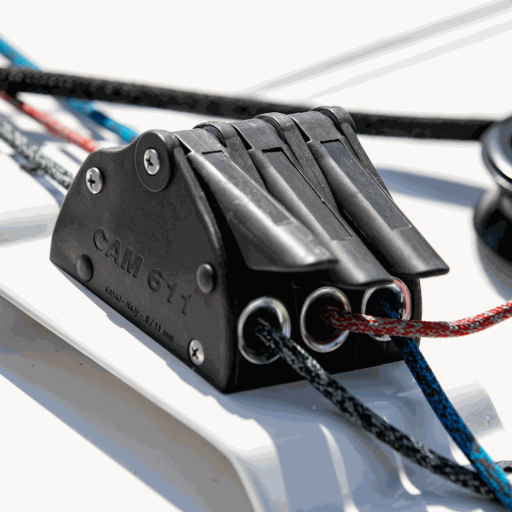
Antal clutches CAM 611
For cruising yachts using moderate-load polyester lines, this type of Antal rope clutch can still make sense. For higher-load Dyneema halyards or performance applications, however, the newer V-Grip or DV-Grip systems may be more appropriate.
2. V-Grip Antal Clutch Technology
Used on:
- V-Grip
This is where Antal starts to differentiate itself. Rather than using a flat cam, the V-Grip system uses a V-shaped upper cam working against a curved lower surface. The rope is effectively gripped on three sides rather than two.
This provides several advantages:
- Higher Holding Power
Because friction is generated over a larger contact area, significantly greater loads can be held.
- Lower Rope Compression
The load is distributed over a larger section of rope cover rather than concentrated at a single point. This is particularly important with expensive Dyneema-cored halyards, where excessive point loading can damage the cover or reduce long-term line life.
- Line Retrieval With Lever Closed
One of Antal’s most useful features is the ability to pull the line through the clutch while the lever remains closed. Once the desired position is reached, the rope locks automatically without needing to reopen and reset the clutch.
- Easier Opening Under Load
The mechanism allows controlled release under substantial loads without first transferring the entire load to a winch.
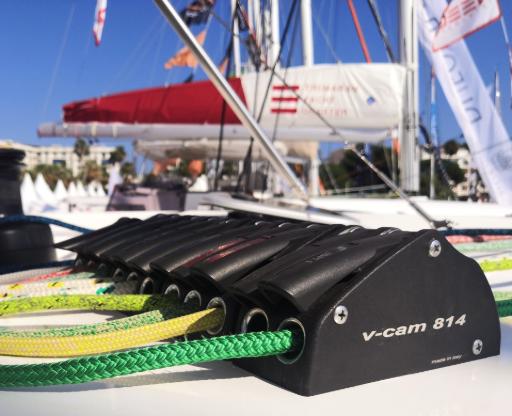
Antal clutches V-Cam 814
For many performance cruising yachts, a V-Grip Antal clutch offers a useful middle ground: higher holding power than a traditional cam clutch, but with conventional clutch handling and practical release behaviour.
3. DV-Grip Antal Clutch Technology
Used on:
DV-Grip is Antal’s highest-performance gripping system.
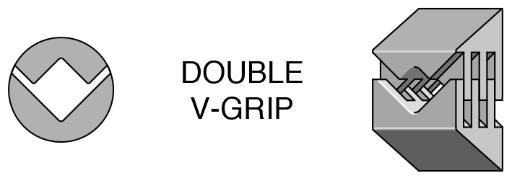
The DV-Grip is a locking system based on two opposing V shaped wedges, the result is a 4 sides grip which provides additional benefits over traditional 2-sides.
Instead of a single V-shaped upper cam, DV-Grip uses opposing V-shaped wedges above and below the rope. The rope is therefore gripped from four sides rather than three.
DV-Grip Benefits:
- Higher holding power
- Reduced rope wear
- More compact overall dimensions
- Lower weight
The difference between the two DV-Grip products lies in how they are released. The QR remains a true clutch that can be opened under full working load. The DV Jammer is a high-load jammer that requires load transfer to a winch before release.
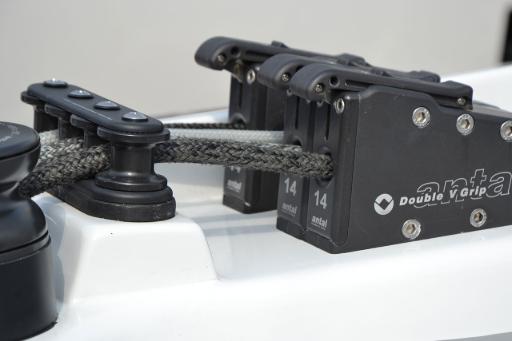
Antal DV-Grip Jammers
This distinction is important. A QR clutch is designed for high-load applications where the line may still need to be released directly from the clutch. A DV Jammer is designed for applications where maximum holding power is the priority and winch-assisted release is acceptable.
Antal Clutch Range Comparison
Range | Line Sizes | Max Load | Versions Available | Construction & Key Features |
|---|---|---|---|---|
CAM 611 | 6-10mm | 500kg | Single, Double, Triple, Horizontal | Traditional cam, resin body, bronze mechanism |
V-CAM 611 | 6-8mm | 600kg | Single, Double, Triple | V-Grip technology, compact format |
V-Grip | 8-16mm | 1600kg | Single, Double, Triple | Extremely compact, only 68mm high |
V-CAM 814 | 8-14mm | 1500kg | Single to Quadruple | Large V-cam for higher loads |
V-CAM R814 | 8-14mm | 1500kg | Single to Quadruple + Side Mount | Improved version with cleaning slots and integrated guides |
V-Grip Plus | 10-16mm | 2100kg | Single, Double, Triple | Stronger aluminium-bodied V-Grip |
V-Grip Maxi | 12-22mm | 3400kg | Single Only | Heavy-duty clutch for larger yachts |
QR | 10-14mm | 3000kg | Standard, Base Mount, Side Mount | DV-Grip technology with full-load release |
DV Jammer | 8-18mm | 6000kg | Single Only | Maximum holding power for extreme loads |
Why Rope Diameter Doesn't Tell The Whole Story
One of the most common mistakes when selecting a clutch is assuming that a 10mm rope simply requires a 10mm clutch.
In reality, Antal offers five different solutions for a 10mm line:
Product | Maximum Load |
|---|---|
CAM 611 | 500kg |
V-Grip | 700kg |
V-CAM 814 | 850kg |
V-Grip Plus | 1050kg |
QR 10 | 1600kg |
Why?
Because not all 10mm ropes are equal. A polyester halyard on a cruising yacht may never approach 500kg of working load. A modern SK78 or SK99 Dyneema halyard on a performance yacht may regularly generate far higher loads. The clutch should be selected according to the expected load in the system, not simply the rope diameter.
This is particularly important when upgrading from older polyester running rigging to modern low-stretch Dyneema lines. The line diameter may remain the same, but the load capability of the rope — and therefore the potential load seen by the clutch — can be much higher.
A Practical 14mm Antal Rope Clutch Example
The differences become even more obvious as rope sizes increase.
For a 14mm line:
Product | Maximum Load |
|---|---|
V-Grip Maxi | 1700kg |
QR 14 | 3000kg |
DV Jammer 14 | 4000kg |
Although all three products can accommodate the same rope diameter, they serve very different purposes.
V-Grip Maxi
Suitable where high holding loads are required but conventional clutch operation remains desirable.
QR
Designed for high-performance yachts where loads are substantial but the line may still need to be released directly from the clutch. This is one of the few products in this load category that genuinely allows release under full working load.
DV Jammer
Designed for applications where maximum holding power is the priority. Before opening the jammer, load must first be transferred onto a winch. The reward is dramatically higher holding capacity.
Do Not Design The Clutch In Isolation
Even the best Antal clutch will perform poorly if the rest of the rope handling system is not properly designed. The clutch is only one part of the complete deck layout. Lead angles, organiser sizing, winch position and rope specification all affect how well the system works in practice.
Deck Organisers
Deck organisers guide halyards and control lines from the mast base into the clutch bank. Correct organiser sizing reduces friction and ensures the line enters the clutch cleanly. Poor alignment into the clutch can increase rope wear, reduce holding performance and make the system harder to trim or release.
Clutch Organisers
Clutch organisers are often overlooked but equally important. These sit between the clutch bank and the winch, maintaining the correct exit angle from the clutch and ensuring smooth loading onto the winch drum. As clutch loads increase, these lead angles become increasingly important.
A high-load Antal rope clutch should therefore be considered as part of a complete rope-handling system, rather than as an isolated deck fitting.
Choosing The Right Antal Clutch
Rather than thinking of the range as eight separate products, it is often easier to view it as three technology platforms:
Technology | Products |
|---|---|
Traditional Cam | CAM 611 |
V-Grip | V-CAM 611, V-CAM 814, V-CAM R814, V-Grip, V-Grip Plus, V-Grip Maxi |
DV-Grip | QR, DV Jammer |
From there, selection becomes a matter of balancing:
- Rope diameter
- Expected working load
- Boat size
- Available mounting space
- Requirement for release under load
Get those five factors right and the correct Antal clutch usually becomes obvious.
For lower-load cruising applications, the CAM 611 or compact V-CAM models may be suitable. For modern performance cruising yachts using Dyneema-cored halyards, the V-Grip and V-Grip Plus ranges offer higher holding power with practical clutch operation. For very high-load applications, the QR and DV Jammer move into a different category, where controlled release behaviour and maximum holding capacity become the deciding factors.
The key point is simple: do not select an Antal rope clutch by rope diameter alone. Match the clutch to the actual load in the system, the rope construction, and the way the line needs to be handled on deck.
If you have any questions about Antal clutches, please feel free to contact us and talk to one of our sailing experts or click below to see our full range:

 and then Add to Home Screen.

Antal Clutch Guide: Rope Clutches Explained from CAM 611 to DV Jammer