
A mainsheet traveller is one of those systems that tends to disappear into the background — right up until it stops working properly.
When traveller friction rises, trimming becomes inconsistent. When the car twists under load, leech tension becomes harder to control. When side loads overwhelm the bearing geometry, the mainsheet traveller suddenly feels heavy exactly when you most need precise adjustment.
Modern yachts place enormous demands on traveller systems:
- larger mainsails,
- wider sterns,
- square-top mains,
- higher vang loads,
- German sheeting systems,
- and increasingly aggressive sail plans.
The loads generated by a modern 40ft performance cruiser can be dramatically higher than those seen on older race boats of similar size.
That is exactly where the Antal 4Race mainsheet traveller range becomes interesting.
Rather than simply chasing ultra-low friction numbers in ideal conditions, the 4Race systems appear designed around something far more useful in real sailing:
- maintaining smooth operation under combined load,
- resisting torsional distortion,
- and surviving the kind of dynamic loading that happens offshore and fully powered upwind.
For owners upgrading from older traveller systems, the difference is often not how easily the car moves in the marina, but how controllable the mainsheet traveller system remains once the mainsheet is heavily loaded and the boat is moving properly.
More Than Just a Mainsheet Traveller Car
One of the easiest mistakes when specifying a mainsheet traveller is to think only about the traveller car itself.
In reality, a mainsheet traveller is an integrated mechanical system made up of:
- track profile,
- bearing geometry,
- end controls,
- purchase ratios,
- control sheaves,
- cleat positions,
- mainsheet block articulation,
- and deck integration.
A traveller that works beautifully on one boat can feel awkward or overloaded on another simply because the control geometry is wrong.
That is why we have approached the Antal 4Race range as a configurable mainsheet traveller system rather than a collection of individual parts.
On every 4Race car page on our website, the compatible components can be added directly from the product page itself, including:
- end fittings,
- stop-pins,
- control ends,
- cam cleats,
- and compatible OPF blocks.
That matters because specifying traveller systems from a catalogue can quickly become confusing once you start combining:
- different track options,
- purchase ratios,
- stand-up joints,
- and block configurations.
Rather than selling a fixed “kit”, we prefer allowing the system to be configured properly around the actual boat and cockpit layout.
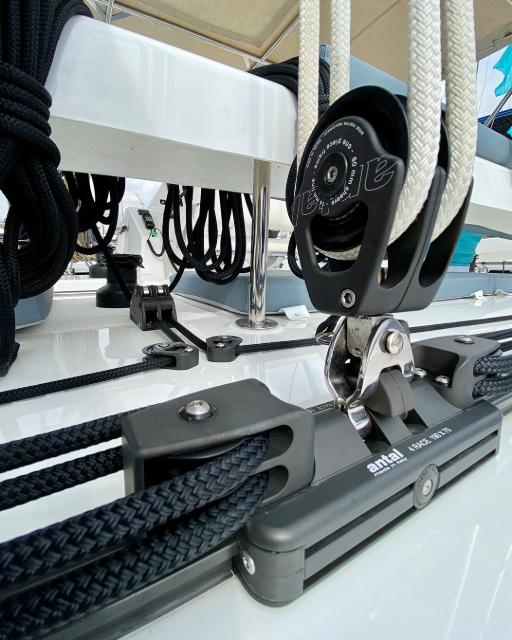
Antal 4Race Mainsheet Traveller Systems 190mm
Understanding the Antal 4Race Mainsheet Traveller Range
Within the range we currently publish, the four key traveller sizes are:
- 4Race100
- 4Race110
- 4Race150
- 4Race190
The model number itself refers approximately to the overall traveller car length in millimetres.
That detail is more important than it first appears.
As the cars become longer, they gain:
- greater bearing contact length,
- increased torsional stability,
- higher working loads,
- and more sophisticated control arrangements.
This is not simply about carrying more vertical load.
Mainsheet traveller systems on modern yachts are subjected to three simultaneous load types:
- vertical compression from sheet tension,
- horizontal side loading from boom angle,
- and torsional twisting loads caused by offset geometry.
The longer the traveller body and bearing spacing, the better the system can resist those combined forces.
Mainsheet Traveller Sizes and Boat Applications
The published 100–190 range covers a large proportion of modern performance cruisers and cruiser-racers from approximately 25ft to 48ft.
| Model | Car Length | Track Size | Boat Size | SWL |
|---|---|---|---|---|
| 4Race100 | 98 mm | 27 × 20 mm | 25–33 ft | 820 kg |
| 4Race110 | 110 mm | 31 × 21 mm | 30–36 ft | 1000 kg |
| 4Race150 | 150 mm | 31 × 21 mm | 35–42 ft | 1400 kg |
| 4Race190 | 190 mm | 31 × 21 mm | 41–48 ft | 1900 kg |
These size recommendations are based around:
- end-boom sheeting,
- and genoa sheet applications.
As always, actual loading depends heavily on:
- sail plan,
- righting moment,
- vang loads,
- and boom geometry.
A lightweight modern performance cruiser with a square-top mainsail can easily generate significantly higher mainsheet traveller loads than a heavier traditional yacht of similar LOA.
Mid-boom sheeting arrangements also increase traveller loads substantially.
Why the 4Race100 Mainsheet Traveller Uses a Different Track
The smallest 4Race100 system runs on:
- a 27 × 20 mm track.
All larger sizes from 110 upwards share:
- the 31 × 21 mm platform.
This is actually a clever split within the range.
The 100 system is optimised around:
- low weight,
- compact dimensions,
- and smaller cockpit layouts.
At just 0.23 kg, the 100 car is remarkably compact for an 820 kg SWL traveller.
The larger 31 × 21 platform used by the 110, 150 and 190 systems provides:
- greater structural stiffness,
- larger fasteners,
- wider bearing spacing,
- and importantly, upgrade compatibility.
A yacht fitted with a 31 × 21 track can potentially move between 110, 150 and 190 mainsheet traveller sizes without replacing the track itself.
That flexibility is particularly useful for evolving race boats or performance cruisers that may later move to larger sail plans.
Four Bearing Circuits — and Why They Matter
One of the more technically interesting aspects of the 4Race mainsheet traveller systems is the bearing arrangement itself.
Each traveller uses:
- two lower Torlon bearing circuits,
- and two upper Delrin bearing circuits.
The lower Torlon bearings carry the highest compressive loads, while the upper Delrin circuits help stabilise the car against uplift and torsional distortion.
The bearing count increases substantially as the traveller size grows:
| Model | Delrin Balls | Torlon Balls |
|---|---|---|
| 100 | 54 | 54 |
| 110 | 62 | 62 |
| 150 | 86 | 86 |
| 190 | 112 | 112 |
This progressive increase in bearing length is one of the reasons the larger cars remain smooth under side loading rather than becoming “notchy” or resistant when highly loaded.
That becomes especially noticeable on:
- wide travellers,
- heavily vang-sheeted boats,
- and yachts sailing aggressively upwind.
Built for Real Mainsheet Traveller Loads
A recurring theme throughout the 4Race design is load management under imperfect conditions.
Several details point clearly towards offshore and performance-oriented use:
- one-piece extruded traveller bodies,
- hard black anodised alloy components,
- AISI316 stainless fittings,
- overload retention geometry,
- and accessible bearing maintenance windows.
One particularly important feature is that the car remains mechanically retained on the track even in the event of ball bearing failure caused by overload.
That is a serious engineering detail rather than a marketing feature.
Mainsheet traveller systems experience extremely high shock loading during:
- accidental gybes,
- broaches,
- crash tacks,
- and mainsheet snatch loads offshore.
Preventing total traveller separation during a failure event is a meaningful safety advantage.
Stand-Up Joints and OPF Blocks
The articulated “stand-up” joint system is another distinctive aspect of the range.
Rather than using a simple loose shackle arrangement, the traveller can be fitted with a dedicated articulated joint designed specifically for Antal OPF blocks.
Compatible block pairings are:
- 4Race100 → OPF 60
- 4Race110 → OPF 70
- 4Race150 → OPF 80
- 4Race190 → OPF 80, single or twin block arrangements
The larger systems also use special long-swivel versions of the OPF blocks:
- J for the 100
- J1 for the 150
- J2 for the 190
This longer articulation geometry improves:
- alignment,
- articulation range,
- and load transfer into the traveller body.
It also explains why properly specifying the system matters.
Without understanding the block compatibility and swivel requirements, it is very easy to end up mixing incompatible components.
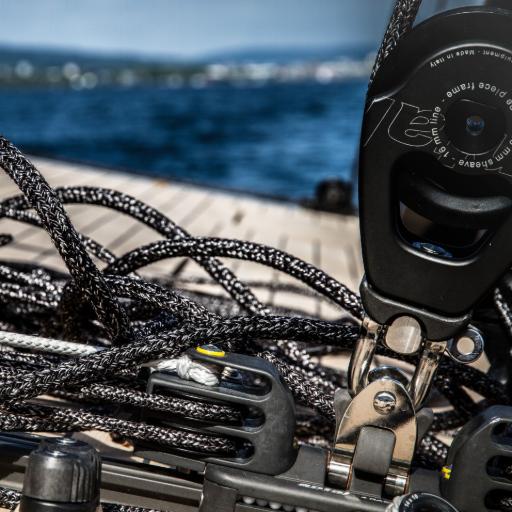
Antal 4Race Mainsheet Traveller Systems
Mainsheet Traveller Control Systems Grow With Boat Size
Another clever aspect of the range is how the traveller control systems evolve with increasing loads.
The smaller 100 systems are typically configured with:
- 1:1,
- 2:1,
- or 3:1 control systems.
As loads rise, the larger cars support increasingly powerful purchase systems:
- 4:1 on the 110,
- 5:1 on the 150,
- and up to 6:1 on the 190.
This matters because mainsheet traveller loads increase very quickly on larger boats.
Without sufficient purchase, travellers become difficult to adjust under load — particularly short-handed or while fully powered upwind.
The modularity within the 4Race range allows the control geometry to be matched properly to the yacht and the way it is sailed.
Not Just for Racing Boats
Despite the “4Race” branding, these mainsheet traveller systems are not limited to pure race boats.
In practice, they are extremely well suited to:
- fast cruising yachts,
- performance cruisers,
- offshore cruiser-racers,
- and short-handed sailing boats.
The emphasis on:
- structural stiffness,
- controllability under load,
- serviceability,
- and modular configuration
makes them particularly attractive for owners who actually sail their boats hard rather than simply chasing low quoted friction figures.
A Mainsheet Traveller System Designed as a System
The strongest aspect of the Antal 4Race range is probably not any single feature.
It is the fact that the entire range feels engineered as a coherent mechanical system:
- tracks,
- bearings,
- control geometry,
- articulation,
- and block integration
all work together.
That systems approach is also why we have structured the range the same way on the website.
Rather than presenting travellers as isolated components, we wanted owners and riggers to be able to visualise and configure the complete setup directly from the product pages themselves.
Because in reality, specifying the right mainsheet traveller is rarely just about choosing a car. It is about designing the entire load path properly. If you have any questions about Antal 4Race Mainsheet Traveller Systems please feel free to contact us and talk to one of our sailing experts or click below to see our full range:

 and then Add to Home Screen.

Mainsheet Traveller Systems: Technical Guide to the Antal 4Race 100–190 Series