
An Antal deck organizer is a key part of a modern coachroof line management system. As more halyards, reefing lines, furling controls, vang controls and sail trim systems are led aft to the cockpit, the way those lines are routed becomes critical to friction, clutch performance and long-term hardware reliability.
Modern sailing yachts no longer rely on simple, low-load polyester halyards and basic cockpit layouts. Today, a single coachroof may need to manage multiple high-load, low-stretch lines running through organisers, clutches, turning sheaves and winches. Every change in direction introduces friction. Every misalignment increases load on the hardware. Poor line management can shorten rope life, reduce clutch holding performance and place unnecessary stress on the deck structure.
Antal’s coachroof line management range has been developed to address these issues with a complete family of deck organisers, Tulip organisers, clutch organisers and turning sheaves. The key is understanding where each component sits in the rope path and what type of load it is designed to manage.
What Does an Antal Deck Organizer Do?
A deck organizer controls the path of a rope as it travels across the coachroof, normally between the mast base turning blocks and the rope clutches.
A typical control line follows this route:
- Clutch organizer or turning sheave
- Winch
Each component performs a different task. A standard Antal deck organizer is mainly responsible for guiding lines towards the clutches, maintaining clean spacing, reducing friction and helping the rope enter the clutch at a sensible angle.
The common mistake is assuming that all organisers perform the same job. They do not. The loads and alignment requirements before the clutch are very different from the loads behind the clutch.
Why Line Alignment Matters on a Coachroof
Correct line alignment is not only about keeping the deck tidy.
A poorly aligned rope can create unnecessary friction, wear the rope cover, reduce clutch efficiency and increase side load on hardware. This becomes more important as rope loads increase, particularly on halyards, reefing systems and highly loaded control lines.
Before the clutch, there is usually enough distance for the rope to naturally straighten after passing through a deck organiser. Minor angular deviations can often be tolerated.
After the clutch, the situation is different. The rope is already loaded and the distance to the winch is usually short. If the rope exits the clutch at an angle, the clutch body, internal mechanism, fasteners and deck structure may all see unwanted side load.
This is why Antal separates deck organisers, clutch organisers and turning sheaves into different product families.
Antal D-Series Deck Organizers for Standard Line Routing
Antal identifies its standard deck organisers by sheave diameter:
Range | Sheave Diameter |
|---|---|
D40 | 40mm |
D50 | 50mm |
D60 | 60mm |
D70 | 70mm |
As the sheave size increases, so does the load capacity and the recommended rope diameter.
The D40 and D50 ranges use high-strength resin sheaves running on double-sided ball bearings. These are well suited to cruising yachts and moderate-load coachroof applications.
The D60 and D70 ranges move to hard anodised aluminium sheaves with composite fibre bearings and side ball bearings. These are designed for higher-load applications, including offshore yachts and performance cruising boats where halyard and reefing loads can be significantly higher.
For many yachts, the standard Antal deck organizer range is the logical choice for clean, efficient routing between the mast base and the clutch bank.
Antal Tulip Deck Organizers for Difficult Lead Angles
At first glance, Antal Tulip organisers look similar to standard deck organisers. The difference is in the sheave profile.
A Tulip sheave has a deeper, more supportive rope groove. This helps retain and control the rope when lead angles are not perfectly aligned.
This becomes useful on modern yachts where:
- Deck layouts are crowded
- Multiple lines converge into limited coachroof space
- Lead angles vary significantly
- Low-stretch ropes are used
- Line retention is more important than simple line separation
Rather than simply allowing the rope to pass through, the Tulip profile helps keep the rope centred on the sheave.
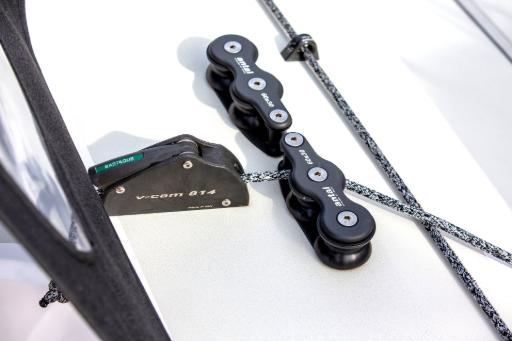
Antal T-Series Tulip Organizers
Antal identifies Tulip organisers by sheave diameter:
Range | Sheave Diameter |
|---|---|
T45 | 45mm |
T60 | 60mm |
The T45 range uses resin sheaves with self-captive double-sided ball bearings.
The T60 range uses hard anodised and Teflon-coated aluminium sheaves with composite fibre bearings and self-captive Torlon side bearings for higher load capacity.
If your coachroof layout involves unusual lead angles, limited deck space or several lines converging from different directions, a Tulip deck organizer may be a better technical choice than a standard flat-sheave organiser.
Antal Clutch Organizers: Why They Are Different from Deck Organizers
Clutch organisers are often misunderstood.
Many sailors assume they are simply another type of deck organiser, but their job is different and more critical.
A deck organizer normally works before the clutch. A clutch organizer works after the clutch, where the rope is loaded and the distance to the winch is short.
This matters because a loaded rope exiting a clutch at an angle can place significant side load on:
- The clutch body
- The clutch mechanism
- Mounting fasteners
- The deck structure
- The rope cover
Over time, this can accelerate wear or damage the clutch installation.
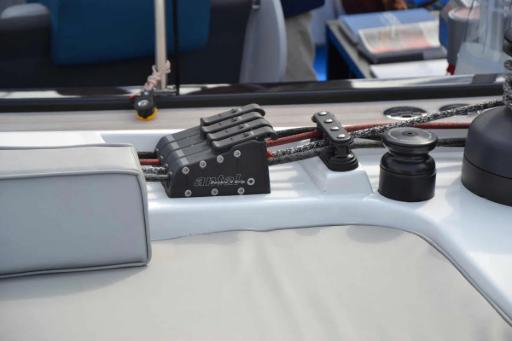
A clutch organiser keeps each line aligned with the clutch before redirecting it towards the winch. This is especially important when several clutches feed a single halyard winch. Without a clutch organiser, the outer clutches in the bank may be heavily side-loaded whenever their lines are tensioned.
Matching Antal Clutch Organizers to Antal Clutches
One of the useful aspects of the Antal system is that the clutch organisers mirror the clutch ranges.
Clutch Range | Matching Organiser |
|---|---|
V-Cam 814 / R814 | 28mm resin sheaves |
V-Grip | 28mm resin sheaves |
V-Grip Plus | 38mm aluminium sheaves |
V-Grip Maxi | 43mm aluminium sheaves |
Because the organiser is designed around the geometry and loading of the corresponding clutch range, selection is relatively straightforward for owners already using Antal clutches.
This is also where the difference between a deck organizer and a clutch organizer becomes most important. The deck organizer manages the line before the clutch. The clutch organizer controls the loaded line after the clutch.
Antal Turning Sheaves for Flexible Line Routing
A multi-sheave clutch organiser is not always the best solution.
Some yachts need individual lines to be routed to different winches. Others have unusual coachroof layouts where grouped sheaves would force poor lead angles.
This is where turning sheaves become valuable.
Mounted aft of the clutch bank, turning sheaves allow each line to be redirected independently towards its optimum winch position.
Standard Antal Turning Sheaves
Standard turning sheaves are available in:
- 50mm
- 60mm
- 70mm
These are useful when maximum flexibility is required and individual line routing is more important than maintaining a grouped clutch organiser arrangement.
Antal Tulip Turning Sheaves
Tulip turning sheaves are available in:
- 50mm
- 70mm
- 100mm
Tulip turning sheaves use a deeper rope profile and multiple Torlon bearings to improve rope control when large lead-angle changes are unavoidable.
They are often the better solution when a loaded rope must be redirected significantly in both horizontal and vertical planes.
One 6-Sheave Antal Deck Organizer or Two 3-Sheave Organizers?
This is one of the most common decisions when specifying a new coachroof layout.
The correct answer depends on the geometry of the yacht, the clutch position, the mast base line exits and the available deck space.
Option 1: A Single 6-Sheave Deck Organizer
Advantages:
- Cleaner appearance
- Fewer deck penetrations
- Simpler installation
- More compact overall footprint
Disadvantages
- Less flexibility when aligning individual lines
- Harder to modify later
- May force compromises in rope lead angles
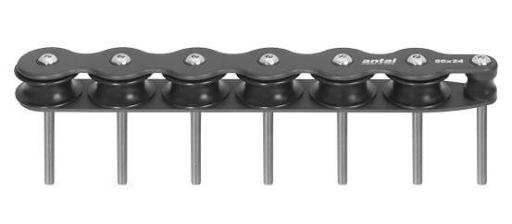
A single 6-sheave Antal deck organizer can work well where the line exits, clutch bank and winch position are already well aligned.
Option 2: Two 3-Sheave Deck Organizers Side-by-Side
Advantages
- Greater flexibility in positioning
- Easier alignment with clutch banks
- Better accommodation of complex deck geometries
- Simpler future expansion
Disadvantages
- Requires more deck space
- Additional mounting holes
- Slightly more complex installation
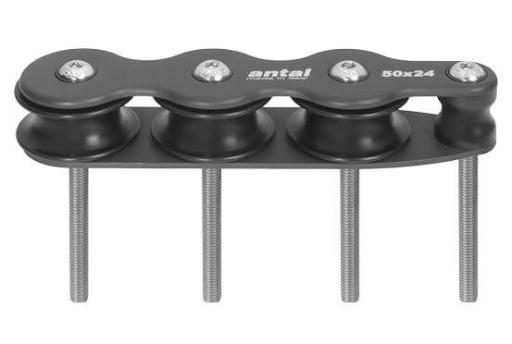
For many retrofit installations, two smaller organisers provide a better engineering solution than one larger organiser. The layout may look less compact, but the rope leads can often be improved significantly.
Can Antal Deck Organizers Be Stacked?
Antal organisers can be stacked, which gives yacht owners another option where coachroof space is limited.
Stacking allows more lines to be routed through a smaller deck footprint. This can be useful on retrofits, compact coachroofs or installations where side-by-side organisers are not possible.
Advantages of Stacking Antal Deck Organizers
- Reduces deck footprint
- Allows more lines in confined areas
- Simplifies some retrofit installations
- Helps avoid excessive spread across the coachroof
Disadvantages of Stacking Antal Deck Organizers
- The main consideration is load capacity.
As organisers are stacked, longer mounting bolts are required. This increases bolt deflection and reduces the overall load capacity of the upper organiser compared with a single organiser mounted directly to the deck.
For lightly loaded control lines, this may not be significant.
For highly loaded halyards and reefing systems, it should be carefully evaluated during system design.
Stacking also increases installation height, which can affect clutch alignment and rope lead angles. In many cases, the decision is ultimately driven by available deck space rather than organiser preference.
How to Choose the Right Antal Deck Organizer System
Choosing the correct Antal deck organizer system depends on four main questions:
- Where is the line in the rope path?
- How much load is the line carrying?
- How severe is the change in direction?
- How accurately must the rope align with the clutch or winch?
As a general guide:
| Application | Recommended Solution |
| Clean routing from mast base to clutch bank | Standard Antal deck organizer |
| Difficult lead angles before the clutch | Antal Tulip deck organizer |
| Loaded line exiting a rope clutch | Antal clutch organizer |
| Independent line routing to different winches | Individual turning sheaves |
| Large angle changes under load | Tulip turning sheaves |
| Limited coachroof space | Stacked organisers, subject to load assessment |
The important point is that these components are not interchangeable. They may look similar, but they are designed for different positions in the rope path.
Final Thoughts: Specifying an Antal Deck Organizer Layout
A good Antal deck organizer layout is not just about adding more sheaves to the coachroof. It is about controlling rope angle, friction, load direction and clutch alignment from the mast base to the winch.
Standard deck organisers manage line routing before the clutch. Tulip organisers improve rope control where lead angles are less predictable. Clutch organisers protect the clutch installation after the rope exits under load. Turning sheaves provide flexibility where lines need to be redirected independently.
When these components are selected and combined correctly, they reduce friction, improve sail handling, protect running rigging and help ensure that loads are transferred into the deck hardware as intended.
For yacht owners upgrading an existing coachroof layout, the best Antal deck organizer system is the one that matches the actual rope path, not simply the one with the highest number of sheaves. If you have any questions about Antal deck organizer range please feel free o contact us and talk to one of our sailing experts or click below to see our full range:

 and then Add to Home Screen.

Antal Deck Organizer Guide: Deck Organisers, Clutch Organisers and Turning Sheaves