
Spinlock deck organisers have been a core part of modern rope-handling systems for decades. Best known for their clutches and jammers, Spinlock has built a reputation around controlled load paths, efficient rope management, and components that integrate cleanly into contemporary cockpit layouts. Their deck organisers follow the same design philosophy: structurally efficient, weight-conscious, and engineered around real-world rope loads rather than marketing claims.
This article provides a technical overview of the Spinlock deck organiser range, comparing organiser families, sheave sizes, materials, and intended applications. The aim is to help yacht owners and refit professionals select the most appropriate organiser configuration for their running rigging.
What Spinlock Deck Organisers Do
Deck organisers sit at the transition between mast base and cockpit. Their primary function is to guide halyards, reefing lines, and control lines aft towards clutches and winches while maintaining fair lead angles and minimising friction. Poor organiser geometry increases friction, accelerates rope wear, and introduces uneven clutch loading.
Spinlock deck organisers are offered in several families, covering sheave diameters from 25 mm to 50 mm and load capacities suitable for everything from small cruising yachts to performance-oriented rigs. Most models are available in symmetric and asymmetric layouts:
- Symmetric organisers keep the sheave stack centred over the mounting footprint and are best suited to straight-line routing.
- Asymmetric organisers offset the sheaves laterally, reducing deck footprint and improving lead fairness where deck geometry forces an angled approach.
This modular approach allows Spinlock deck organisers to be matched closely to deck layout rather than forcing compromise.
Spinlock T-Series Deck Organisers: Entry to the Clutch Bank
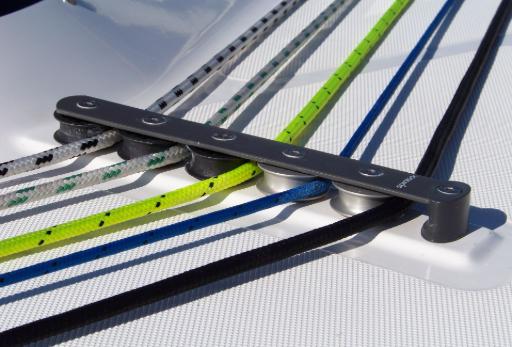
The T-series organisers (T25, T38, T50, and TC50) are all designed specifically for routing lines into clutches and jammers. They form the foundation of Spinlock’s organiser offering.

T25 – Compact Spinlock Deck Organisers
The T25 uses 25 mm composite sheaves in a lightweight fibre-reinforced body. It is intended for smaller yachts and moderate loads, where space and weight are key constraints. Stainless steel bases accommodate curved coachroofs, and asymmetric versions are particularly useful on compact deck layouts with limited real estate.
T38 – Mid-Load Deck Organisers
The T38 steps up to 38 mm sheaves and an improved bearing surface, reducing friction under load and improving rope longevity. The Vari-camber base allows better conformity to curved decks, making the T38 a common choice for mid-sized cruising and club racing yachts.
T50 – High-Load Composite Organisers
With 50 mm composite sheaves, the T50 is designed for higher halyard loads and larger rope diameters. It remains relatively light while offering increased load capacity. Stackability and compatibility with the TC50 range make it suitable for systems that may evolve over time.
TC50 – High-Load Alloy Spinlock Deck Organisers
The TC50 range uses 50 mm alloy sheaves, offering higher stiffness, improved heat dissipation, and long-term durability under repeated high-load cycles. These Spinlock deck organisers are typically specified for performance rigs, high-tension halyards, and heavily loaded reefing systems. Double-stack variants allow high line density in minimal deck space.
Sheave Materials in Spinlock Deck Organisers
Sheave material is a defining difference within the Spinlock deck organiser range:
- Composite sheaves (T25, T38, T50) prioritise low weight and efficient rope handling for moderate loads. They are well suited to cruising yachts and lightly loaded control systems.
- Alloy sheaves (TC50, TSR) offer superior stiffness and resistance to deformation under high loads. They also handle thermal build-up more effectively during fast trimming or repeated load cycling.
Choosing between composite and alloy sheaves should be driven by load profile rather than boat length alone.
When to Use Stacked Spinlock Deck Organisers
Stacked organisers such as the T50/D and TC50/D allow multiple sheaves to be arranged vertically rather than side-by-side. This is particularly useful when coachroof width is limited or clutch banks are densely populated.
Spinlock also provides stacking options in the smaller range. The T25 can be stacked with BE10/2 or BE10/3 fairleads, offering a practical and cost-effective way to increase line capacity without increasing the deck footprint. This is especially useful on compact yachts where space is restricted.
Advantages of stacked Spinlock deck organisers:
• Increased line capacity without widening the organiser base
• Separation of high- and lower-load lines between rows
• Cleaner lead geometry in dense halyard layouts
• Proven compatibility between T25 units and BE10 stacked fairleads
Drawbacks include:
• Reduced Safe Working Load on upper rows in true stacked organisers
• Increased vertical height which must be managed carefully
• More complex installation and inspection requirements
When specified correctly, stacked Spinlock deck organisers are an efficient solution for complex rope systems.
TSR20 and TSR30: Spinlock Deck Organisers for Post-Clutch Routing
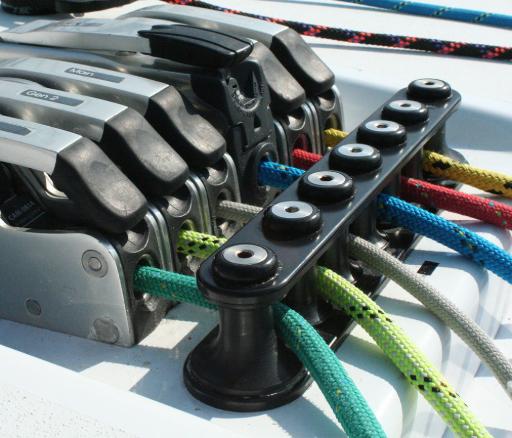
Unlike the T-series, the TSR20 and TSR30 organisers are designed for use after the clutch bank. These Spinlock deck organisers are aft organisers engineered to handle significant deflection loads rather than entry loads into clutches.
Key characteristics include:
- Alloy rotating sheaves (20 mm or 30 mm)
- Modular spacing for custom routing
- Very high deflection load ratings (up to 5000 kg on TSR30 at 30°)
- Tulip-shaped sheaves to reduce friction during vertical movement
- Low-profile options for tight spaces such as mast bases or in-deck tunnels
- Optional fixed sheave inserts to increase allowable deflection loads
- Availability of custom configurations for complex deck plans
TSR Spinlock deck organisers are the correct choice when redirecting heavily loaded lines from clutches to winches or reshaping rope geometry in advanced cockpit layouts.
Selecting the Right Spinlock Deck Organiser
A practical summary of typical applications:
- T25 – Small yachts, low to moderate loads
- T38 – Mid-sized yachts requiring efficient halyard handling
- T50 – Higher-load halyards and larger rope diameters
- TC50 – Very high-load systems with alloy sheaves
- T25 + BE10 – Compact stacked fairlead solution
- TSR20 / TSR30 – Post-clutch routing under high deflection loads
Spinlock deck organisers combine durability, efficiency, and adaptability, making them a cornerstone of modern yacht rope management. Their long-standing expertise in clutches and rope control ensures every organiser is engineered with the precision and reliability sailors have come to expect.

 and then Add to Home Screen.

Spinlock Deck Organisers: A Complete Guide to the Industry’s Leading Rope Control Systems