
Shock cord is one of the least conspicuous components on a sailing yacht, yet it plays a disproportionately important role in how cleanly, safely and efficiently sail handling systems operate. When correctly specified and thoughtfully installed, shock cord reduces friction, prevents fouling, improves line management and lowers crew workload. When poorly chosen, it degrades quickly, loses elasticity and becomes another consumable that quietly undermines deck ergonomics.
This article looks at how shock cords can be used to optimise sail handling systems, with a particular focus on correct specification and system integration rather than generic application.
What Shock Cord Actually Does on a Sailing Yacht
At its core, shock cord is an elastic control element. Unlike static rope, it is designed to store energy and apply a controlled return force over repeated cycles. In sail handling systems, this allows shock cord to:
- Maintain light but consistent tension on running rigging
- Automatically retract slack line or fabric
- Keep control lines aligned with blocks, fairleads and clutches
- Prevent sheets, guys and control tails from falling into the cockpit or bilge
Importantly, shock cord is not intended to carry significant working loads. Its role is positional control rather than load bearing, and treating it as a structural component is a common cause of premature failure.
Common Sail Handling Applications for Shock Cord
Shock cords appear in more places on a modern sailing yacht than many owners initially realise.
On headsails and downwind sails, shock cords are frequently used to manage furling lines. A lightly pre-tensioned elastic run parallel to the furling line helps maintain even wraps on the drum and reduces the likelihood of overrides, particularly on continuous-line and top-down furling systems.

On mainsails, shock cords are commonly used to retract lazy jacks when sailing. This reduces sail chafe and prevents unnecessary windage. Similar principles apply to slab reefing systems, where shock cord can be used to keep reefing pennants clear of battens and sailcloth when not under load.
Below decks, shock cords are often employed in halyard management systems, keeping tails off the cabin sole and away from winches while still allowing unrestricted movement during hoists and drops.
Shock Cords Specification: Diameter, Stretch and Construction
Selecting shock cord by diameter alone is rarely sufficient. Effective specification depends on understanding diameter, stretch behaviour and construction, particularly the relationship between the elastic core and the protective cover.
Diameter determines the usable tension range. On most sailing yachts, shock cord between 4mm and 8mm covers the majority of sail handling applications. Smaller diameters are well suited to line management and lazy jack retraction, while larger diameters are more appropriate for furling line control on larger sails.
Stretch characteristics are equally important. Shock cord should operate well within its elastic range in normal use. If it stretches too easily, it will not maintain effective tension; if it is too stiff, it behaves more like a static line and transmits unwanted shock loads into fittings and attachment points.
Construction is where meaningful differences emerge in real-world use. Most marine shock cord uses a multi-strand latex core to provide elasticity, protected by a braided polyester cover. This construction offers a good balance of UV resistance, flexibility and cost, and remains entirely appropriate for many sail handling tasks.
For higher-demand applications, however, the cover rather than the core often becomes the limiting factor. In these cases, shock cord with a Dyneema cover offers a clear technical advantage. The latex core remains unchanged, so elastic behaviour is broadly similar, but the Dyneema braid provides significantly improved abrasion resistance and tensile durability.
Dyneema-covered shock cord is particularly well suited to applications involving tight lead angles, small-radius fittings or continuous low-level cycling, such as furling line management on performance headsails or frequently sailed lazy jack systems. In these environments, polyester covers can glaze, flatten or abrade long before the elastic core is exhausted.
It is important to stress that a Dyneema cover does not make shock cord suitable for carrying working loads. The elastic core remains the structural limitation. The benefit lies in durability and service life, not increased functional strength.
Conversely, polyester-covered shock cord often remains the better choice where UV exposure is dominant or where the cord is frequently handled, knotted or adjusted. Polyester is less slippery and more forgiving in general-purpose applications, making it well suited to lower-duty systems and occasional-use controls.
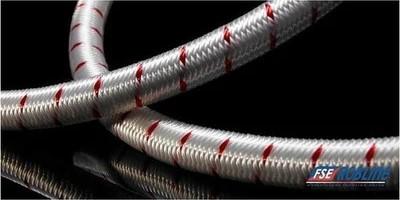
Robline Shock Cords
Optimising Shock Cord Layout and Attachment
Installation quality has a major influence on shock cord longevity. Sharp bends, poor lead angles and hard attachment points all accelerate fatigue in both the core and cover.
Where possible, shock cord should run through smooth fairleads or low-friction rings rather than around hard edges. Attachment points should allow some articulation so the cord is not forced to bend sharply at full extension.
Knots deserve particular attention. Simple overhand knots significantly weaken shock cord and concentrate stress. Where adjustability is required, small lashings or rolling hitches onto static control lines allow the elastic element to work more evenly and be replaced independently.
Pre-tension should be conservative. The aim is to remove slack, not to preload the system. Excessive pre-tension shortens service life and increases the likelihood of sudden failure.
Shock Cord as Part of a System
Shock cord is most effective when viewed as part of an integrated sail handling system rather than a standalone solution.
A furling line that regularly overrides may benefit from elastic tension, but only if drum diameter, line size and lead geometry are already correct. Shock cord should refine a well-designed system, not compensate for fundamental layout issues.
Similarly, halyard management systems benefit most when shock cord is combined with low-friction organisers and clearly defined lead paths.
Inspection, Maintenance and Replacement
Shock cord is inherently a consumable. The latex core degrades over time, even if the cover appears intact. Inspection should focus on loss of elasticity, surface glazing and cover abrasion.
In high-exposure deck applications, annual replacement is often justified. Below decks, service life is typically longer. Carrying spare lengths on board allows rapid replacement and avoids improvised solutions.
Final Thoughts about shock cords
Shock cord is a small component with an outsized influence on how refined a sail handling system feels in daily use. When correctly specified, thoughtfully installed and matched to its operating environment, it reduces clutter, prevents errors and improves overall handling efficiency.
For technically minded yacht owners, optimising shock cords use is less about adding more elastic and more about choosing the right construction, in the right place, for the right job.

 and then Add to Home Screen.

Optimising Sail Handling Systems Using Shock Cord