
A well-serviced winch is one of the most dependable pieces of hardware on a boat, and with the right winch service accessories and a couple of hours each season, most owners can keep a Harken winch turning smoothly for decades. The mechanism is simpler than it looks, and the servicing routine is well within the capabilities of a reasonably practical boat owner.
The whole job comes down to three main consumables: a winch service kit, pawl oil and winch grease, plus a clear understanding of which internal parts get grease, which get oil and which require no lubrication at all. Get that distinction wrong and it is quite possible to make a healthy winch work worse rather than better.
Harken is one of the leading names in performance winches, and there is a useful degree of parts commonality across its ranges. In practice, this means a relatively small number of service kits cover a very large number of winches, making routine servicing and carrying spares relatively straightforward.
How Often Should You Service a Winch?
Flush winches frequently with fresh water to help keep salt and grit out of the mechanism. Beyond that, a full strip, inspection and re-lubrication during the pre-season is a sensible baseline. Boats that see intensive saltwater use may benefit from servicing twice a season, while heavily used race winches should be inspected more frequently.
Service or investigate a winch straight away if any of the following symptoms appear:
- Ratcheting feels sluggish or sticky — the pawls may be contaminated with old grease, salt or dirt. Clean and inspect them before re-oiling.
- The winch does not turn freely — strip and clean the mechanism, then inspect the gears, bearings, pawls and springs before lubricating and reassembling.
- The drum turns or drives incorrectly in both directions — investigate the pawl mechanism immediately. Pawls may be sticking, damaged or failing to engage correctly.
While the winch is apart, inspect the pawls, springs, bearings, gears, spindles and retaining components for wear or corrosion. It is also a useful opportunity to check the winch mounting and accessible deck fasteners.
Winch Service Accessories: The Three Essentials
For a routine service you need three main Harken winch service accessories: the appropriate service kit, pawl oil and winch grease. Everything else is essentially cleaning, inspection and careful reassembly.
The Winch Service Kit — Pawls and Springs
The winch service kit contains the small spring-loaded ratchet components responsible for allowing the winch to drive under load in one direction while permitting the appropriate free movement in the other.
Pawls and springs work continuously whenever the winch is turning. They are also small components that can suffer from wear, corrosion and contamination, while springs are particularly easy to lose during servicing.
Worn, rounded, damaged or sticky pawls can result in poor or inconsistent engagement. The service kits therefore provide the principal routine replacement components needed when servicing a winch.
You can browse the full range of Harken winch service kits and spare parts online.
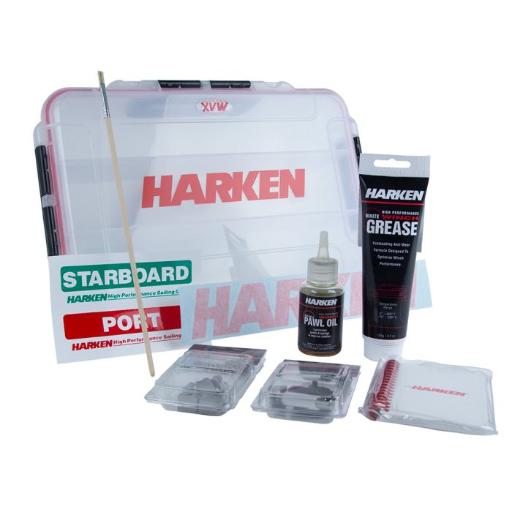
Pawl Oil
Pawls and springs are lubricated with light pawl oil, never winch grease.
Harken Pawl Oil (50 ml, part BK4521) provides the light lubrication needed at the pawl pivots without restricting the rapid movement required for positive ratchet engagement.
Only a small amount is required.
Winch Grease
Metal gears and metal roller bearings use winch grease. Harken High Performance White Winch Grease (100 ml, part BK4513) provides lubrication and corrosion protection for these heavily loaded moving surfaces.
Again, the objective is not to pack the mechanism with as much grease as possible. A thin, even coating on the appropriate surfaces is preferable to excessive grease, which can collect contamination and migrate to parts of the mechanism where it is not wanted.
Together, the service kit, pawl oil and winch grease form the core Harken winch service accessories required for routine maintenance.
Grease or Oil? The Mistake That Clogs a Winch
One of the most important principles in winch servicing is that pawls should not be greased.
Winch grease has the viscosity required to remain on loaded gear and bearing surfaces, but that same characteristic makes it unsuitable for a small spring-loaded pawl. Heavy grease can restrict the pawl's movement and prevent the spring from returning it rapidly and positively into engagement.
If the ratchet action feels sticky or inconsistent, contamination of the pawl mechanism is therefore one of the first things to investigate. Remove the old lubricant and dirt, inspect the pawls and springs and apply fresh pawl oil sparingly.
The basic lubrication rules are straightforward:
Winch component | Lubricant | Why |
Metal gears | Winch grease (BK4513) | Reduces friction and wear on loaded gear surfaces |
Metal roller bearings | Winch grease (BK4513) | Lubricates and protects the bearing surfaces |
Pawls | Pawl oil only (BK4521) — never grease | Allows rapid, positive engagement |
Pawl springs | Pawl oil only (BK4521) — never grease | Avoids restricting the pawl mechanism |
Composite roller bearings (Radial®, carbon) | None | Designed to operate without lubrication |
A thin, even film is the goal. Remove old and contaminated lubricant before applying fresh grease, and avoid leaving excess grease that can trap grit or migrate towards the pawls.
Radial® and carbon-fibre winches can also incorporate composite roller bearings that require no lubrication at all, making it important to identify what you are looking at rather than automatically greasing every bearing in the winch.
Which Harken Winch Service Kit Do You Need?
Because Harken has standardised pawls and springs across a substantial part of its winch range, just three service kits cover most current and many earlier Harken winches.
Identify your winch from the size marked on the top of the drum and its family — Classic, Radial®, Performa™ or Racing/Carbon — and then match it to the appropriate kit. For individual replacement components, Harken's model-specific manuals and exploded diagrams provide the relevant part numbers.
Winch family & size | Service kit | Contents | Part |
Classic B6–B980 | 10 pawls, 20 springs | BK4512 | |
Radial® 2-speed 15–70.2, Rewind™, UniPower™ | 10 pawls, 20 springs | BK4512 | |
Radial® 60.3 & 70.3, Performa™ 35–70 & Quattro, Custom/Racing 50–650, Air® | 10 × 17-4 PH pawls, 20 springs | BK4516 | |
Radial® 80, Performa™ 80, Racing B880–B1120 | 10 × 17-4 PH pawls, 20 springs | BK4515 |
Standard, Classic and Radial Winch Service Kits
The Classic/Radial Winch Service Kit (BK4512) is the workhorse of the range. Its 10 pawls and 20 springs cover Classic winches from B6 to B980 and 2-speed Radial® winches from 15 to 70.2, along with Rewind™ and UniPower™ models.
For many cruising yachts equipped throughout with compatible Harken winches, this can mean that one type of service kit covers every winch on deck.
Racing Winch Service Accessories
Larger and higher-load winches use hardened 17-4 PH stainless-steel pawls, with two racing service kits covering the relevant sizes.
The 8 mm Racing Winch Service Kit (BK4516) suits Radial® 60.3 and 70.3, Performa™ 35 to 70 and Quattro, together with Custom and Racing winches from 50 to 650 and Air® winches.
The 10 mm Racing Winch Service Kit (BK4515) covers the largest models, including Radial® 80, Performa™ 80 and Racing winches from B880 to B1120.
Both kits contain 10 pawls and 20 springs.
Drum Screw Kits, Handle Repair and Lubricants
Alongside the pawl-and-spring service kits, a handful of accessories cover some of the other routine maintenance requirements.
Accessory | Fits / use | Part |
Metal gears and appropriate metal roller bearings | BK4513 | |
Pawls and springs | BK4521 | |
B16–B46 | BK4519 | |
B48–B980 | BK4518 | |
Harken® lock-in winch handles | BK4517 |
These are worth considering when preparing for a service, particularly on an older winch where corroded fasteners or worn handle components may become apparent once work begins.
Beyond the Kit — Ordering Harken Winch Spare Parts
The core winch service accessories cover the routine service items, but they are not the whole story.
Bearings, gears, circlips, washers, top caps, self-tailing jaws, stripper arms and many other components are available individually as spare parts. The relevant Harken exploded diagram is therefore one of the most useful tools when working on an older winch.
The process is straightforward: identify the exact winch model, use its exploded diagram to identify the component and part number, and order the required replacement.
For offshore or extended cruising, carrying a small selection of appropriate winch spares can also make sense. Pawls, springs and small retaining components occupy very little space, while the correct pawl oil and grease allow routine servicing to be carried out away from shore facilities.
A Practical Harken Winch Servicing Sequence
Before lifting the drum, gather the parts and cleaning materials you are likely to need: the correct Harken service kit, pawl oil, winch grease, degreaser or suitable cleaning solvent, a stiff brush and clean rags, plus any drum screws, washers or handle components you already know need replacing.
The precise dismantling sequence varies between Harken winch models, so have the relevant Harken manual or exploded diagram to hand rather than assuming every winch comes apart in the same way. The underlying service process, however, is broadly consistent.
Before starting, remove the winch handle, make sure the winch is completely unloaded and prepare a clean working area. Pawls, springs, circlips and other small components are remarkably good at disappearing overboard, so a tray or light-coloured cloth around the base of the winch is a sensible precaution:
- Remove the drum and retaining components. Follow the procedure for your particular winch and take care with small clips, screws, washers and other retaining parts.
- Keep track of the dismantling sequence. Lay components out in the order they are removed. Taking photographs as you go can be useful, particularly if this is the first time you have dismantled that particular model.
- Clean before inspecting. Remove old grease, salt deposits and accumulated dirt from the gears, bearings, spindles and winch body. Cleaning is not simply preparation for fresh lubricant: wear, corrosion and damaged surfaces are considerably easier to identify once the components are clean.
- Inspect the mechanism. Examine the gear teeth and bearing surfaces for abnormal wear or damage and check the pawls and springs carefully. Inspect the spindles, fasteners, retaining components and drum at the same time. A proper service is as much an inspection exercise as a lubrication exercise.
- Replace worn service parts. Fit new pawls and springs from the appropriate service kit where required. If you discover significant wear or damage elsewhere, identify the component from the exploded parts diagram and replace it before returning the winch to service.
- Oil the pawls and springs. Apply Harken Pawl Oil sparingly to the pawl pivots and springs. Do not apply winch grease. The pawls need to move freely and return rapidly and positively into engagement.
- Grease the appropriate components. Apply a thin, even film of winch grease to the metal gears, appropriate metal roller bearings and other surfaces specified in the manual. More is not better: excessive grease attracts contamination and can migrate towards the pawl mechanism. Composite bearings specified to run dry should remain unlubricated.
- Reassemble carefully. Work back through the dismantling sequence, paying particular attention to spacers, washers, circlips and other retaining components. If something does not sit correctly, investigate rather than forcing the assembly together.
- Function-test before applying load. Rotate the drum by hand and check for smooth movement and positive pawl engagement. Listen and feel for a consistent ratchet action and make sure the winch operates correctly unloaded before returning it to normal use.
The important point is that winch servicing is not simply a matter of adding fresh grease. It is a clean, inspect, lubricate and reassemble process. Done regularly, it provides an opportunity to identify developing wear or corrosion before it becomes a failure, while ensuring that the different parts of the mechanism receive the lubrication — or lack of lubrication — that they actually require.
Not sure which winch service accessories fit your winch, or need a spare part that is not a standard service item? Contact us and one of our sailing hardware experts can help identify the winch and the correct components:
HARKEN WINCH SERVICE ACCESSORIES

 and then Add to Home Screen.

Harken Winch Service Accessories: A Technical Guide to Servicing and Spare Parts