Clutches & organisers
Clutches and organisers are the deck hardware that turns, holds and releases the lines led aft from the mast. Deck organisers and fairleads turn them, rope clutches and jammers hold them so one winch can serve several, cleats hold the lighter lines, and deck bushings take lines through the deck. Choose by rope diameter, load and deck layout. Read more...



What clutches and organisers do on a sailing yacht
On a yacht with lines led aft, halyards, reefing lines and control lines run from the mast base through turning blocks to a deck organiser, which turns them aft across the coachroof. Each line then passes through a rope clutch or jammer and on to a winch. The clutch holds the line once it is tensioned, so the winch can be cleared for the next one: a bank of three clutches lets one winch serve three lines. Barton's guide to leading lines aft gives the geometry: the organiser sits where it splits the angle between the mast base blocks and the clutch, the clutch is fitted at least 200 mm from the winch, and the line should reach the winch at an angle of less than 10°, or a wedge is needed.
Rope clutch, jammer, cleat or organiser?
The terms overlap, so it helps to separate them by what they do under load. A rope clutch (also called a sailing clutch or halyard clutch) holds a loaded line and can be opened to ease it under control. A rope jammer is for more static, high-load lines: in most installations the load is taken back onto the winch before the jammer is opened. A cleat holds lighter loads and is released by hand. An organiser or fairlead does not hold anything; it only changes the line's direction, and every turn adds friction.
Sizing clutches and organisers to rope diameter
Every clutch and jammer has a working rope range, and the rope has to sit inside it. Ours cover lines from a few millimetres up to 22 mm, with most made for ropes up to 10, 12 or 14 mm. Measure the rope as it is now: old covers flatten and polish, and a rope at the small end of the range is the usual cause of a slipping halyard. Use the 14 mm maximum rope diameter filter as a starting point for halyards on a yacht of around 40 ft, and match the organiser's sheave to the same rope.
Load: SWL and holding power
The SWL (safe working load) values on our clutches, jammers and organisers run from 50 kg to over 11 tonnes. Choose by the load on the line, not the boat's length: a main halyard or a 2:1 halyard carries far more than a reefing line of the same diameter. Where a line is rarely eased under load, a jammer gives more holding for its size; where it is trimmed often, use a clutch. For high-modulus covers, check that the clutch is approved for them by its maker.
Mounting and number of lines
Clutches come as single units or banks of two to four on one base. Most of ours are mounted upright on the coachroof; some organisers mount on their side, port or starboard, against a coaming. A clutch organiser combines an organiser with a row of clutches so the line runs straight into each one. When mixing makes, check that the organiser's line exit height matches the clutch's line entry height, which some makers state.
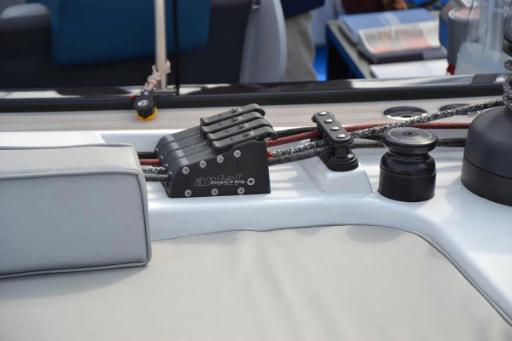
Antal clutch bank and clutch organiser on a coachroof
Ranges and brands
Spinlock makes clutches, jammers and deck organisers; see the Spinlock XAS clutches for cruising halyards and the Spinlock XTS clutches for higher loads. Antal builds the V-Cam clutches, the DV Jammer and the Deck Organizer and Antal Clutch Organizer ranges. Karver makes the Karver KJ jammers for racing yachts. Ronstan cleats and deck fittings, Harken Gizmo bushings and Allen Brothers cleats, fairleads and deck bushes cover the smaller fittings. The Cousin Constrictor textile clutch holds the line in a braided sleeve instead of a cam. For lines that leave the deck, see deck bushings and fairleads and organisers.
Service parts for clutches and organisers
Clutches wear at the cam or jaw, and a worn cam lets the line creep. Before replacing a whole clutch, check the rope clutch parts: cams, bases, handles, covers and repair kits for the main ranges. When replacing a clutch with another make, compare the fixing hole spacing; a different pattern means new holes or an adaptor plate. For a wider guide, read our Antal deck organiser guide.
Clutches and organisers FAQ
Rope clutch or jammer: which do I need?
A clutch, if you need to ease the line under load, as with most halyards and reefing lines on a cruising yacht. A jammer, if the line is set and left, and the winch takes the load before you release it.
How far should a rope clutch be from the winch?
Barton recommends at least 200 mm, with the line reaching the winch at under 10°. A shorter distance or a steeper angle causes riding turns and wear.
Can I mix clutch and organiser brands?
Yes, as long as each is sized for the rope and the line runs straight from the organiser into the clutch. Check the line heights where the makers give them.
Why does my halyard slip in the clutch?
Usually a worn cam, a rope that has become thinner or harder than the clutch's range, or a cover that the cam cannot grip. Replace the cam or fit a clutch sized to the rope as it is now.

To install this Web App in your iPhone/iPad press
 and then Add to Home Screen.
