Cousin Trestec
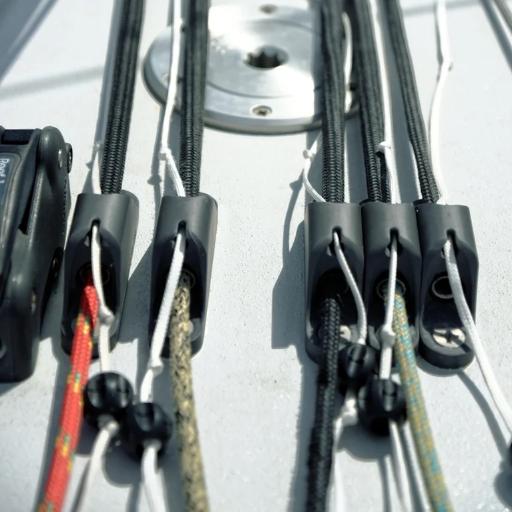
The Cousin Constrictor rope clutch replaces the cam and toothed jaw of a conventional clutch with a braided Technora sleeve that constricts around the line under load. Holding force rises with applied tension rather than depending on a fixed clamping pressure. Cousin Trestec builds it for 6mm to 14mm rope in standard and flush-mount bases, with replacement sleeves and size-matched service tools. Read more below...
|
|
|
|
|
|
|
|
|
|
|
|
|
|
|
|
|
|
|
|
|
|
|
|
|
How the Cousin Constrictor rope clutch works
A conventional rope clutch holds line by pressing a sprung, toothed cam against the cover. Holding force is fixed by cam geometry and spring rate, and the cover takes a concentrated load at the tooth line every time the clutch closes. The Constrictor works differently. The line runs through a braided Technora sleeve whose bias angle closes as the sleeve is drawn out — the mechanism of a Chinese finger trap. Tension tightens the braid, so grip rises with load and is spread along the contact length rather than concentrated at one point. A Dyneema trip line shortens the braid to release the line under load, and can be led away from the clutch for remote operation.
Cousin Constrictor clutch specification and sizing
Cousin Trestec publishes the following for the range, which covers 6mm, 8mm, 10mm, 12mm and 14mm line:
| Reference | Rope dia. | Width | Length | Weight | Breaking load |
|---|---|---|---|---|---|
| CTCON306 | 6mm | 25 mm | 11.5 cm | 155 g | 750 daN (7.5 kN) |
| CTCON308 | 8mm | 25 mm | 11.5 cm | 160 g | 1150 daN (11.5 kN) |
| CTCON310 | 10mm | 25 mm | 11.5 cm | 165 g | 2200 daN (22 kN) |
| CTCON312 | 12mm | 36 mm | 12.6 cm | 335 g | 2800 daN (28 kN) |
| CTCON314 | 14mm | 36 mm | 12.6 cm | 345 g | 3700 daN (37 kN) |
These are breaking loads, not working loads. Size against the peak load expected in the line and the diameter actually fitted, not against the nominal size of the clutch being replaced.
Rope compatibility
Grip depends on friction between sleeve and cover, so cover construction matters more than with a mechanical clutch. Standard polyester covers, and technical covers with polyester or aramid content, work as intended. Covers braided from HMPE — Dyneema or Spectra — are not suitable: the fibre's low coefficient of friction stops the sleeve biting, and the symptom is a clutch that creeps under load. Where a slippery line is unavoidable, splicing a polyester-covered section in at the clutch position is the usual solution.
Mounting, retrofit and service
Standard units bolt to the deck; flush-mount versions sit in a recess for a lower profile and are also used at the masthead and under coachroof fairings. Because the sleeve is a wear item rather than a mechanism, service means replacing the sleeve rather than rebuilding a cam and spring — each size has a matching service tool, and replacement sleeves are stocked separately. Weight and the absence of moving parts are the usual reasons to specify one; cost per position and cover compatibility are the usual reasons not to.
About Cousin Trestec
Cousin Trestec has manufactured rope in northern France since 1848, working synthetic fibre by twisting, cabling, braiding and impregnation. It now trades as part of the COUSIN® group alongside Cousin Composites, and supplies yachting, industrial, defence, rope-access and climbing markets from the same fibre expertise — high-tenacity polyester and polyamide, Technora®, Dyneema®, Twaron®, Vectran® and PBO®. Upffront stocks the marine side of that output: the Constrictor textile clutch range, replacement sleeves and service tools.
Cousin Trestec FAQ block
How does a textile rope clutch work?
The line passes through a braided Technora sleeve. Load on the line draws the braid out and reduces its diameter, constricting it onto the cover — the more tension applied, the tighter the grip. There is no cam, spring or toothed jaw. A Dyneema trip line shortens the braid to release the line, including under load.
What is the difference between a rope clutch and a rope jammer?
A clutch is designed to be opened under load; a jammer is not. Jammers hold in one direction and generally require the load to be taken on a winch before they can be released. The Constrictor behaves as a clutch: the trip line opens it against load, which is why it is used on spinnaker halyards and other lines that need to be dumped quickly.
What size Constrictor rope clutch do I need?
Match the unit to the diameter of the line it will hold, then check the published breaking load against the peak load you expect in that line. The 6mm, 8mm and 10mm units share a 25mm-wide, 11.5cm-long footprint; 12mm and 14mm units are 36mm wide and 12.6cm long. Do not size from the clutch being replaced.
Why would a Constrictor clutch slip?
Almost always line choice. The sleeve holds by friction against the rope cover, so an HMPE cover (Dyneema, Spectra) will not give it enough to grip. Check the cover material before assuming a fault. A worn or glazed sleeve is the second cause and is corrected by fitting a replacement sleeve.
Does a textile clutch damage the rope?
It applies pressure over the length of the sleeve rather than at a tooth line, so it does not indent or shear the cover the way a closed cam can. This is the main reason it is specified on expensive halyards and control lines where cover damage, rather than clutch failure, is what ends the life of the rope.
Can I fit a Constrictor in place of an existing clutch?
Usually, but check the deck footprint and fastener positions against the unit you are replacing — the Constrictor is not dimensioned to a universal clutch bolt pattern. Flush-mount versions require a recess. Bank spacing also differs from ganged mechanical clutches, so replacing a triple clutch position by position needs measuring before ordering.
How long does the sleeve last, and can it be replaced?
The sleeve is a consumable and life depends on cycles, load and UV exposure rather than a fixed interval; inspect it as you would a halyard cover. Replacement sleeves are available for every size and are fitted using the size-matched service tool, so the base unit stays on the boat.
Standard or flush mount?
Standard units bolt to the deck and are the straightforward retrofit. Flush-mount versions sit in a recess for a lower profile and a cleaner deck, and are the option used at the masthead or under a coachroof fairing. The flush version requires cutting a recess, so it is normally specified at build or refit rather than as a running change.
Who makes the Constrictor rope clutch?
Cousin Trestec, a rope manufacturer based in northern France and part of the COUSIN® group. The textile clutch is Cousin's patented design. Ronstan also lists a Constrictor textile rope clutch, so the same system appears under more than one name in the chandlery market.
Is Cousin Trestec the same as Cousin Group?
Yes. The COUSIN® group brings together the former Cousin Trestec and Cousin Composites businesses. Rope and textile clutches are still made and catalogued under the Cousin Trestec name, which is how most chandleries and riggers refer to the brand.

To install this Web App in your iPhone/iPad press
 and then Add to Home Screen.
