
Sailing lines are among the most highly stressed components on any sailing yacht. Unlike deck hardware, which is largely static once installed, sailing ropes are continuously loaded, adjusted and exposed to the elements. From halyards and sheets to control lines and dock lines, every rope onboard operates in a uniquely demanding marine environment.
Understanding how sailing lines behave under load, abrasion, UV exposure and moisture is essential when specifying rope for a cruising or performance yacht. This article provides a broad technical introduction to sailing ropes, focusing on how environmental conditions and onboard applications influence rope construction, core material and cover material choices.
The Marine Environment and Its Impact on Sailing Lines
Marine ropes operate in conditions that quickly reveal material weaknesses. UV radiation degrades fibres over time, salt contamination increases internal abrasion, and repeated wet–dry cycles accelerate fatigue. Sailing lines are also subject to dynamic loading from wind, waves and rig movement, rather than simple static loads.
Heat generation is another critical factor. Lines running through clutches, winches and sheaves can experience significant friction during hoists or trimming. If the rope’s materials are not suited to this, strength loss and cover damage can occur long before the quoted breaking load is reached. For this reason, sailing line selection should always consider how the rope is used, not just how strong it appears on paper.

Pre Spliced Ropes
Core Materials in Modern Sailing Ropes
The core of a sailing rope carries the primary load and defines its stretch characteristics.
Polyester cores remain common across cruising yachts due to their durability, UV resistance and predictable elongation. For sheets, control lines and general-purpose yacht ropes, polyester offers a well-balanced solution with good longevity.
Higher-performance sailing lines increasingly use HMPE fibres such as Dyneema®. These cores, widely used across ranges from Gottifredi Maffioli, Robline and PremiumRopes, deliver very high strength with minimal stretch. This makes them well suited to halyards and load-sensitive applications where sail shape and rig geometry matter.
Within HMPE fibres, different grades offer varying resistance to creep under sustained load. For cruising yachts that keep halyards tensioned for long periods, low-creep fibres are often prioritised over absolute strength. This distinction is particularly relevant when comparing halyard-specific sailing lines to more general-purpose Dyneema-based ropes.
Rope Cover Materials: Handling and Wear Resistance
While the core defines strength, the cover determines how sailing lines interact with deck hardware and the crew.
Polyester covers remain the most widely used due to their abrasion resistance, consistent grip and compatibility with winches and clutches. For many yacht rope applications, a polyester cover remains the most practical choice.
More specialised sailing lines use blended covers incorporating fibres such as Technora®, Cordura® or high-tenacity polyester. These materials improve heat resistance and abrasion life, particularly in halyards that see repeated high-load cycles through rope clutches.
Dyneema covers are also used in some sailing ropes, offering excellent durability and low weight. However, reduced friction can affect grip in certain hardware, making them more suitable for specific applications rather than general-purpose use.
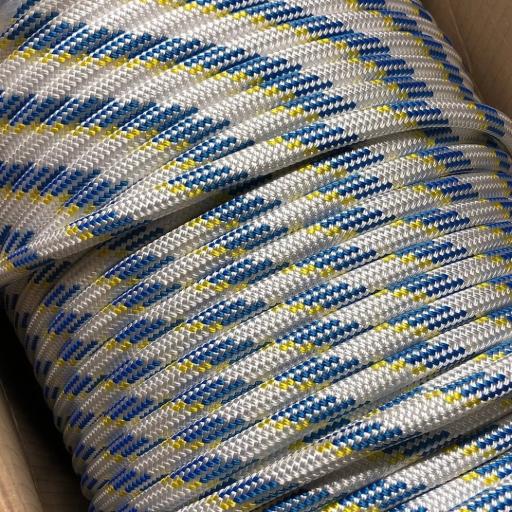
Ropes by the meter
Marine Rope Construction and Diameter Selection
Most modern sailing ropes are double braid ropes, balancing strength, handling and ease of splicing. Single braid ropes offer higher strength-to-weight ratios but are less forgiving and demand careful handling and termination.
Diameter choice is equally important. A thinner sailing rope may exceed the required strength, but if it falls outside the working range of existing winches or clutches, performance and safety are compromised. Rope diameter should always be matched to deck hardware as well as load requirements.
Different Sailing Lines, Different Priorities
Each type of sailing line onboard has distinct performance priorities:
- Halyards prioritise low stretch, creep resistance and heat tolerance
- Sheets require flexibility, grip and abrasion resistance
- Control lines balance handling comfort with controlled elongation
- Mooring and docking lines prioritise energy absorption and durability
This is why rope manufacturers structure sailing line ranges by application rather than offering a single universal solution.
Selecting Sailing Ropes in Practice
The most effective approach to choosing sailing ropes is application-led. Load levels, duty cycle, deck hardware and handling preferences should all inform material and construction choices.
For most yachts, a mixed specification is optimal: higher-performance sailing ropes where precision matters, paired with more forgiving constructions where comfort and durability are the priority.
Explore Our Range of Sailing Ropes
There is no single “best” sailing line — only the right rope for the job. Our Rope category includes a wide range of sailing lines and marine ropes, available by the metre, on full spools, or as custom spliced solutions built to specification.
If you have any questions about sailing ropes please feel free to contact us or explore our full range by clicking below:

 and then Add to Home Screen.

Sailing Lines: Choosing the Right Rope for the Marine Environment