
After a dismasting, the first question is always why. Usually the answer is pieced together from wreckage, memory and assumption. In this case there was something better: logged load data from a load cell sensor on the backstay.
When the Rimar 45RS Bloom lost her mast in the 2026 Brindisi–Corfu International Regatta, the conditions, the boat handling and the crew all pointed away from the usual explanations. Cyclops Marine has published the investigation, and it is one of the clearest real-world examples we have seen of what rig load data can tell you that inspection cannot. This case study summarises it, with credit to the Cyclops team for the original analysis, and looks at what load cell sensors can add to a rig.
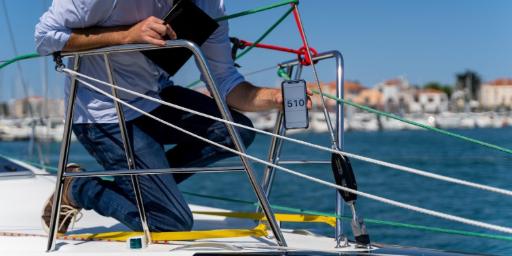
What Bloom's Load Data Showed
The boat and the conditions
Bloom is a Rimar 45RS. She dismasted around 70 nautical miles into the 2026 Brindisi–Corfu International Regatta, in conditions that were demanding but entirely normal for offshore racing.
| Parameter | Recorded |
|---|---|
| Maximum true wind speed | approx. 25 knots |
| Maximum boat speed | approx. 15 knots |
| Point of sail | Broad reach, waves on the quarter |
| Sail plan | Mainsail, A2 gennaker, staysail |
| Backstay load just before failure | approx. 1,600 kg |
| Backstay system working load limit | 9,000 kg |
The boat was balanced, heel was moderate and the helm was steady. The crew included sailors with Olympic campaign experience. Four were working the boat (helm, main trimmer, tailer and trimmer), four were on the windward rail, and two were below.
There was no warning. The crew heard a bang, and the mast fell to leeward.
What the load data ruled out
Without data, a dismasting like this tends to get a default explanation: the boat was pushed too hard. Bloom carried a Cyclops load cell sensor on the backstay, logging continuously, and that record allowed investigators to test the usual explanations one by one.
Overload
Just before the failure, the backstay was carrying about 1,600 kg — less than a fifth of the system's 9-tonne working load limit. Peak loads across the whole race stayed well below that limit. An overload or extreme-tension event would have shown up as loads approaching or exceeding it. The data showed nothing of the kind.
Mast pumping
Dynamic instability is a classic driver of fatigue, so investigators looked for it. The load trace showed no cyclic variation, video showed a stable backstay throughout the race, and the crew reported no history of pumping in this or earlier seasons.
Conditions and handling
Wind, sea state, speed and heel were all moderate, and the boat was under control.
With those ruled out, the investigation turned to the rig assembly itself: material fatigue, local stress concentrations, and whether any component was specified too close to its limits.
What Load Cell Sensors Can Tell You About Your Own Rig
Why this matters beyond Bloom
A component that fails under a moderate load, with no recorded overload, is a pattern consistent with damage that built up over time. Fatigue cracks grow below the working load, inside terminals, tangs, chainplates and mast fittings, often where no inspection can see them. The final load that breaks the part can be quite ordinary.
The Bloom data shows both the strength and the limit of a single load cell sensor. One backstay sensor was enough to prove the rig was not overloaded on the day. It could not show where the weakness was, or how it developed. Cyclops make the point that load cell sensors spread across the rig and logged over a longer period might have revealed subtle long-term trends — the kind of change that prompts an inspection before a failure, not after it.
What to watch for in logged data
In practice, that means watching for things like:
- a gradual loss of pre-tension in one stay that keeps returning after re-tuning
- port and starboard shrouds drifting apart at the same dockside settings
- a change in how load is shared between stays for the same wind and heel
None of these is visible to the eye. All of them show up in logged data.
Upgrade Season: Plan Your Load Cell Sensors This Winter
The best time to add load monitoring is when the boat is out of the water and the rig is being looked at anyway. Fit load cell sensors over the winter and you start next season with a measured baseline, not a guess.
What Bloom's new rig does differently
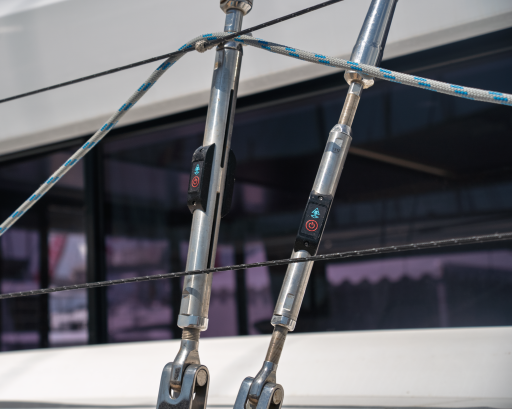
The team has taken the lesson into the replacement rig. The new carbon mast has an integrated mast jack for precise control of mast compression, and Cyclops smarttune load sensors on both cap shrouds, alongside the backstay sensor. Together they give continuous, real-time monitoring of standing rigging loads and how force is distributed through the rig.
The shift is the real story here. Load sensors started on grand-prix boats as tuning tools. On Bloom, the data first served as the evidence after a failure; on the new rig it becomes an early-warning system.
Where to start
The simplest starting point is the one Bloom's team chose for their new rig: the two cap shrouds. They carry the largest share of the rig's working load, so a pair of load cell sensors there gives the best overall gauge of total rig load. On most boats it is a direct swap: a Cyclops smarttune replaces the standard turnbuckle body, with no drilling or cabling. Forestay, backstay and running rigging can follow later, building into a full system logged through your instruments.
Next steps
See the full Cyclops Marine load cell sensor range at Upffront.
Talk to us. Not sure where to start or what size you need? Fill in our enquiry form with your boat and rig details, and we will help you put together the right monitoring system for your boat.

 and then Add to Home Screen.

Load Cell Sensors Case Study: What the Load Data Revealed About Bloom's Dismasting