
For racing and cruising sailboats up to around 45ft, a furling cable made from torsion rope is often a practical, cost-effective alternative to a factory-built custom cable. You buy the rope off the roll, add a furling thimble and a torsion clamp at each end, and you have a working furling cable for your code zero, gennaker or top-down furler. This guide covers how to choose the diameter, how much rope to order, which fittings to use and what to check on your furler before you start cutting.
If you are still deciding between rope and a custom cable, our article on torsional cable vs torsion rope explains the differences and where the boundary between them lies.
Planning a DIY Furling Cable
Torsion rope (also called anti torsion luff rope) is made on long spools in industry-standard diameters of 7, 9, 11, 13 and 15mm. There are several manufacturers, and from a technical point of view their ropes are quite similar. We stock Hampidjan DynIce torsional furling rope in all five diameters.
In practice, the rope itself is rarely what limits performance. What matters far more is choosing the right diameter for your length and furling system, and terminating each end properly.
Sizing Your Furling Cable: Diameter vs Length
A torsion rope works like a tube: it transmits twist from the drum to the swivel. The longer it is, the more it winds up before the top of the sail starts to turn, so longer cables need a larger diameter. How the cable is used matters too.
Top-down or bottom-up?
On a bottom-up furler (a code zero with the cable in a luff pocket), the sail luff starts carrying part of the torsional load from the first turn. On a top-down furler, the full twist has to travel the whole length of the cable, at higher speed, before the head of the sail rolls. For the same length, a top-down cable therefore needs a bigger diameter.
The rule of thumb from our specification guide is simple: for bottom-up, use the smallest diameter that suits your length; for top-down, use the largest. We do not recommend torsion rope above 16.5m luff length for top-down, or above 19m for bottom-up. Beyond those lengths, a custom cable is the better choice.
Diameter selection table
Approximate length ranges, read from our Kohlhoff torsional rope specification guide:
Rope Ø | Top-down luff length | Bottom-up luff length | Furling thimble | Fitting width | Pin Ø | Thimble SWL |
|---|---|---|---|---|---|---|
7mm | up to ~9.5m | up to ~12m | LOOP L-FT07 | 9mm | 8mm | 1,500kg |
9mm | ~9–12m | ~11–14.5m | LOOP L-FT09 | 10.5mm | 8mm | 1,500kg |
11mm | ~10.5–13.5m | ~12.5–16m | LOOP L-FT11 | 15mm | 8–10mm | 2,500kg |
13mm | ~12–15m | ~14–17.5m | LOOP L-FT13 | 16.5mm | 10–12mm | 5,000kg |
15mm | ~13.5–16.5m | ~15.5–19m | LOOP L-FT15 | 18.5mm | 12–14mm | 5,000kg |
Where ranges overlap, the top-down/bottom-up rule decides. For example, a 13m bottom-up cable could be 11mm or 13mm: choose 11mm. A 13m top-down cable could be 11mm or 13mm: choose 13mm.
Terminations: Where Furling Cable Performance Is Won or Lost
Each end of the rope is bent around a furling thimble and clamped back onto itself. A torsion rope is stiff, so getting a snug fit around the thimble takes care. A loose or poorly clamped end lets the rope move, and that movement is where twist is lost and where failures start.
Furling thimbles
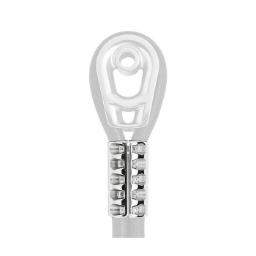
Furling thimbles give the rope a load-bearing eye that fits into the furler drum jaw and the top swivel. The LOOP Products thimbles in the table above are designed to fit as many furling units as possible, and each size is matched to one rope diameter.
Torsion clamps
Torsion clamps for your furling cable hold the doubled-back tail against the standing part of the rope. We stock clamps from Facnor, Ubi Maior and Karver; check the clamp's rope diameter range against your rope before ordering:
Rope Ø | Facnor FRC | Ubi Maior FRcp | Karver KRE |
|---|---|---|---|
9mm | FRC D09 | for 8–9mm | – |
11mm | FRC D11 | for 10–11mm | KRE1.5 (9–11mm) |
13mm | FRC D13 | for 12–13mm | KRE3.0 (11–13mm) |
15mm | FRC D15 | for 15–16mm | KRE4.5 (13–15mm) |
For 7mm rope, please contact us for clamp options.
Building Your Furling Cable Step by Step
The Four-Step DIY Process
Once you know your furling system and luff length, building the cable comes down to four steps.
Step 1: Select the diameter
Use the table above. Start from your luff length and furling configuration (top-down or bottom-up), and pick the diameter the rule gives you.
Step 2: Order your furling cable rope overlength
Each end needs enough tail to fold back around the thimble and sit inside the clamp. Order your finished length plus the overlap at both ends:
Rope Ø | Minimum overlap per end |
|---|---|
7mm | 350mm |
9mm | 450mm |
11mm | 550mm |
13mm | 650mm |
15mm | 750mm |
As a worked example, a 12m bottom-up cable in 11mm rope needs at least 12m + (2 × 0.55m) = 13.1m of rope. Our torsion rope by the metre is cut to the length you order.
Step 3: Add thimbles and clamps
You need one furling thimble and one torsion clamp for each end: two of each per cable. Use the thimble matched to your rope diameter and a clamp whose range covers it.
Step 4: Check furler compatibility
Before you order, check the thimble against your furler drum and swivel:
- Jaw width: if the furler jaw is 0.2–0.3mm wider than the thimble's fitting width, it will fit comfortably. It is common for the fitting to be 1–2mm narrower than the jaw.
- Pin diameter: if your furler pin is too big for the thimble, the cable will not fit. If the pin is too small, a bushing can take up the difference.
If the thimble does not fit your drum or swivel, go back to Step 1 and look at the next diameter that suits your length.
When a custom-finished furling cable makes more sense
If you would rather not terminate the rope yourself, we also supply custom-finished torsion rope, made up by our riggers to your length with thimbles fitted. And above 16.5m top-down or 19m bottom-up, a custom torsional cable is the right tool for the job.
Furling cable FAQ
Can I use torsion rope on a boat over 45ft? Our specification guide covers boats up to around 45ft. For a larger boat, send us your details before ordering and we will advise.
Does the brand of rope matter much? Less than you might think. Ropes from the main manufacturers are technically quite similar; diameter selection and the quality of the terminations have a bigger effect on how the furling cable performs.
Why does a top-down cable need a bigger diameter? The whole twist has to travel the length of the cable before the sail head starts to roll, so it needs more torsional stiffness than a bottom-up cable of the same length.
My furler pin is smaller than the thimble hole. Is that a problem? No. A bushing can take up the difference. A pin that is too large is the real problem.
Need a hand with your furling cable?
If you would like us to check your luff length, furler model and fittings before you order, send us an enquiry and one of our riggers will come back to you or click below to shop torsion rope, thimbles and clamps:

 and then Add to Home Screen.

DIY Furling Cable: How to Build Your Own from Torsion Rope