
When sailors discuss rope performance, the focus is often on strength and stretch. Breaking loads are compared, diameters are reduced, and low-stretch fibres such as Dyneema® are specified almost by default for high-load sailing ropes. Yet one of the most important long-term performance characteristics of modern sailing ropes is frequently misunderstood or overlooked entirely: creep.
For sailing yachts, particularly cruising boats that carry sustained rig loads for long periods, understanding the difference between strength, elastic stretch and creep is essential when selecting the right sailing rope for the job. This is especially true when distinguishing between adjustable running rigging and fixed-length structural applications.
This article examines creep and long-term elongation in sailing ropes, explains how it differs from normal stretch, and explores how different fibre families behave in real sailing systems.
Strength, Stretch and Creep: Three Distinct Properties
Although often grouped together, strength, stretch and creep describe fundamentally different sailing rope behaviours.
Strength is the maximum load a sailing rope can withstand before failure. In sailing, this is usually expressed as a breaking load, with working loads derived as a conservative fraction of that value.
Stretch refers to elastic elongation under load. This temporary extension largely recovers when the load is removed. Stretch contributes to shock absorption and influences handling comfort.
Creep is permanent elongation that occurs over time under sustained load. Unlike elastic stretch, creep does not recover when the load is released. Once a sailing rope has crept, its length has changed permanently.
In many sailing applications, creep is a more important long-term consideration than short-term stretch.
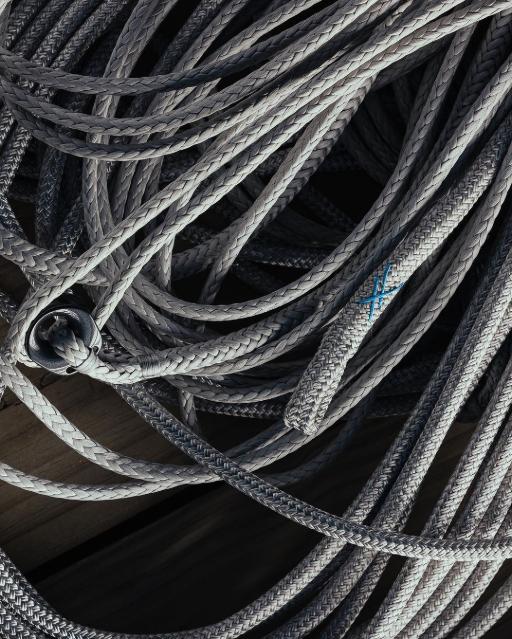
Single Braid Ropes
Polyester Sailing Ropes and Long-Term Dimensional Stability
For traditional fibres such as polyester, creep is effectively negligible at the load levels typically seen on sailing yachts. While polyester exhibits noticeable elastic stretch, it does not suffer from meaningful permanent elongation in service.
This predictable behaviour is one reason polyester remains widely used for sheets, control lines and mooring lines. Although it stretches more than high-modulus fibres, its length stability over time is reliable, and any elongation is almost entirely elastic rather than permanent.
Where Creep Matters Most in Sailing Rope Applications
Creep does not affect all sailing lines equally. Its practical importance depends largely on whether a sailing rope operates as part of a fixed-length system or an adjustable one.
In most running rigging applications — such as halyards, sheets and control lines — creep can usually be managed effectively. These systems are rarely fixed in length, include working tails, and are adjusted routinely during normal sailing. Small amounts of long-term elongation are typically accommodated through re-tensioning, and absolute length stability is not critical.
By contrast, creep becomes a defining factor in fixed-length applications, where dimensional stability is essential. Standing rigging elements, structural stays and permanently loaded lashings rely on consistent length to maintain rig geometry and load distribution. In these systems, even modest amounts of creep can accumulate into meaningful changes in rig tune over time.
| Fibre / Material | Typical Use in Sailing Ropes | Elastic Stretch | Long-Term Creep Resistance | Relative Creep Risk | Typical Applications | Technical Notes |
|---|---|---|---|---|---|---|
| Polyester (PET) | Sheets, control lines, mooring lines | High | Excellent | Very Low | Sheets, guys, dock lines | Negligible creep at yacht load levels; elongation is almost entirely elastic |
| Nylon (PA) | Dock lines, anchor rodes | Very High | Good | Low | Mooring, anchoring | High stretch masks creep; not used where length stability matters |
| Dyneema® SK75 (UHMWPE) | Older performance ropes | Very Low | Poor | High | Legacy halyards | Noticeable creep under sustained load; largely obsolete |
| Dyneema® SK78 (UHMWPE) | Modern cruising halyards | Very Low | Good | Moderate | Halyards, control lines | Creep significantly reduced vs SK75; still load-dependent |
| Dyneema® SK99 (UHMWPE) | High-performance racing ropes | Extremely Low | Good to Very Good | Low–Moderate | Performance halyards | Higher modulus; creep reduced but not eliminated |
| Dyneema® DM20 (UHMWPE) | Industrial & specialist rigging | Very Low | Excellent | Very Low | Lashings, specialist stays | Exceptional creep resistance; lower strength efficiency |
| Aramid (Kevlar®, Technora®) | Racing halyards, specialist rigging | Extremely Low | Excellent | Very Low | Halyards, runners | Near-zero creep; sensitive to UV and flex fatigue |
| PBO (Zylon®) | Grand-prix racing | Extremely Low | Near-Zero | Minimal | High-end racing rigging | Outstanding dimensional stability; short service life |
| Carbon fibre (rope constructions) | Experimental / specialist | Negligible | Near-Zero | Minimal | Research, niche systems | Very stiff; limited marine practicality |
Elastic Stretch vs Long-Term Elongation
A rope with noticeable elastic stretch may feel forgiving and comfortable in use, yet return to its original length once unloaded. Conversely, a low-stretch sailing rope may feel extremely stable under load while still suffering from slow, permanent elongation.
This distinction is particularly important with UHMWPE-based sailing ropes. Dyneema® ropes typically exhibit very low elastic stretch, which makes them feel exceptionally stable in use. However, depending on fibre grade and sustained load level, they may still experience creep.
Dyneema® Sailing Ropes: Fibre Grades and Creep Behaviour
Different Dyneema® grades exhibit different long-term elongation characteristics.
Dyneema® SK75 sailing rope offers high strength and low initial stretch but relatively poor creep resistance. Under sustained load, measurable permanent elongation can occur, making it unsuitable for permanently tensioned systems.
Dyneema® SK78 sailing rope represents a significant improvement in creep resistance and has become a common choice for cruising and performance halyards. Long-term elongation under constant load is substantially reduced compared to SK75.
Dyneema® SK99 sailing rope increases modulus and strength further, allowing smaller diameters for a given working load. While creep resistance is improved relative to SK78, the primary benefits are reduced diameter and increased stiffness rather than complete elimination of creep.
Dyneema® DM20 offers exceptionally low creep, even under continuous high load and elevated temperatures. However, this performance is achieved at the expense of strength efficiency. To reach equivalent working loads, larger diameters are required, which limits its suitability for most sailing hardware systems.
Standing Rigging: Where Creep Becomes the Limiting Factor
From a purely mechanical standpoint, UHMWPE fibres come close to being ideal for sailing applications: high strength, low weight, excellent fatigue resistance and very low elastic stretch. The primary limitation in standing rigging applications is creep.
Conventional cruising rigs rely on fixed-length stays with turnbuckles, where long-term dimensional stability is essential. Even small amounts of creep in a shroud or forestay will progressively alter mast tune, requiring repeated adjustment and potentially leading to uneven load sharing across the rig. For this reason, UHMWPE fibres — including Dyneema® — are generally unsuitable for fixed-length standing rigging in traditional turnbuckle-based systems.
That said, alternative rigging philosophies exist. Systems such as those promoted by Colligo Marine, using UHMWPE fibres like Dynex Dux, demonstrate how fibre-based standing rigging can be successfully implemented by abandoning conventional fixed-length assumptions.
In these systems:
- Rigging terminations are deliberately long, typically in the range of 750mm to 1500mm
- Length adjustment is achieved through lashings rather than threaded turnbuckles
- Periodic inspection and re-lashing are accepted as part of normal operation
This approach does not eliminate creep but manages it by design. The compromise is a shift away from set-and-forget rig tuning toward an actively adjustable system.
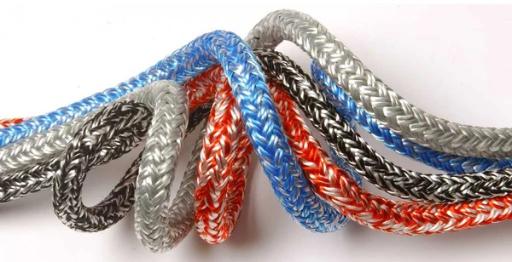
Double Braid Polyester Sailing Ropes
Aramids and PBO Sailing Ropes: Low Creep, Different Trade-Offs
Aramid fibres (such as Kevlar® and Technora®) and PBO fibres exhibit very low or near-zero creep, making them attractive where dimensional stability is paramount.
However, these fibres introduce other compromises:
- Reduced resistance to flex fatigue compared to UHMWPE
- Sensitivity to UV exposure, particularly in aramids
- Lower tolerance of shock loading
- More demanding handling and termination requirements
As a result, aramids and PBO are typically used selectively, most often in halyards or specialist rigging applications, rather than as general-purpose sailing ropes.
Managing Creep in High-Performance Sailing Rope Systems
Creep cannot be eliminated entirely in high-modulus sailing lines, but it can be managed effectively.
Practical strategies include:
- Selecting fibre grades appropriate to sustained load levels
- Avoiding unnecessary diameter reduction that increases working load percentage
- Matching rope diameter to realistic load cases rather than theoretical maxima
- Choosing covers that manage heat and clutch interaction
For many cruising yachts, Dyneema® SK78-based sailing ropes offer a balanced solution, combining low stretch, manageable creep and good durability. Higher-performance systems may justify SK99 or aramid-based constructions, with the understanding that inspection and maintenance become more critical.
Final Thoughts on Long-Term Elongation
Creep and long-term elongation are not abstract material science issues; they directly influence rig tune, sail shape and system reliability. Dyneema® comes close to being the ideal sailing fibre, but creep defines where and how it can be used.
Understanding the distinction between strength, elastic stretch and creep — and recognising the difference between adjustable running rigging and fixed-length structural applications — allows sailors to specify systems that remain stable in service rather than simply strong on day one.
If you have any questions about sailing ropes, please feel free to contact us or click below to see our full range:

 and then Add to Home Screen.

Creep and Long-Term Elongation in Sailing Ropes: Strength, Stretch and Stability Explained