Cam cleats
Our Cam Cleats category offers an extensive range of high-performance solutions, including fixed cam cleats, swiveling cam cleats, and cam cleat accessories. We feature top brands, ensuring reliability and precision for all sailing applications. Perfect for line control and adjustment, explore our wide selection for the best sailing performance. Read more...



Cam cleats are a core control component in modern sailing systems, providing fast, load-sensitive rope locking for a wide range of applications. Used extensively on dinghies, keelboats, and performance yachts, cam cleats are designed to securely grip lines while allowing instant release under load. This category includes composite and aluminium cam cleats, alongside fairleads, risers, and mounting solutions from leading manufacturers.
Cam cleats are widely used across sailing yachts to manage control lines where rapid adjustment and reliable holding are required. Typical applications include outhauls, cunninghams, vangs, traveller controls, and spinnaker systems. Their function is based on opposing spring-loaded cams with toothed profiles that grip the rope when tension is applied, while allowing controlled release by lifting the line upward.
Types of Cam Cleats
Several cam cleat configurations are available, each suited to specific installation and control requirements.
- Standard cam cleats or fixed cam cleats are the most common format, mounted directly onto flat surfaces and used where the lead angle is consistent and well controlled.
- Cam cleats with fairleads incorporate either wire or composite guides to retain the line within the cleat. These are particularly useful in dynamic trimming situations or where accidental release must be minimised, such as on dinghies or active racing setups.
- Swivel cam cleats are mounted on rotating bases, often combined with a ratchet block. This configuration allows the cleat to align automatically with the direction of load, improving ergonomics and maintaining consistent holding performance when trimming from multiple positions.
- Cam cleats with integrated becket provide a fixed point for terminating a control line, reducing the need for additional deck hardware and simplifying system layouts.
Cam Cleat Sizing and Rope Compatibility
Correct sizing is critical to ensure consistent holding performance without excessive rope wear. Each cam cleat is designed for a defined rope diameter range, typically between 3 mm and 12 mm depending on the model. Using undersized rope reduces contact area and holding power, while oversized rope can prevent proper engagement between the cams.
For modern low-stretch lines such as Dyneema cores with polyester covers, cam profile geometry and surface finish become particularly important. Aggressive tooth patterns improve grip but may increase cover wear under repeated cycling.
Load Capacity and Material Construction of Cam Cleats
Cam cleats are manufactured in either high-strength composite or hard-anodised aluminium. Composite cleats are lightweight and suitable for moderate load applications commonly found on dinghies and smaller keelboats. Aluminium cam cleats provide higher load capacity, improved heat resistance under dynamic loading, and greater durability in high-load or high-frequency adjustment systems.
Safe working load varies significantly by size and construction, and should always be matched to the expected line loads within the system rather than the breaking strength of the rope alone.
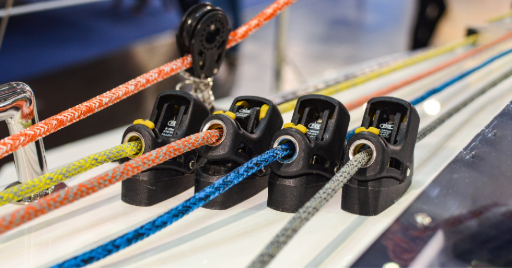
Spinlock Cam Cleats
Mounting Geometry and Lead Angle
Efficient cam cleat performance depends heavily on correct installation. The entry angle of the rope into the cleat directly affects both holding power and ease of release. For most applications, the line should enter the cleat at a shallow upward angle, typically achieved using risers or angled wedges.
Incorrect alignment is a common cause of line slippage or unintended release. Where control lines are adjusted from variable positions, swivel bases allow the cleat to self-align with the load direction, improving consistency and ergonomics.
Cam Cleat Accessories and Configurations
Cam cleats are frequently paired with fairleads to guide the rope into the correct engagement angle and prevent accidental disengagement. Wire fairleads provide minimal obstruction and are often preferred in racing applications, while composite fairleads offer additional line control and containment.
Other configurations include cam cleats with integrated beckets for dead-ending control lines, as well as combined systems with ratchet blocks for higher load management.
Performance Considerations and Maintenance
Over time, cam cleat performance can degrade due to worn teeth, reduced spring tension, or contamination from salt and debris. Regular inspection and rinsing with fresh water helps maintain consistent operation. Springs and cams are serviceable on many models, extending operational life.
Leading manufacturers such as Harken, Ronstan, Spinlock, and Allen offer a wide range of cam cleats engineered for specific load ranges and sailing disciplines, allowing precise specification based on application requirements.
Final Considerations on Cam Cleats
Our extensive range of cam cleats and accessories from leading manufacturers ensures that sailors have the best possible solutions for line control. When selecting your cam cleat, consider both the rope diameter and load requirements, and don't overlook the importance of accessories like fairleads and wedges to fine-tune your setup for maximum efficiency.

To install this Web App in your iPhone/iPad press
 and then Add to Home Screen.
