Anchor lines
Anchor lines are the rope part of the anchor rode, between the chain at the anchor and the boat. They are lighter than chain, easier to stow and absorb shock loads as the boat surges. We stock 1852 anchor lines in braided polyester, 40 m long with a spliced stainless thimble, in 10, 12 and 14 mm. Choose the diameter by boat length and displacement. Read more...
-
Boat fenders
-
Fender covers
-
Boat anchors
-
Mooring lines
-
Anchor accessories
-
Rope fender lines
-
Anchor lines
|
|
|
|
  |
 |
What anchor lines do in the rode
The rode is everything between the anchor and the boat: chain, rope and the shackles that join them. Chain at the anchor end adds weight that keeps the pull on the anchor low and horizontal, and it resists chafe on the seabed. Anchor lines make up the rest. They weigh far less than chain, which matters in the bow of a small or performance yacht, and they stretch, so the boat's surges in a gust or swell are cushioned before they reach the anchor. Chain has almost no stretch and passes those shocks straight on, which can jerk an anchor free.
Anchor rope and chain, or all chain?
Many cruisers choose all-chain rodes for chafe resistance; racers keep chain to a minimum to save weight. Most yachts are best served somewhere between, with a length of chain at the anchor and an anchor line behind it. The trade-off is scope: Upffront's rule of thumb, in our post on the ratio of anchor line to chain, is 8 m of rope-and-chain rode for every metre of depth, against 4 m for all chain. In deep water that gets long, so the same post gives an alternative of 15 m + 4 × depth for a rope-and-chain rode.
Choosing anchor lines by diameter
Size the line by the boat's length and displacement. Our guide, based on LIROS's recommendations and our own experience, pairs these diameters with chain sizes:
| Yacht length | Displacement | Chain | Anchor line |
|---|---|---|---|
| under 6 m (20 ft) | 1 t | 6 mm | 10 mm |
| 6–8 m (20–26 ft) | 2.5 t | 7–8 mm | 12 mm |
| 8–10 m (26–33 ft) | 5 t | 8 mm | 14 mm |
Larger yachts need 16 mm and above. If the boat is heavy for its length, or often anchors in exposed places, go up one size: a thicker line is also easier to grip when hauling by hand.
Polyester or nylon anchor lines?
Both are used, and their breaking strengths are similar. Nylon stretches more: Practical Sailor gives 3 to 4% at 10 to 12% of breaking strength, against about 1 to 2% for polyester. Polyester resists chafe two to four times better and UV nearly twice as well. Our 1852 anchor lines are polyester with a braided sheath. With less stretch, make sure there is enough line out to absorb shocks, or add a nylon snubber in shallow water.
Length and scope
Our anchor lines are 40 m long. Add the chain to find the total rode, then check it against the depths you anchor in: 40 m of line plus 20 m of chain gives 60 m, enough for about 7 m of water at 8:1. For deeper anchorages, add chain or choose a longer line. Mark the rode every 5 or 10 m so you know how much is out.
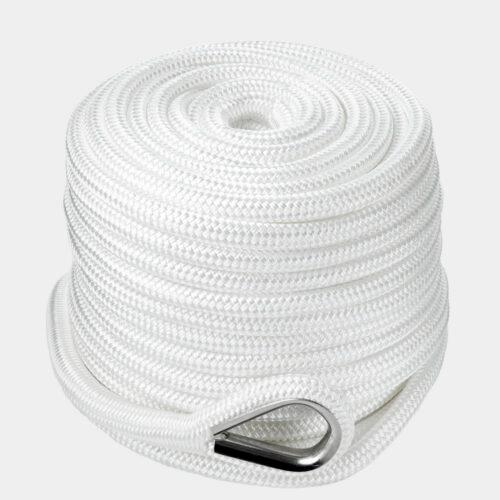
1852 anchor line with spliced stainless thimble
Connecting the anchor line to the chain
The spliced stainless thimble protects the eye from wear where it meets the shackle. Join it to the chain with a shackle sized for the chain, and secure the pin with seizing wire or a cable tie. Swivels and connectors are in our anchor accessories. If the line has to run through a windlass, a thimble and shackle will not pass the gypsy: that needs a rope-to-chain splice and a gypsy made for rope and chain.
Care of anchor lines
Rinse the line in fresh water when you can and let it dry before stowing, so the locker does not stay wet. Check the eye, the splice and the part that runs over the bow roller for chafe each season. For the chain end of the rode, read our guide on choosing the right anchor chain.
Anchor lines FAQ
How much anchor line do I need?
Enough, with the chain, for at least 8 times the depth you anchor in, or 15 m plus 4 times the depth. For a boat that anchors in 5 m, that means at least 40 m of rode.
Do I need chain with an anchor line?
Yes. A length of chain at the anchor adds weight, keeps the pull low and resists seabed chafe, which rope alone does not.
Does an anchor line float?
No. Polyester is denser than seawater (about 1.23–1.38 g/cm³ against 1.03), so the line sinks to the seabed with the chain.
Can I splice my own thimble?
Braided lines can be spliced with the right fid, but the 1852 lines come with the thimble already spliced in, ready to shackle to the chain.

To install this Web App in your iPhone/iPad press
 and then Add to Home Screen.
