Trogear
Trogear SAS, founded in 2015 by development engineer Henry Dokonal, specializes in the design and manufacture of adjustable carbon fiber bowsprits for sailing yachts. The company's inception traces back to 2012 when Dokonal, an avid sailor with extensive short-handed racing experience, sought to enhance his own sailing performance. Drawing inspiration from high-speed ocean racing sailboats, he developed a unique triangular bowsprit design that could rotate upwards from a hinge mount, prioritizing safety and sail adjustability. Read more below...
|
|
|
|
|
|
|
|
|
|
|
|
|
|
|
Trogear Adjustable Carbon Bowsprits
Trogear designs adjustable carbon bowsprits for yachts using Code 0 sails, asymmetric spinnakers and other free-flying reaching sails. The range is aimed at owners who need a strong forward tack point without permanently modifying the deck layout more than necessary. Trogear bowsprits are especially relevant for retrofit installations where clearance around the pulpit, forestay, anchor roller and bow fittings is limited.
Trogear bowsprits for Code 0 and asymmetric sail handling
A modern Code 0 or asymmetric spinnaker normally needs a tack point positioned forward of the forestay. This improves sail projection, reduces interference with the pulpit and helps the sail rotate cleanly during gybes. On many production yachts, however, the bow was not originally designed with a dedicated bowsprit or furling tack point. This is where a Trogear bowsprit becomes a practical technical solution.
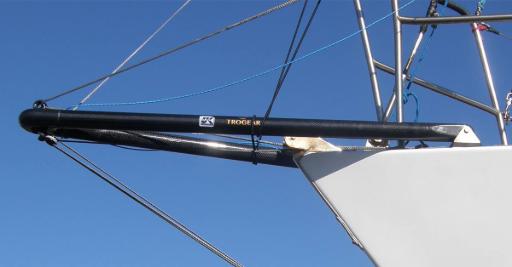
Trogear adjustable carbon bowsprits use a hinged A-frame structure rather than a simple straight pole. The bowsprit can be lowered for sailing, raised for attaching or removing the sail, and stowed upright when not in use. This is particularly useful for short-handed sailors, cruising yachts and retrofit installations where a permanent fixed sprit may not be desirable.
The Trogear range is designed for yachts from approximately 20 to 70 ft, covering smaller performance cruisers through to larger monohulls and multihulls. Model choice depends on boat length, displacement, sail area, expected tack load, installation method and how the yacht is used. Trogear and Upffront list models including AS-25, AS-30R, AS-40, AS-50, ATLAS and MAXI versions.
How a Trogear adjustable bowsprit works
The key feature of a Trogear adjustable bowsprit is the combination of a carbon A-frame, hinge mounting and bobstay support. The bowsprit projects the tack point forward of the bow, while the bobstay transfers vertical and forward load back into the bow structure. This is important because Code 0 and asymmetric spinnaker loads can become high, particularly when reaching or when the sail is shock-loaded.
Unlike a conventional retractable aluminium pole, the Trogear system is not simply pushed in and out through deck-mounted rings. Instead, the hinged geometry allows the sprit to pivot. This makes it possible to raise the bowsprit for sail attachment, furling preparation or dockside stowage. Depending on the installation, the luff tension can also be adjusted from the cockpit via the bobstay control line. Trogear’s own rigging guidance notes that an adjustable setup can be used to control luff tension or bring the bowsprit upright for stowage and sail handling.
This makes Trogear relevant not only for racing boats, but also for cruising owners who want to fly a Code 0 or asymmetric sail with less time spent working on the foredeck.
Choosing the right Trogear bowsprit model
Selecting the correct Trogear carbon bowsprit should not be based only on boat length. Boat weight, sail area, bow structure and intended use all matter. A light 35 ft performance yacht and a heavy 35 ft cruising yacht may need different approaches, especially if the sail area or apparent wind angles are different.
As a general guide, Trogear models are commonly positioned as follows:
| Trogear model | Typical boat size guide | Typical application |
|---|---|---|
| Trogear AS-25 | Up to approx. 25 ft / 8 m | Smaller yachts using compact Code 0 or asymmetric sails |
| Trogear AS-30R | Up to approx. 35 ft / 11 m | Shorter-extension retrofit installations |
| Trogear AS-40 | Up to approx. 35 ft / 11 m | Longer extension than AS-30R for improved sail clearance |
| Trogear AS-50 | Up to approx. 45–50 ft depending on configuration | Larger cruising and performance yachts |
| Trogear ATLAS | Up to approx. 50 ft | Higher-load installations and larger sail plans |
| Trogear MAXI | Up to approx. 70 ft | Large yachts with significant Code 0 or asymmetric loads |
Trogear’s published comparison data includes model differences in length, weight, extension past the bow and working load, so these values should be checked against the yacht and sail plan before ordering.
Trogear installation options
A major reason sailors search for Trogear is installation flexibility. A retrofit bowsprit has to work around real-world bow layouts: anchor rollers, stemhead fittings, pulpits, forestays, furlers, navigation lights and sometimes limited access inside the bow.
Trogear’s standard through-hull installation uses a hinge tube and shaft arrangement, but other mounting approaches may be used depending on the yacht. Common installation considerations include:
- available bow structure for the hinge and bobstay attachment;
- clearance around the anchor roller and pulpit;
- whether the bowsprit needs to be removable;
- internal access for backing plates, tubes or fasteners;
- bobstay angle and attachment point;
- tack height relative to the furler and sail geometry.
Trogear’s installation documentation states that different boats may require different installation modifications and recommends consulting a rigger if there is any doubt. This is sensible advice: the bowsprit itself is only one part of the system. The surrounding laminate, fittings, bobstay hardware and load paths must be suitable for the loads involved.
Bobstay rigging and load considerations
The bobstay is one of the most important parts of a Trogear bowsprit installation. It is not a secondary accessory. It is a primary structural element that supports the sprit under sail load.
Trogear’s rigging guidance notes that bobstay load is generally around 1.5 times the tack load, and that components should be sized with an appropriate safety factor. This matters because Code 0 sails can generate high luff tension, while asymmetric spinnakers can create dynamic loads when reaching, collapsing, refilling or sailing in waves.
A well-designed bobstay setup should consider:
- Dyneema or equivalent low-stretch rope selection;
- bobstay angle relative to the bowsprit;
- chafe protection at the bow and tack point;
- correct attachment to a structurally sound bow fitting;
- suitable blocks, low-friction rings or purchase system;
- whether the bobstay will be fixed or adjustable;
- safe handling under load.
For adjustable systems, the control line may be led aft so the crew can tension the luff or raise the sprit without working directly at the bow. This can improve sail handling, but it also increases the need for careful clutch, jammer and line selection.
Trogear for cruising, racing and short-handed sailing
A Trogear adjustable bowsprit can be useful for different types of sailors, but for different reasons.
For cruising sailors, the key benefit is easier handling of Code 0 and asymmetric sails. The bowsprit provides a dedicated forward tack point and can help keep the sail clear of the pulpit and anchor gear. The ability to raise the bowsprit for attaching the furler or tack line can also make handling more manageable, especially with a small crew.
For racing sailors, the appeal is more about geometry, stiffness and clean sail projection. A forward tack point can improve reaching sail shape and separation from the mainsail and forestay. The carbon construction helps keep weight forward to a minimum compared with heavier metal structures, although the full system weight depends on mounting hardware and bobstay setup.
For short-handed sailing, the combination of cockpit-adjustable luff tension, raised stowage and reduced foredeck work can be especially relevant. It does not remove the need for good sail handling technique, but it can make a Code 0 or asymmetric sail system more manageable.
Trogear vs fixed or retractable bowsprits
A fixed bowsprit is simple and structurally direct, but it is always exposed and may interfere with berthing, anchoring or marina space. A retractable pole can be compact and familiar, but it requires deck space, support rings and a clear path for the tube. A Trogear adjustable bowsprit sits between these approaches. It provides a forward tack point but can be raised or removed depending on installation.
This makes Trogear particularly suitable where the owner wants a retrofit bowsprit for Code 0 or asymmetric sailing but does not want a long permanent projection from the bow.
Complete your Trogear installation
A Trogear bowsprit is normally part of a wider sail-handling system. For a complete setup, consider related hardware such as Code 0 furlers, asymmetric spinnaker furlers, bobstay rope, Dyneema control lines, low-friction rings, soft shackles, padeyes, rope clutches, deck organisers and tack-line blocks. The correct combination will depend on the yacht, sail area and whether the installation is fixed, removable or cockpit-adjustable.
Trogear FAQ
What is a Trogear bowsprit used for?
A Trogear bowsprit provides a forward tack point for sails such as Code 0s and asymmetric spinnakers. It helps position the sail ahead of the forestay, pulpit and bow fittings.
Can I use a Trogear bowsprit with a Code 0?
Yes, Trogear bowsprits are commonly used with Code 0 furling systems. The correct model and bobstay setup must be selected according to sail area, tack load and boat size.
Can I use Trogear with an asymmetric spinnaker?
Yes. Trogear adjustable bowsprits are designed for asymmetric spinnakers as well as Code 0 sails. The bowsprit helps project the tack forward for cleaner sail handling.
Does a Trogear bowsprit need a bobstay?
In most practical sailing installations, yes. The bobstay supports the bowsprit under vertical and forward load. The bobstay hardware must be correctly specified for the expected tack load.
Can a Trogear bowsprit be installed on any yacht?
Not automatically. Suitability depends on bow shape, structure, anchor gear, pulpit clearance, boat size and sail loads. Measurement and installation planning are important before selecting the model.
Is Trogear suitable for cruising yachts?
Yes. Trogear is often relevant for cruising yachts that want to add a Code 0 or asymmetric sail without installing a permanent fixed bowsprit. It is also useful where short-handed sail handling is a priority.
Is Trogear suitable for multihulls?
Trogear systems are used on both monohulls and multihulls, but model selection should consider righting moment, sail area and higher potential loads. Multihull installations should be checked carefully.
What maintenance does a Trogear carbon bowsprit need?
Regular inspection is important. Check the carbon structure, hinge hardware, bobstay, fittings, fasteners and control lines for wear, chafe, movement, corrosion or impact damage before sailing.

To install this Web App in your iPhone/iPad press
 and then Add to Home Screen.
