LOOS & CO.
A Loos tension gauge measures the tension in a shroud or stay by deflecting the wire against a calibrated spring, so rig settings can be set, recorded and repeated. Choose by rigging type and diameter: the Professional PT1M, PT2M and PT3M cover 2.5 to 10 mm 1x19 wire, the RT10M and RT11M cover 4.4 to 9.5 mm rod, and two basic gauges cover small-boat wire. Read more below.
|
|
|
|
|
|
|
|
|
Loos tension gauges: measuring standing rigging tension
Turnbuckle turns and feel do not give repeatable rig tension: a gauge does. A Loos gauge hooks onto the wire between two spools, a spring-loaded slider deflects it, and the pointer position is read off a scale. A calibration table on the gauge converts the reading into load. You can leave the gauge on the wire while you adjust the turnbuckle, so you see the change as you make it.
Loos & Co. calibrates its wire gauges for 302/304 stainless 1x19 wire. On other wire constructions or materials the reading is still repeatable, but the load printed on the label no longer applies. That matters if you use the gauge to compare settings, not just to repeat them.
Choosing a Loos tension gauge: wire or rod, basic or Professional
Choose first by rigging type, then by diameter. Each gauge covers a set of diameters, so one gauge often covers all the shrouds and stays on a boat, but not always.
| Gauge | Rigging | Diameters |
|---|---|---|
| PT1M (Professional) | 1x19 wire | 2.5, 3, 4 mm |
| PT2M (Professional) | 1x19 wire | 5, 6, 7 mm |
| PT3M (Professional) | 1x19 wire | 7, 8, 9, 10 mm |
| RT10M | Rod | 4.4, 5, 5.7, 6.3, 7.1 mm |
| RT11M | Rod | 7.1, 8.4, 9.5 mm |
| Basic gauge 2.5–4 mm | 1x19 wire | 2.5–4 mm |
| Basic gauge 5–7 mm | 1x19 wire | 5–7 mm |
Professional Loos tension gauge: PT1M, PT2M and PT3M
The Professional gauges are the ones for cruising and racing yachts. Loos rates each one across roughly 5% to 25% of the wire's breaking strength, with an accuracy of ±3% at mid-range. Pick by your largest and smallest wire: a boat with 6 mm shrouds and a 7 mm forestay is covered by the PT2M; one with 7 mm and 8 mm wire needs the PT3M. Loos also publishes a conversion chart, so one-design class settings given for its basic gauges can be set with a Professional gauge.
Rod rigging gauges: RT10M and RT11M
Rod is stiffer than wire, so it needs its own gauge and its own calibration. The RT10M covers rod from 4.4 to 7.1 mm and the RT11M from 7.1 to 9.5 mm; at 7.1 mm either will do. Rod gauges are heavier and take more effort to engage than the wire gauges. Do not use a wire gauge on rod, or a rod gauge on wire: the readings will not match the table.
Basic gauges for small boats and one-design classes
The two basic gauges, for 2.5–4 mm and 5–7 mm wire, work on the same principle in a simpler anodised aluminium body. Loos quotes ±5% accuracy for its standard gauges. They suit dinghies, sportboats and one-design keelboats, where class tuning guides often give settings as a reading on a Loos gauge rather than as a load.
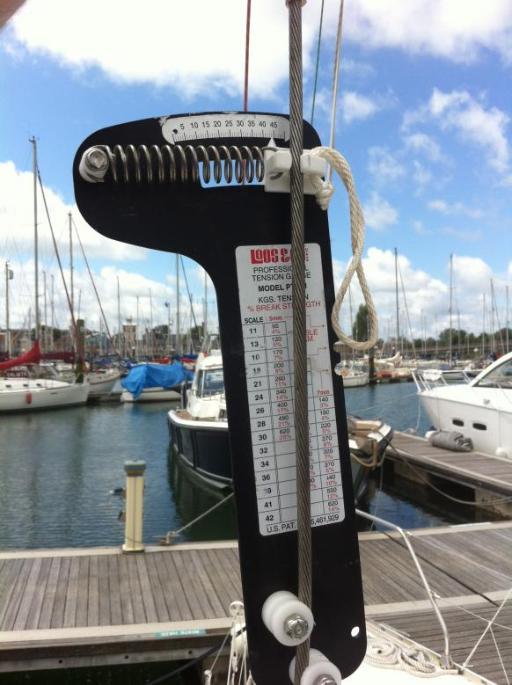
Loos Professional tension gauge on a shroud
Using a Loos tension gauge: how tight is right?
Loos gives starting points as a percentage of the wire's breaking strength. On a masthead rig, the forestay is set as tight as the structure allows, generally about 15%, and the shrouds about 10–12%, so that the leeward shrouds stay taut close-hauled in a breeze. A fractional forestay needs at least 15%, eased off if the mast bends too much. Rigs with swept-back spreaders may need about 20% in the shrouds. Never go above 25%: excess tension permanently stretches wire and loads the mast and chainplates. Your mast maker's or class figures take priority over these. Record the readings once the rig is set, so you can return to them after unstepping or re-rigging.
Care of the gauge
Rinse after use in salt water and keep the slider slot free of grit; Loos recommends a silicone lubricant. The nylon spools can develop flat spots with use: rotating them by 45° restores a true reading. A gauge calibrated at mid-range may not read zero at rest, and that is normal.
About Loos & Co.
Loos & Co. was founded in 1958 by A. W. "Gus" Loos and manufactures wire, aircraft cable and wire rope in Pomfret, Connecticut, for aerospace, military and commercial use. It is part of the Central Wire group. For a wider look at why a gauge is worth having, read our blog post Why every serious sailor needs a rig tension gauge. To monitor loads while sailing rather than set them at the dock, see digital load cells.
Loos tension gauge FAQ
Which Loos tension gauge do I need?
Start with your rigging type and diameters. For 1x19 wire: PT1M for 2.5–4 mm, PT2M for 5–7 mm, PT3M for 7–10 mm. For rod: RT10M for 4.4–7.1 mm, RT11M for 7.1–9.5 mm.
Can I use a Loos gauge on Dyneema or other synthetic standing rigging?
The gauge gives a repeatable reading, but the label table is calibrated for 302/304 stainless 1x19 wire, so the load shown will not be correct.
What is the Loos gauge conversion chart?
A table from Loos that converts settings given for its basic Model A and B gauges into readings on the Professional PT1, PT2 and PT3, used mainly for one-design class tuning guides.
How accurate is a Loos tension gauge?
Loos gives ±3% at mid-range for the Professional PT gauges and ±5% for its standard gauges. Repeatability, setting the rig the same way each time, matters more than the absolute figure.
What is the difference between a Loos gauge and a digital load cell?
A Loos gauge is a mechanical tool for setting rig tension at the dock. A load cell stays in the rig and shows loads while sailing.

To install this Web App in your iPhone/iPad press
 and then Add to Home Screen.
