Ewincher
Ewincher electric winch handles provide powered winch assistance for sailing yachts without converting existing winches or modifying the deck layout. Designed for halyard hoists, sail trimming, furling assistance and short-handed manoeuvres, Ewincher combines electric, manual and combined operating modes in a portable winch handle format. For owners looking to reduce physical effort while retaining control at the winch, Ewincher is a practical alternative to fixed electric winch conversion. Read more below...
|
|
|
|
|
|
|
Ewincher electric winch handles for sailing yachts
Ewincher is designed for sailors who want electric assistance at the winch without installing fixed electric winches. Instead of replacing the existing winch system, the electric winch handle fits into the winch socket and can be moved between winches as required. This makes it particularly relevant for cruising yachts, short-handed crews, older owners, and boats where deck structure, space below the winch, wiring routes or battery capacity make a full electric winch conversion more complex.
The main advantage of an Ewincher electric winch handle is flexibility. One handle can assist with several onboard operations, including hoisting the mainsail, tensioning halyards, trimming genoa or Code Zero sheets, furling under controlled load, and assisting with mast work where correct safety procedures are followed. It does not replace good line handling or correct winch technique, but it reduces the physical work required during high-load or repetitive manoeuvres.
Ewincher SE vs Ewincher 2
The Ewincher range includes Ewincher SE and Ewincher 2. Both models are listed with 90 Nm maximum torque, 2.2 kg weight, IPX6 water resistance and three operating modes: electric, manual and combined. The main technical differences are speed and included accessories. Ewincher SE is listed at 83 rpm unloaded, while Ewincher 2 is listed at 110 rpm unloaded and includes additional equipment such as the winch handle pocket, 12V inverter, charging station, security leash and carrying case.
For owners looking for a lower-cost powered handle, Ewincher SE covers the core function. For those wanting a more complete onboard package, faster unloaded speed and more accessories included from the start, Ewincher 2 is the more comprehensive option.
Power, control and safe winch operation
Winch loads can increase quickly when hoisting sails, tensioning halyards or trimming under pressure. Ewincher’s maximum torque rating of 90 Nm gives useful powered assistance, but the key technical benefit is controlled delivery rather than raw power alone. The handle can be used in electric mode for maximum assistance, manual mode for fine adjustment, or combined mode where electric assistance and manual input are used together.
Ewincher also includes a torque limiter, configurable via smartphone. This is useful for reducing the risk of excessive force during manoeuvres, although it should not be treated as a calibrated rope-load measuring device. The actual line load will always depend on the winch size, gearing, rope lead, friction in the system and the sail or hardware being loaded. Correct operator judgement remains important, especially when a sail reaches full hoist or a line stops moving unexpectedly.
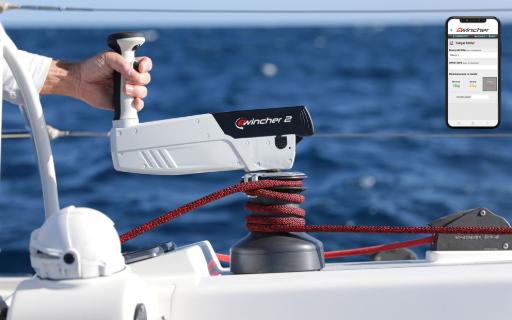
Ewincher 2
Battery, charging and onboard use
Unlike a fixed electric winch, Ewincher uses its own removable lithium-ion battery. This reduces the need to draw high current directly from the yacht’s service battery bank during each winching operation. Ewincher states that the battery is intended for at least one day of navigation, with winter storage requiring the battery to be fully charged and kept dry.
For day sailing and coastal cruising, one battery may be enough for typical use. For larger yachts, frequent short-handed manoeuvring, offshore sailing or repeated high-load hoists, a spare battery can be a sensible option. Battery planning should be based on real onboard usage: number of hoists, tacks, furling operations, sail size and whether the handle is also being used for mast climbing support.
Ewincher vs electric winches and drill-based alternatives
An electric winch conversion gives permanent push-button operation at a specific winch station, but it normally requires installation work, wiring, circuit protection and space below deck for the motor. Ewincher takes a different approach: it provides portable electric assistance through the existing winch socket and can be used across multiple winches.
Compared with drill-based winch adapters, Ewincher is a purpose-designed marine winch handle system. The more relevant comparison points are ergonomics, locking into the winch, water resistance, torque control, battery management and the ability to operate manually when required. For technically minded owners, the decision is less about “power” alone and more about how the system behaves under load, how easily it can be controlled, and how it fits into the existing deck layout.
Common Ewincher questions
Is Ewincher an electric winch?
No. Ewincher is an electric winch handle used with existing sailing winches.
Does Ewincher require installation?
No fixed installation is required for the handle itself, making it suitable for boats where electric winch conversion is impractical or unnecessary.
Is Ewincher waterproof?
Ewincher is listed with IPX6 water resistance, suitable for spray and rain exposure, but it should not be treated as a submersible device.
Can Ewincher be used for halyards and sail trimming?
Yes. Typical uses include mainsail hoists, halyards, sheet trimming, furling assistance and other winch-driven manoeuvres, provided the winch, rope system and deck hardware are correctly specified for the load.
Which Ewincher model should I choose?
Choose Ewincher SE for the essential electric winch handle function. Choose Ewincher 2 if you want the faster unloaded speed and a more complete accessory package included from the start.

To install this Web App in your iPhone/iPad press
 and then Add to Home Screen.
