
Choosing a sailing life jacket used to be relatively straightforward. You picked a buoyancy rating, decided whether you wanted a harness, and bought something that fitted reasonably well.
Modern offshore lifejackets are rather more sophisticated.
Sprayhoods, AIS beacons, integrated lights, hydrostatic inflators and harness release systems have transformed what was once a fairly simple piece of safety equipment into something that deserves more careful thought. At the same time, the Spinlock Deckvest range has evolved into a much clearer family of sailing life jackets than it was a few years ago.
Today, the leisure sailing range centres around five key models: the Deckvest LITE, LITE+, 6D, 6D HRS and VITO AFS. Alongside them sit the NEMO, NEMO+ and CENTO junior ranges for younger sailors.
The challenge is no longer simply understanding what each product does. The challenge is deciding how much life jacket you actually need for the way you sail.
Choosing Sailing Life Jackets for Different Crew and Conditions
Junior Sailing Life Jackets: NEMO, NEMO+ and CENTO
For families introducing children to sailing, the choice is refreshingly simple.
The NEMO and NEMO+ are inherently buoyant lifejackets designed specifically for younger children. Unlike inflatable life jackets, they provide flotation immediately and continuously. Their buoyancy and collar design are intended to turn a child face-up in the water and support their head, even if they are not strong swimmers.
For many parents, the NEMO+ is particularly appealing because it incorporates a harness attachment system and lifting handle. The harness attachment is positioned on the back of the jacket, helping to keep clips away from small hands whilst still allowing children to be safely secured aboard.
As children become older and more independent, the Spinlock CENTO sailing life jacket takes a different approach. Designed for sailors between approximately 20kg and 50kg, it introduces the lower bulk and greater freedom of movement of an inflatable lifejacket whilst retaining the key safety features expected for junior sailors.
For most sailing families, the transition is natural: NEMO or NEMO+ for younger children, followed by CENTO as they grow into more active sailing roles.
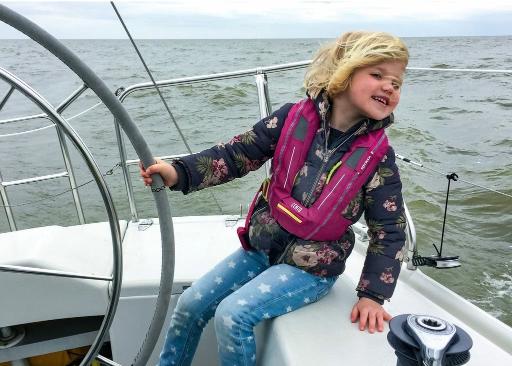
Spinlock Cento junior life jacket
Coastal Sailing Life Jackets: When Simplicity Is Enough
For adults, the journey begins with the Deckvest LITE sailing life jacket.
There is a tendency amongst sailors to assume that the most expensive sailing life jacket must automatically be the safest choice. In reality, the most appropriate lifejacket is often the one you are happy to wear all day.
That is precisely where the LITE makes sense.
It is compact, lightweight and unobtrusive enough that many owners simply forget they are wearing it. Whether you spend your weekends coastal cruising, racing around the cans, fishing, kayaking or driving a RIB, the LITE delivers the essential purpose of a sailing life jacket without adding unnecessary bulk.
This does not make it a basic product. It simply reflects a different philosophy. Rather than being designed around offshore contingencies that many sailors may never encounter, the LITE focuses on comfort, simplicity and everyday wearability.
For many coastal sailors, that is exactly the right answer.
Sailing Life Jackets with Harnesses: When Clipping On Matters
The conversation changes the moment sailors start clipping on.
A lifejacket helps after something has gone wrong.
A safety harness is intended to stop it going wrong in the first place.
That distinction is why the Deckvest LITE+ sailing life jacket occupies such an important position within the range. It retains the same low-profile design as the standard LITE but incorporates an integrated deck harness, allowing the use of jackstays and safety lines when conditions demand it.
For some sailors, clipping on is something reserved for rough weather or night passages. For others, it is routine whenever they leave the cockpit.
Either way, once safety lines become part of your sailing routine, the LITE+ starts to make a great deal of sense.
It is perhaps one of the easiest Deckvest models to recommend because it bridges the gap between casual coastal sailing and more ambitious cruising without forcing the wearer into a fully-featured offshore lifejacket.
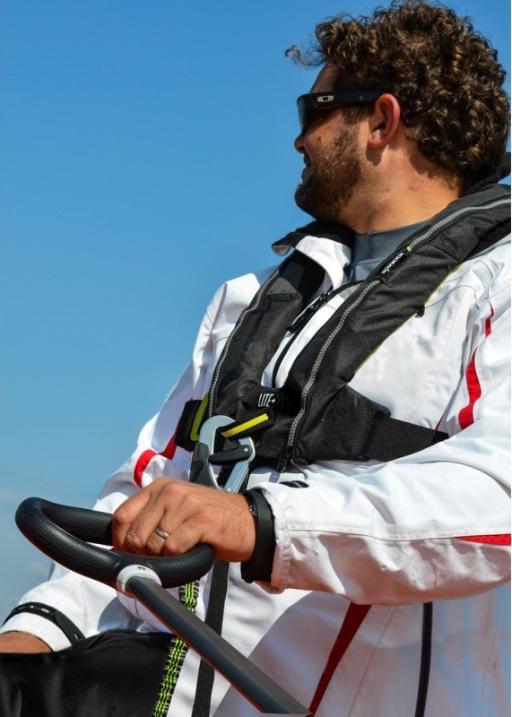
Spinlock Deckvest LITE+ sailing life jacket
Offshore Sailing Life Jackets: When the Safety Equation Changes
The step from a LITE+ to a Deckvest 6D sailing life jackets is not really about additional features.
It is about changing priorities.
As passages become longer and conditions become more demanding, flotation alone becomes only one part of the safety equation. Visibility, location and survival in the water become equally important considerations.
That is why the Spinlock Deckvest 6D sailing life jacket comes equipped with features such as an integrated sprayhood, lifejacket light and bladder illumination system. These are not additions designed simply to look impressive in a brochure. They address real challenges faced during offshore recoveries, particularly at night or in poor weather.
The sprayhood helps reduce the inhalation of spray and breaking waves. The lights make a casualty significantly easier to locate in darkness. The overall design is intended for sailors who may spend days at a time wearing their lifejacket continuously.
This is why the 6D has become a common sight amongst offshore cruisers, race crews and passage makers. It is not necessarily more comfortable than a LITE. It is simply optimised for a different environment.
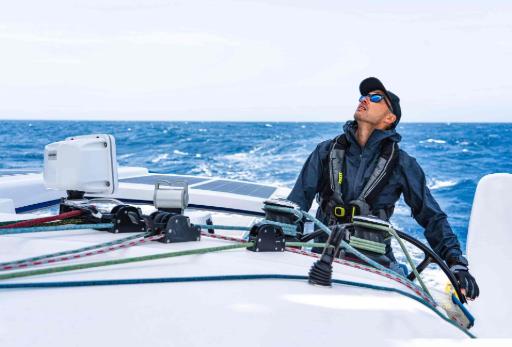
Spinlock Deckvest 6D sailing life jacket
170N or 275N Sailing Life Jackets?
One of the most common questions when choosing a 6D or LITE+ concerns buoyancy.
Should you choose 170N or 275N?
The assumption is often that more buoyancy must be better, but the reality is more nuanced.
For the vast majority of recreational sailors, including many undertaking serious offshore passages, a modern 170N sailing life jacket is entirely appropriate. It provides substantial flotation whilst remaining relatively compact and comfortable to wear.
The argument for 275N becomes stronger when additional weight enters the equation. Heavy offshore clothing, survival suits, tool belts, commercial equipment and larger body sizes can all benefit from increased buoyancy. The additional flotation may also help achieve faster rotation and support an unconscious casualty more effectively in certain circumstances.
The trade-off is increased bulk.
That is worth remembering because comfort remains an important safety feature. A sailing life jacket that is comfortable enough to wear continuously is often safer in practice than a larger lifejacket left hanging below deck.
Most cruising sailors will be well served by 170N. Those sailing in more extreme conditions, carrying additional equipment or wanting the maximum available buoyancy may find 275N worthwhile.
The important point is that 275N is not simply an upgrade. It is a specialist solution for specific circumstances.
Deckvest 6D HRS: Harness Release for Offshore Sailing
For decades, offshore safety training focused on one overriding objective: stay attached to the boat.
That remains excellent advice.
A person in the water is far harder to recover than a person still connected to the yacht.
Yet experience has shown that staying attached is not entirely without risk. A sailor who falls overboard whilst clipped on can find themselves dragged alongside the hull, trapped against topsides or repeatedly submerged in rough conditions. Whilst uncommon, these situations can become extremely serious.
The Harness Release System, or HRS, was developed in response to this problem.
Rather than attempting to release the tether itself, Spinlock’s solution allows the harness attachment point to be released in an emergency. The system is designed as a last-resort option when remaining attached to the yacht has itself become dangerous.
This is an important distinction.
The HRS is not an argument against clipping on. Quite the opposite. Staying connected remains overwhelmingly safer than becoming separated from the vessel.
Instead, HRS acknowledges that offshore safety is rarely black and white. The best sailing life jackets are often those that provide options when circumstances do not unfold as expected.
For sailors regularly undertaking offshore passages, overnight sailing or short-handed cruising, the Deckvest 6D HRS has become increasingly compelling for exactly this reason.
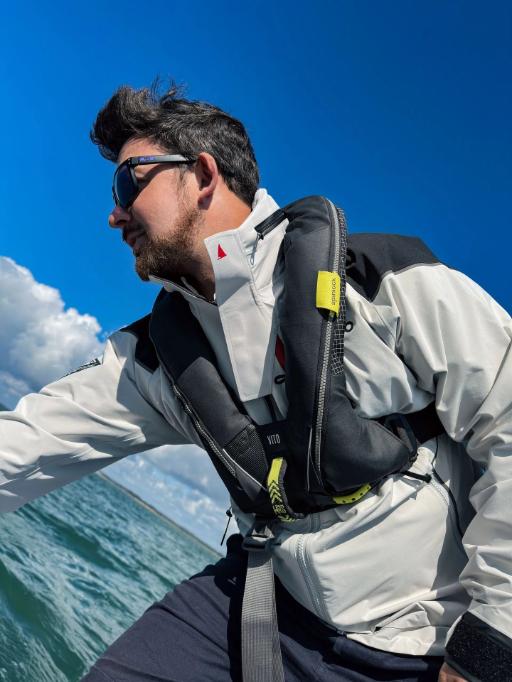
Spinlock VITO AFS sailing life jacket
Spinlock VITO AFS: A Different Approach to Sailing Life Jackets
If the 6D represents the refinement of the traditional offshore lifejacket, the VITO AFS sailing life jacket represents something different.
Rather than asking how many features can be added to a lifejacket, Spinlock has focused on improving the lifejacket itself.
The Advanced Flotation System places buoyancy where it is most effective, creating a lower-profile jacket when worn and a more stable flotation shape when inflated. The result is a sailing life jacket that feels smaller and less restrictive on deck whilst improving rotation, freeboard and stability in the water.
Importantly, these gains are not achieved by simply increasing buoyancy. The current VITO remains a 170N lifejacket, reflecting the fact that Spinlock’s focus has been on flotation efficiency rather than flotation quantity.
The VITO also incorporates HRS as standard and uses a Hammar hydrostatic inflator, a system that only activates once submerged rather than relying on water-sensitive paper elements. For sailors spending extended periods offshore, particularly in heavy weather, the reduction in accidental inflation risk is a significant advantage.
Perhaps the most impressive aspect of the VITO is that none of this feels revolutionary when you first put it on.
It simply feels lighter, softer and less intrusive than many traditional offshore lifejackets.
After twelve hours on deck, however, those differences begin to matter.
Which Spinlock Sailing Life Jacket Should You Choose?
The answer depends far more on your sailing than on the products themselves.
For day sailing, coastal cruising and general watersports, the Deckvest LITE remains one of the most comfortable and practical options available.
For sailors who regularly use jackstays and safety lines, the Deckvest LITE+ introduces harness capability whilst retaining the same low-profile feel.
For offshore passage making, the Deckvest 6D adds the equipment and protection that become increasingly important once land is no longer close at hand.
For sailors who spend significant time clipped on offshore, the Deckvest 6D HRS offers an additional layer of emergency capability that many experienced sailors now regard as highly desirable.
For those seeking the most technically developed offshore lifejacket in the Spinlock leisure range, the VITO AFS represents a fresh approach to offshore safety, focused not simply on adding more equipment but on improving the performance of the lifejacket itself.
Ultimately, there is no single “best” Deckvest.
There is only the sailing life jacket that best matches the way you sail.
If you have any questions about sailing life jackets please feel free to contact us and talk to one of our sailing experts or click below to see our full range:

 and then Add to Home Screen.

Sailing Life Jackets: Which Spinlock Deckvest Is Right for You?