
If you've spent any time browsing Harken's catalogue, you'll have noticed that Harken blocks aren't a single product — they're a family of distinct engineering platforms, each built around different bearing technology, sideplate materials, and load targets. Harken splits its block range into two top-level groups, Small Boat Blocks and Big Boat Blocks, and then further into around a dozen named ranges across the two. Understanding that architecture — rather than just picking whatever block looks like the right size — makes it much easier to specify the right Harken block for your boat, your control lines, and your budget.
This isn't a buying guide for a specific block. It's a map of the territory, so you know which range to start looking in before you get into individual product specs.
Quick reference: where to start looking
If your boat/application is... | Start with |
|---|---|
| Small dinghy, sailboard, or one-design with light synthetic control lines | 16 mm, Micro |
| Foiling dinghy, skiff, or sportboat vang/backstay cascade | Fly Blocks |
| Racer-cruiser or one-design wanting the lowest-friction small block | Zircon |
| General-purpose trimming on a small-to-mid cruiser, any configuration | Small Boat Classic, Carbo Air |
| Medium cruiser that has outgrown small-boat hardware | Mid-Range Classic |
| Cruising yacht prioritising low maintenance over ultimate load | Element, Cruising ESP |
| Performance racer-cruiser: mainsheet, runner, halyard, spinnaker systems | Black Magic Air |
| Grand-Prix racer wanting max efficiency at high load | V Blocks |
| Classic yacht where finish matters as much as load | Stainless Steel |
| Any boat needing a quick-release, temporary line lead | Snatch Blocks |
Treat this as a starting point, not a rulebook — the sections below explain the reasoning so you can adjust for your specific setup.
The logic behind Harken's block range split
Harken's own "Small Boat" and "Big Boat" categorisation is a useful starting point, but it's worth treating it as a spectrum rather than a hard rule. A well-loaded sportboat mainsheet might sit happily on a Carbo Air or Zircon block from the Small Boat side, while a lightly-loaded genoa lead on the same boat might use a Cruising ESP block from the Big Boat range. The real differentiators aren't boat length so much as: sheave size, working load range, bearing type (ball, ceramic, roller, or sleeve), and sideplate material (composite, stainless strap, or machined metal). Once you're thinking in those terms, the "which range" question gets a lot easier to answer.
Small Boat Blocks
Harken's Small Boat ranges span from dinghy hardware up through coastal cruiser and racer-cruiser control lines. Within that group, these seven ranges of Harken blocks split mainly along two lines: how much the bearing system prioritises low friction versus load-carrying simplicity, and how broad the configuration library is versus how specialised the application.
At the simple end, 16 mm and Micro are single-purpose small blocks — stainless or Delrin ball bearings in compact housings, aimed at dinghies, sailboards, and lightly loaded control lines rather than at any particular performance niche. Harken Fly Blocks sit alongside them but are built specifically around strength-to-weight, making them the default for foiling dinghies and vang/backstay cascades where reducing mass aloft matters more than outright load capacity.
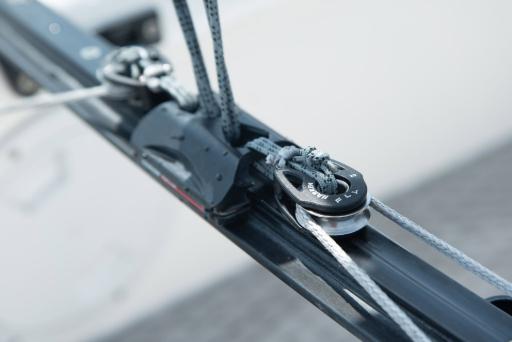
Harken Fly Blocks
Small Boat Classic is the generalist of the family — it carries by far the largest configuration library (singles, doubles, triples, fiddles, ratchets, and more) on a proven stainless-strap construction, making it a sensible default whenever you need a specific fitting without an unusual weight or friction constraint. Mid-Range Classic is the same construction philosophy scaled up for medium cruisers that have outgrown the smaller Classic sizes. Carbo Air Blocks cover similar sheave sizes to Classic but swap stainless straps for glass-fibre-reinforced resin sideplates, cutting weight while keeping working loads high — Harken positions these as the compact companion to its Big Boat range.
Harken Zircon is the newest range in the family, using ceramic ball bearings in caged races rather than stainless or Delrin. The ceramic bearings are claimed to be substantially stronger in compression than stainless equivalents of the same size, which translates into lower friction and better feedback through the sheet — relevant if you're trimming by feel in light air.
Small Boat Harken blocks — specifications at a glance
| Range | Sheave Size | Working Load Range | Bearing System | Sideplate/Construction |
|---|---|---|---|---|
| 16 mm | 16 mm | Up to ~113 kg (250 lb) | Stainless ball bearings, captive race | Stainless |
| Fly Blocks | 18–40 mm | Up to ~1,000 kg (2,200 lb) | Stainless ball bearings | Low-mass housing |
| Micro | 22 mm | Up to ~250 kg (550 lb) | Delrin® ball bearings | Stainless sideplates |
| Carbo Air | 29–75 mm | Up to ~2,500 kg (5,500 lb) | Ball bearings | Glass-fibre-reinforced resin |
| Small Boat Classic | 29–76 mm | Up to ~500 kg (1,100 lb) | Ball bearings | Stainless steel straps |
| Mid-Range Classic | 76 mm | ~500–2,500 kg (1,100–5,500 lb) | Ball bearings | Stainless steel straps |
| Zircon | 29–57 mm | Up to ~500 kg (1,100 lb) | Ceramic ball bearings, caged races | — |
Load figures are drawn from Harken's published filter bands per range and are indicative of the range's ceiling — always check the specific product page for the exact working load of an individual block.
Big Boat Blocks
The Big Boat ranges — the larger, higher-load half of the Harken blocks lineup — start where the Small Boat Classic and Carbo Air ranges leave off, running from around 40 mm up past 200 mm, with working loads extending well beyond 5,000 kg at the top end. Here the differentiators shift from friction and weight toward maintenance philosophy, bearing type suited to static vs. dynamic loads, and finish.
Element Harken Block is the value-oriented entry point into the Big Boat range — a simplified construction that strips out anything not contributing to strength or durability, aimed at cruisers who want dependable hardware without paying for a Grand-Prix specification. Cruising ESP occupies similar territory but makes a different engineering choice: sleeve bearings instead of ball bearings, which suit high static loads better than dynamic, high-cycle trimming — a good match for halyards and limited-purchase systems rather than sheets under constant load changes.
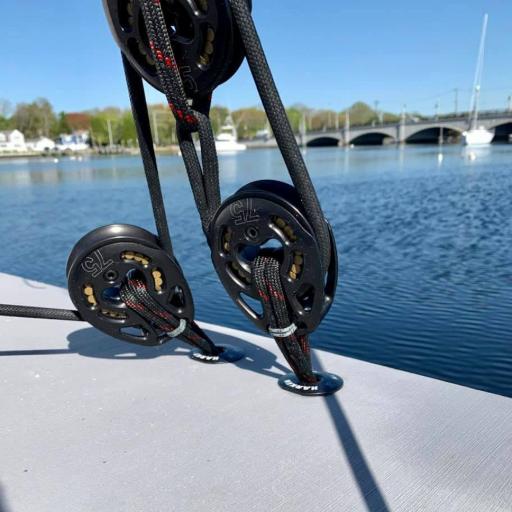
Harken Black Magic Air Blocks
Black Magic Air is the established all-rounder for performance racers and cruisers, used across mainsheet, runner, halyard, and spinnaker systems, with a bearing system designed for easy field servicing and no loose balls or rollers to lose during maintenance. V Blocks push further toward pure racing performance, combining axial and thrust bearing functions into a single set of titanium V-shaped rollers — efficient under high load but still free-spinning when easing in light air, a trait that matters if your programme is genuinely Grand-Prix level.
At the top of the range, Stainless Steel blocks use an ultralight composite bearing system on a heat-treated stainless inner race, with Torlon® balls carrying thrust loads — built for high loads while keeping the mirror-polished, traditional look some owners want to match against classic deck hardware. Snatch Blocks round out the range as opening blocks for quick, temporary line leads — useful for spinnaker sheets, preventers, and other lines that need to go in and out without unreeving.
Big Boat Harken blocks — specifications at a glance
| Range | Sheave Size | Working Load Range | Bearing System | Sideplate/Construction |
|---|---|---|---|---|
| Element | 45–80 mm | ~250–5,000 kg (550–11,000 lb) | Ball bearings | Composite w/ metal reinforcement |
| Cruising ESP | 40–100 mm | ~500–5,000 kg (1,100–11,000 lb) | Sleeve bearings | Aluminium or polished stainless |
| Black Magic Air | 45–150 mm | ~500 kg to 5,000+ kg (1,100–11,000+ lb) | Ball bearings | Composite/aluminium, tool-free service |
| V Blocks | 47–155 mm | ~1,000 kg to 5,000+ kg (2,200–11,000+ lb) | Titanium V-shaped roller bearings | Carbon or anodised aluminium |
| Stainless Steel | 75–200+ mm | ~1,000 kg to 5,000+ kg (2,200–11,000+ lb) | ULC composite bearing + Torlon® balls | Mirror-polished stainless |
| Snatch Blocks | Varies | Varies by model | Varies by model | Opening/quick-release body |
Load figures are drawn from Harken's published filter bands per range and are indicative of the range's ceiling — always check the specific product page for the exact working load of an individual block. Snatch block specs weren't fully verified against the live product page — flagging for a follow-up check before publishing.
Choosing the right Harken block range
In practice, most boat owners can narrow the search among Harken blocks to three questions: what's the working load of the line in question, does the application call for low friction and light weight (racing, foiling, light-air trim) or durability and low maintenance (cruising, standing rigging leads, infrequent use), and does the block need to match an existing hardware aesthetic on deck. Answer those, and you'll usually land on one or two candidate ranges rather than the full catalogue.
This piece deliberately leaves out Harken's specialist categories — flip-flop blocks, deck organisers, mast base blocks, and the like — which solve narrower problems and deserve their own treatment. We'll cover those, along with a closer look at bearing technology (ball vs. ceramic vs. roller vs. sleeve) and soft-attach vs. shackle-style terminations, in future articles.
Ready to see the ranges in full? Explore Harken blocks by clicking below or contact us if you have any questions:

 and then Add to Home Screen.

Understanding Harken Blocks: A Guide to the Range Architecture