
Dyneema ropes have become a fundamental component of modern sailing systems. From halyards and high-load control lines to lashings, soft shackles and running rigging, Dyneema®-based ropes are now widely used across cruising and performance sailing yachts. Their adoption is driven by a combination of very high strength, low weight and minimal stretch — properties that are difficult to achieve with traditional rope materials.
That said, Dyneema ropes are not a single, uniform product category. Dyneema® is a registered trade name for a family of UHMWPE fibres, available in multiple grades with distinct mechanical characteristics. At the same time, not all ropes described as UHMWPE are made using branded Dyneema® fibres, and the differences between fibre grades and manufacturers can have a measurable impact on performance in sailing applications.
This article provides a detailed technical overview of Dyneema ropes, explains the differences between the main Dyneema® fibre grades, and explores how they compare with other UHMWPE options used in marine rope construction.
What Is Dyneema® and UHMWPE?
Dyneema® is the trade name for ultra-high molecular weight polyethylene (UHMWPE) fibres produced by DSM. UHMWPE is a class of polymer defined by extremely long molecular chains, which give the fibre its characteristic combination of high tensile strength, low density and excellent fatigue resistance.
In practical terms, UHMWPE fibres:
- Deliver very high strength for their weight
- Exhibit extremely low stretch compared to polyester
- Float due to low density
- Perform well under cyclic loading
Dyneema® is the most widely recognised UHMWPE brand in sailing, but it is not the only one. Generic UHMWPE fibres and alternative branded variants also exist, such as Stirotex® used in selected PremiumRopes constructions. While these fibres share a common chemical base, differences in processing, fibre orientation and quality control can influence creep behaviour, stiffness and long-term dimensional stability.
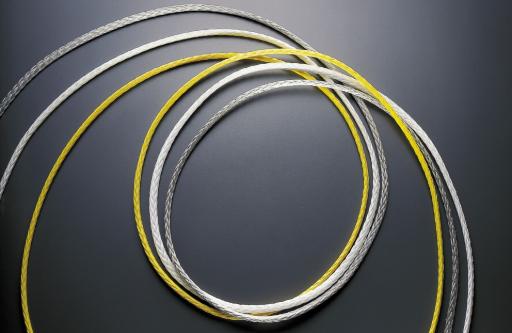
Dyneema SK78 Ropes
Why Dyneema Ropes Matter on Sailing Yachts
Dyneema ropes are typically specified where load control and dimensional stability are critical. Common sailing applications include:
- Sheets and Halyards
- Backstays and running rigging
- High-load control lines
- Lashings, strops and soft shackles
Compared to polyester ropes, Dyneema ropes allow smaller diameters for a given working load and exhibit significantly reduced elongation under load. For cruising yachts, this often translates into more consistent sail shape and reduced need for re-tensioning. For performance-oriented sailors, it enables finer trim control and reduced system friction.
Understanding Dyneema® Fibre Grades
Not all Dyneema® fibres behave the same way. Over time, DSM has developed multiple grades, each optimised for different performance priorities.
Dyneema SK75
Dyneema SK75 was one of the earliest widely adopted grades in marine rope applications. It offers high strength and low initial stretch but exhibits relatively high creep under sustained load. While still suitable for dynamic applications, it is now less common in modern halyards and load-critical sailing lines.
Dyneema SK78 represents a significant improvement in creep resistance compared to SK75, while maintaining similar strength levels. Long-term elongation under constant load is substantially reduced, making Dyneema SK78 a widely used choice for cruising and performance halyards.
Many Dyneema ropes from manufacturers such as Gottifredi Maffioli, Robline and PremiumRopes are based on Dyneema SK78 cores due to this balance of strength, stability and cost.
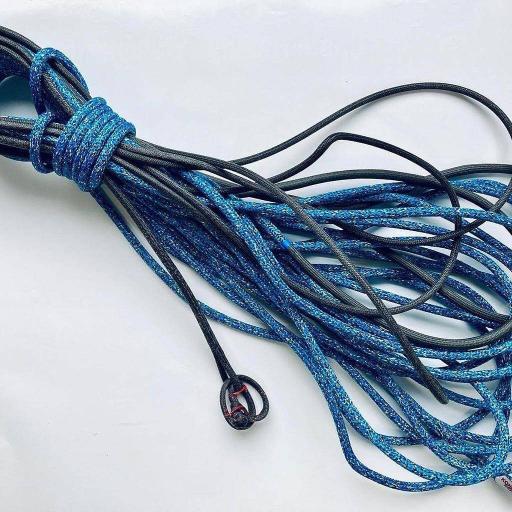
Dyneema SK99 is a higher-modulus fibre offering increased strength and stiffness compared to Dyneema SK78. For a given diameter, Dyneema SK99 lines can carry higher loads or allow further diameter reduction, which is particularly attractive in performance-oriented halyard systems.
Creep resistance is also improved relative to SK78, but SK99 is generally less forgiving in handling and requires careful cover selection to manage higher loads and clutch interaction.
Dyneema DM20
Dyneema DM20 is a specialist UHMWPE fibre developed for applications involving continuous or near-continuous high loads, where long-term creep must be minimised, even at elevated temperatures. In this respect, Dyneema DM20 delivers exceptional performance, with creep levels significantly lower than those of Dyneema SK78 or Dyneema SK99.
However, this creep resistance comes with important trade-offs. Dyneema DM20 has a lower modulus and reduced strength efficiency compared to other Dyneema® grades. To achieve equivalent working loads, a Dyneema DM20 rope requires a greater volume of fibre, resulting in larger diameters and increased weight.
In sailing applications, this increased diameter is often the limiting factor. Larger ropes are less compatible with existing deck hardware, increase bending fatigue over small sheaves, and add unnecessary weight aloft. As a result, Dyneema DM20 is rarely used for general sailing lines or halyards, despite its excellent creep performance.
Dyneema DM20 is instead widely used in commercial and industrial marine applications, such as offshore platform mooring systems, where long-term static loading is critical and rope diameter is not constrained by yacht-scale hardware.
Covers and Construction in Dyneema Ropes
Dyneema Ropes are rarely used as bare cores in sailing systems. While uncovered Dyneema® offers maximum strength and minimum weight, it performs poorly in clutches, winches and high-abrasion environments.
Most sailing Dyneema ropes therefore use double braid constructions with protective covers. Common cover materials include:
- Polyester for grip and general durability
- High-tenacity polyester blends for improved heat resistance
- Aramid fibres such as Technora® in high-load halyards
In practice, the choice of cover often has a greater impact on service life than the difference between Dyneema® fibre grades, particularly in clutch-driven systems.
Dyneema® vs Other UHMWPE Fibres
Ropes marketed as UHMWPE but not explicitly as Dyneema ropes may use alternative fibres with different performance characteristics. While suitable for many applications, these fibres may exhibit:
- Higher creep under sustained load
- Greater variability in stiffness and elongation
- Differences in heat behaviour and fatigue resistance
In dynamic or lightly loaded applications, these differences may be negligible. In halyards or permanently tensioned systems, however, long-term creep performance can become a defining factor.
Choosing the Right Dyneema Rope
Selecting Dyneema ropes should always be application-led. Key considerations include:
- Sustained versus dynamic loading
- Compatibility with winches and clutches
- Required diameter and handling characteristics
- Expected service life and inspection intervals
For many cruising yachts, Dyneema SK78-based lines provide an effective balance of performance and durability. Higher-load or performance applications may justify Dyneema SK99, while Dyneema DM20 remains primarily relevant in specialist commercial contexts rather than general sailing use.
Explore Our Range of Dyneema Ropes
Dyneema ropes are not a single solution but a family of highly specialised sailing ropes. Our rope category includes a wide range of Dyneema®-based lines from established manufacturers, available by the metre, on spools, or as custom spliced solutions built to specification.
If you have any questions please feel free to contact us or explore the full range of Dyneema ropes and UHMWPE ropes here:

 and then Add to Home Screen.

Dyneema Ropes: A Technical Guide to UHMWPE Rope for Sailing Yachts