Rope clutch units
A rope clutch is used to hold loaded control lines securely while allowing efficient trimming, release and load management from the cockpit, mast base or deck organiser. On sailing yachts, a sailing clutch or halyard clutch is commonly fitted for halyards, reefing lines, furling lines, outhauls and control systems where reliable rope holding, correct line diameter and suitable working load are critical. Read more...


What a rope clutch does on a sailing yacht
A rope clutch allows a loaded rope to be held without leaving it permanently on a winch. This makes it possible to manage multiple halyards and control lines from a limited number of winches, particularly on cruising yachts, performance cruisers and offshore boats with lines led aft to the cockpit.
In use, the rope normally passes through the clutch body in a straight line. With the handle closed, an internal cam, jaw, wedge, V-grip or constrictor-style mechanism grips the rope cover and prevents it from easing under load. When the handle is opened, the line can be released, eased or fully unloaded. Most modern clutch designs also allow the rope to be trimmed through the unit while the handle remains closed, so the line can be tensioned on a winch and then held automatically when the winch load is removed.
Typical applications include mainsail and headsail halyards, spinnaker and gennaker halyards, reefing lines, outhauls, vang/kicker controls, furling lines, pole controls and traveller adjustment systems. The correct clutch must be selected according to rope diameter, expected load, rope construction, deck layout and the way the line will be handled during manoeuvres.
Rope clutch, sailing clutch, halyard clutch, jammer or cleat?
The terms rope clutch, sailing clutch and halyard clutch are often used interchangeably. Technically, the product is a rope clutch; “sailing clutch” describes the marine application, while “halyard clutch” usually refers to the same type of unit used specifically for a halyard.
A rope clutch is different from a cam cleat. Cam cleats are useful for lower-load control lines that need frequent hand adjustment, but they are not normally the correct solution for highly loaded halyards or reefing lines. A rope clutch gives a more secure, enclosed holding system and is designed to work with winch-loaded lines.
A rope jammer is generally used where loads are higher, or where accidental release must be minimised. Rope jammers are often selected for larger yachts, high-load halyards and offshore race applications. For many cruising and performance-cruising boats, however, a correctly sized rope clutch remains the standard solution for low to medium-load halyards and control lines.
How to choose the correct rope clutch size
The first selection point is rope diameter. Every rope clutch has a recommended line range, for example 6–10mm, 8–12mm, 8–14mm or 10–14mm depending on the manufacturer and model. The line must fall within the stated range, but this alone does not guarantee ideal performance.
As a general rule, grip is usually better when the rope diameter is closer to the upper end of the clutch’s working range. For example, a 10mm halyard may normally perform better in a clutch optimised for 8–10mm than in a broader 10–14mm unit where 10mm is at the lower limit. This is particularly important with modern low-stretch ropes, where small changes in diameter, cover firmness and rope flattening under load can affect clutch holding performance.
When selecting a halyard clutch, check both the nominal rope size and the real measured diameter of the line after use. Older ropes can flatten, glaze or reduce in effective diameter where they pass through the clutch. New performance ropes with Dyneema or other HMPE cores may also behave differently from traditional polyester double braid, even when the quoted diameter is identical.
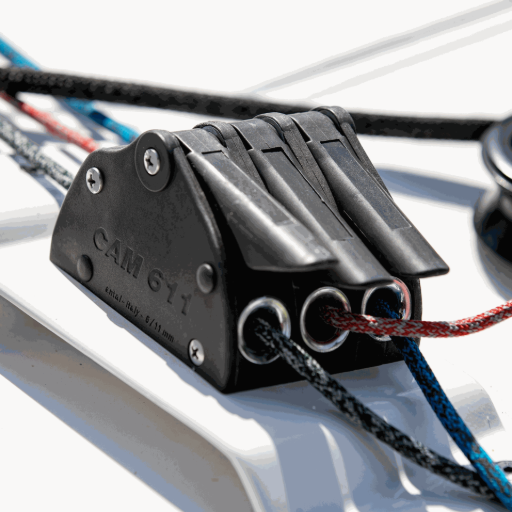
Antal Rope Clutch
Matching clutch load to halyards and control lines
Load rating is the second critical factor. A clutch should not be selected only by rope diameter; it must also have sufficient holding capacity for the application. Halyards, reefing lines and highly loaded sail controls can generate substantial loads, especially on yachts with low-stretch running rigging and efficient deck hardware.
The required holding load depends on several variables: sail area, mast height, halyard purchase, rope material, sheave friction, winch power, reefing geometry and the wind range in which the system will be used. A mainsail halyard, genoa halyard or reefing line will normally require a higher-load clutch than a lightly loaded traveller control or pole lift. If the load is close to the upper limit of a clutch range, moving to a higher specification sailing clutch or a rope jammer should be considered.
Safe working load, maximum holding load and manufacturer test load are not always the same thing, so compare specifications carefully. Where possible, select with margin rather than choosing the smallest acceptable clutch. This is especially relevant for offshore sailing, shorthanded sailing and boats where halyards are frequently winched hard.
Rope material, cover grip and halyard slipping
One of the most common reasons for replacing or upgrading a rope clutch is halyard slip. A slipping clutch is not always caused by the clutch alone. The problem can come from the rope, the clutch, the installation or a combination of all three.
Common causes include undersized rope, a rope that has flattened under load, a worn cam or jaw, a polished or glazed rope cover, incorrect clutch range, poor lead angle, or a modern low-friction cover that does not generate enough grip in an older clutch design. Dyneema-cored halyards can increase the issue because they stretch less than polyester, transferring higher peak loads to the clutch. If the cover is too soft, the rope may compress below the minimum effective clutch diameter and begin to creep.
When diagnosing slip, first check whether the rope diameter still matches the clutch range. Then inspect the gripping surfaces for wear, contamination or damage. If the rope is technically within range but still slipping, a clutch with a different gripping mechanism, a smaller rope range, a ceramic cam option, or a more suitable rope cover may be required.
Mounting position, clutch orientation and line lead
The mounting format of a rope clutch is not just a deck-layout detail; it affects line lead, handle access, rope wear and the way the clutch can be operated under load. When choosing a sailing clutch or halyard clutch, check whether the line is led aft across the coachroof, mounted vertically at the mast, fixed to a side surface, or integrated into a continuous-line control system.
Most conventional deck installations use an upright rope clutch mounted on a flat horizontal surface between the deck organiser and the winch. This is the common arrangement for halyards, reefing lines and control lines led aft to the cockpit. The line should enter and exit the clutch as straight as possible, with the clutch aligned to the deck organiser ahead and the winch behind. Poor horizontal or vertical alignment can increase friction, accelerate cover wear and reduce holding efficiency.
An integrated rope clutch is used where the clutch function forms part of a more compact or system-specific deck layout. Integrated solutions can be useful where space is restricted, where the clutch is part of a dedicated rope-handling assembly, or where the line path has already been defined by the surrounding hardware. In these installations, check the manufacturer’s mounting footprint carefully and confirm that the line can still be led cleanly without side loading the clutch body.
Side-mounted rope clutches are used where a horizontal deck-mounted clutch is not practical, or where the clutch needs to be fixed to a vertical or angled surface. Port and starboard versions are not interchangeable in every installation, because the handle orientation, rope lead and accessible operating side may differ. A port side rope clutch should normally be selected for a port-side installation, while a starboard side rope clutch should be selected where the line is handled from the starboard side. This is particularly important on coachroof sides, mast-side installations and compact cockpit layouts where handle clearance is limited.
A continuous line rope clutch is a more specialised option, normally associated with endless or continuous control lines rather than a conventional halyard tail. These are relevant for some furling, trimming and control-line systems where the line is not simply loaded and tailed in one direction. When selecting a continuous-line clutch, check line diameter, rope construction, bend radius and whether the clutch is designed to hold both parts of the line without creating excessive compression or localised cover damage.
In all cases, mounting selection should be considered alongside rope diameter, safe working load, number of leads and service access. A correctly specified clutch in the wrong orientation can still create handling problems, while a correctly mounted clutch improves line control, reduces rope wear and makes the deck layout easier to operate under load.
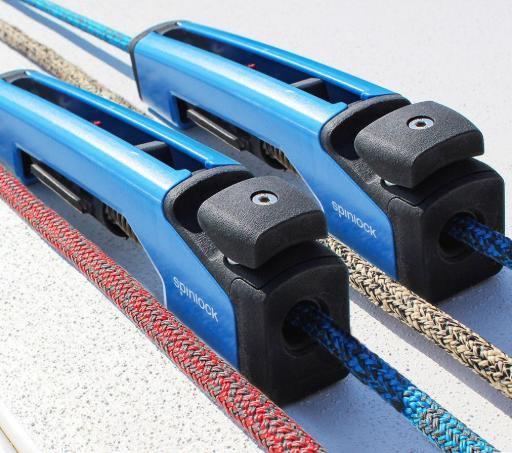
Spinlock Rope Clutch
Rope clutch brand and range considerations
Different manufacturers use different clutch mechanisms and materials. Some designs use conventional cam and base gripping surfaces; others use V-shaped gripping geometry, ceramic-coated components, textile constrictor systems or multi-contact rope deflection mechanisms. The correct choice depends on load, rope type, deck space, release behaviour and serviceability.
Spinlock, Lewmar, Antal, Karver, Rutgerson and Cousin Trestec all offer rope clutch solutions for different yacht sizes and applications. Rather than choosing by brand alone, compare the line range, holding load, clutch mechanism, handle action, mounting footprint, spare parts availability and compatibility with your existing deck layout. A compact rope clutch may suit a crowded coachroof, while a higher-load unit may be more appropriate for modern halyards and reefing systems.
Maintenance, cams and replacement parts
A rope clutch is a working load-bearing component and should be inspected regularly. Check for worn cams, cracked handles, loose fasteners, distorted bases, sharp edges, salt build-up and rope dust inside the mechanism. If the clutch becomes harder to operate, releases unevenly or starts to slip, it may need cleaning, servicing or replacement parts.
Many rope clutch ranges have replaceable cams, bases, handles, labels and service kits. Replacing a worn cam can restore holding performance if the clutch body is still in good condition and the rope remains compatible. However, if the clutch is undersized for the application, damaged, obsolete or no longer suitable for the rope type being used, full replacement is usually the better technical solution.
Rope clutch FAQ
What is the difference between a rope clutch and a halyard clutch?
A halyard clutch is a rope clutch used specifically for a halyard. The same clutch type may also be used for reefing lines, furling lines and other control systems, provided the rope diameter and load rating are suitable.
How do I know what size rope clutch I need?
Start with the rope diameter, then check the holding load required for the application. The rope should sit within the manufacturer’s stated range, ideally not right at the lower limit if high holding power is required.
Why is my halyard slipping in the clutch?
Halyard slip is usually caused by an undersized or flattened rope, worn clutch internals, an unsuitable rope cover, excessive load, incorrect clutch range or poor line alignment. Modern low-stretch halyards can expose limitations in older clutch designs.
Can I release a rope clutch under load?
Some clutches are designed for controlled release under load, but the safest approach is usually to take the load on a winch before opening the clutch, especially on halyards and reefing lines.
When should I choose a jammer instead of a rope clutch?
A jammer should be considered where loads are higher, where accidental release would be critical, or where the application is beyond the safe working range of available clutch units.

To install this Web App in your iPhone/iPad press
 and then Add to Home Screen.
