Pulley blocks
Explore our Pulley Blocks category, featuring a wide range of high-quality all purpose sailing blocks. Use our technical filters to narrow your product choice, ensuring the perfect fit for your specific sailing application. Discover reliable and versatile pulley blocks designed to enhance your sailing performance and ease of use. Read more...
Top sailing ranges:


Pulley Blocks for Sailing – High-Performance Sailing Blocks & Boat Pulleys
Welcome to our Pulley Blocks for Sailing category, where you'll find a wide range of high-quality sailing blocks and boat pulley systems designed to meet the demands of both cruising sailors and high-performance racing yachts.
Pulley blocks are essential components in modern sailboat rigging. They are used to redirect lines, reduce friction, and create mechanical advantage, making sail handling easier, safer, and more efficient. Whether you're trimming a mainsheet, adjusting a halyard, or fine-tuning control lines, choosing the right sailboat blocks is crucial for optimal performance.
In this guide, we’ll walk you through the key factors when selecting the right pulley blocks for sailing, including safe working load (SWL), bearing systems, block types, sizing, and attachment methods.
What Are Pulley Blocks Used for in Sailing?
Sailing blocks (pulleys) are used throughout a boat’s running rigging to control and manage loads efficiently. Their main functions are:
- Redirecting lines across the deck or mast
- Reducing friction for smoother trimming
- Increasing mechanical advantage in systems like mainsheets and vang systems
Common applications include:
- Mainsheets
- Jib and genoa sheets
- Halyards
- Control lines (outhaul, cunningham, vang)
Using the correct low-friction pulley blocks improves trimming precision and reduces physical effort, especially under load.
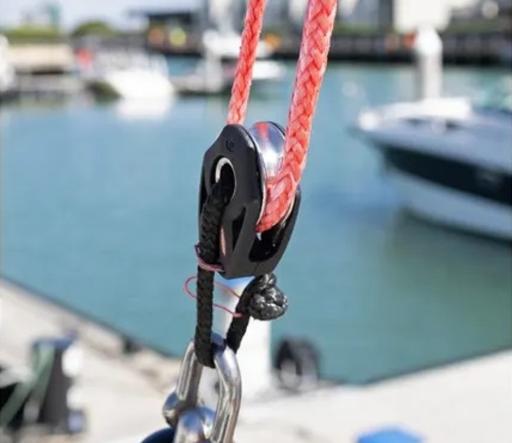
Ronstan Orbit Pulley Block
Importance of Safe Working Load (SWL)
When selecting sailing pulley blocks, it’s essential to consider the safe working load (SWL). The SWL defines the maximum load a block can safely handle under real sailing conditions.
Choosing a block with insufficient load capacity can lead to failure and compromise safety. Always evaluate the expected loads in your system—especially for high-load applications such as mainsheets or spinnaker systems—and select boat blocks with a SWL that exceeds those loads with an adequate safety margin.
How to Choose the Right Block Size
One of the most common questions is: what size pulley block do I need?
The correct block size depends on:
- Rope diameter – The sheave must match your line size to reduce wear and friction
- Load requirements (SWL) – Higher loads require larger and stronger blocks
- Application – Dynamic systems (like sheets) vs static loads (like halyards)
As a general rule:
- Use larger sheaves for thicker lines and higher loads
- Ensure compatibility between rope size and block specifications
- For performance sailing, prioritize low-friction blocks with optimized sheave size
- Types of Sailing Blocks Explained
Different sailing applications require different block configurations. Understanding the main types helps you select the right solution:
- Single pulley blocks – for simple line redirection
- Double pulley and triple pulley blocks – to create mechanical advantage in purchase systems
- Ratchet blocks – provide grip under load, ideal for sheets in high-load trimming
- Snatch blocks – can be opened to attach to loaded lines quickly
- High-load blocks – engineered for extreme loads and performance sailing
Choosing the correct type ensures efficient load handling and improved sail control.
Pulley Blocks Bearing Selection
The bearing system within pulley blocks significantly impacts performance and efficiency. Leading brands like Lewmar, Harken, and Antal offer advanced bearing systems designed for various sailing conditions:
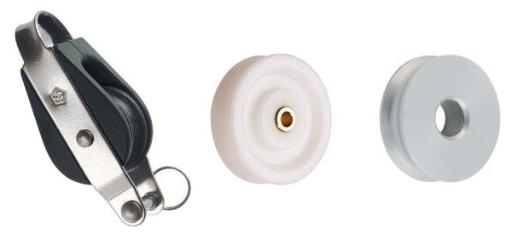
Plain Bearing Blocks
Brands such as Lewmar and Antal offer durable plain bearing pulley blocks suitable for moderate loads and low-speed applications. These blocks require minimal maintenance and provide reliable performance for cruising applications.
Ball Bearing Blocks
Harken and Ronstan excel in ball-bearing blocks, providing smooth operation under high loads and speeds. These pulley blocks reduce friction significantly, making line adjustments effortless, ideal for racing scenarios and frequent sail trim adjustments.

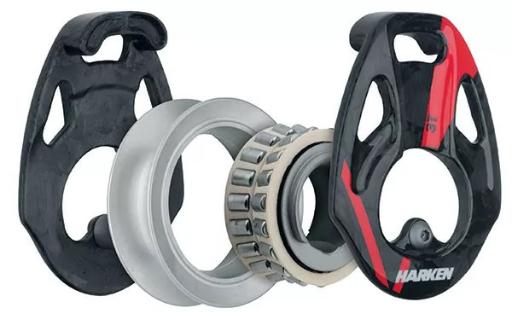
Needle Bearing Blocks
For extreme loads and minimal friction, Karver and Antal offer needle-bearing blocks engineered for high-load, high-performance environments. Needle bearings excel in critical applications where efficiency and load distribution are paramount, particularly beneficial in high-level racing and offshore conditions.
How to Reduce Friction in Sailing Systems
Reducing friction is essential for improving sail handling and overall boat performance. To optimize your setup:
- Use ball bearing or needle bearing blocks for dynamic systems
- hoose blocks with appropriate sheave size for your rope diameter
- Minimize unnecessary line deflections
- Consider high-performance blocks for racing applications
Low-friction systems reduce effort, improve responsiveness, and enhance trimming precision.
Pulley Blocks Attachment Methods
Choosing the correct block attachment method is another important factor:
Metallic Connections
Traditional shackles and clips from brands like Lewmar and Antal provide strong, rigid connections. These are ideal for high-load and permanent installations.
Soft Connections
Harken and Karver promote soft attachments such as Dyneema loops. These are lightweight, flexible, and easy to inspect. They reduce weight aloft and improve overall sailing performance, making them popular in modern racing setups.
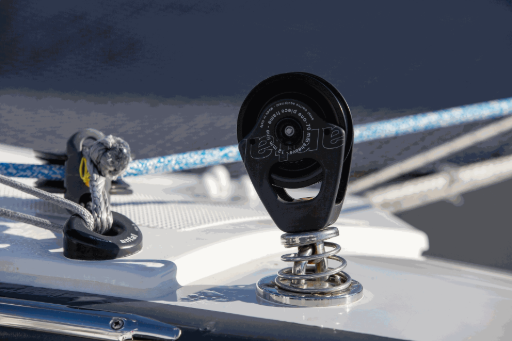
Antal OPF Pulley Block
How to Choose the Right Sailing Blocks
When selecting the best pulley blocks for your sailboat, consider:
- Load requirements (SWL)
- Rope diameter compatibility
- Block type (single, double, ratchet, etc.)
- Bearing system (plain, ball, needle)
- Sailing style (cruising vs racing)
A well-matched setup ensures durability, safety, and maximum efficiency on the water.
Navigating Our Pulley Blocks Category
Our Sailing Pulley Blocks category is designed to help you quickly find the right product.
Use our filters to refine your selection by:
- Application (cruising, racing, performance sailing)
- Boat length
- Rope diameter
- Safe working load (SWL)
- Bearing type
- Attachment method
This allows you to efficiently find the ideal boat blocks and pulleys for your specific setup.
High-Performance Sailing Blocks for Every Application
In summary, our range of pulley blocks for sailboats includes everything from reliable cruising solutions to high-performance, low-friction blocks for competitive sailing.
By understanding key factors such as load capacity, block type, bearing system, and attachment method, you can confidently select the right sailing blocks to optimize your rigging and enhance performance on the water.

To install this Web App in your iPhone/iPad press
 and then Add to Home Screen.
