Furling lines
In the sailing industry, furling lines are a critical component for efficient sail management. High-quality furling lines ensure smooth and reliable operation of your furling system, allowing you to easily reef or furl your sails in varying wind conditions. Investing in the best furling lines not only enhances your sailing performance but also improves safety and convenience on the water. Whether you're cruising or racing, our selection of durable, low-stretch furling lines is designed to meet the rigorous demands of modern sailing. Explore our range of top-tier furling lines and upgrade your sailing gear to achieve optimal control and reliability.



Furling Lines – Technical Overview, Design Criteria and Sailing Applications
Furling lines are a critical control component in modern sail handling systems, responsible for transferring torque from the furling drum to the sail in a controlled, repeatable manner. They are used across a wide range of applications including headsail furlers, Code Zero furlers, bottom-up furling systems for asymmetric sails, and continuous-line furling setups. Correct furling line selection has a direct impact on system efficiency, sail longevity, and overall deck safety.
Unlike conventional sheets or halyards, furling lines are subject to high abrasion, repeated cyclic loading, and localized compression as they wrap tightly around furling drums. As a result, furling line performance is driven far more by cover construction and diameter consistency than by ultimate breaking strength.
Functional Requirements of Furling Lines
From a technical perspective, furling lines must satisfy several key requirements:
- High abrasion resistance against furling drums, fairleads, and deck organisers
- Consistent grip on aluminium or composite furling drums
- Controlled elongation, allowing shock absorption without excessive stretch
- Roundness under load to prevent slippage and uneven drum loading
- UV and saltwater resistance for long-term exposure on deck
Unlike halyards, which prioritise minimal elongation, furling lines benefit from a balanced construction that combines durability with predictable elasticity, particularly during high-load unfurling in stronger breeze.
Rope Construction and Material Considerations
Core Design
Most furling lines use polyester-based cores, sometimes blended with Dyneema® to improve strength-to-diameter ratios on larger yachts. However, fully Dyneema® cores are rarely required, as furling systems are typically limited by drum friction rather than tensile load.
A slightly elastic core can be advantageous, helping to reduce peak loads transmitted to furling drums, swivels, and sail attachment points.
Cover Construction
The cover is the most critical element of a furling line. Common features include:
- High-tenacity polyester covers for durability and grip
- Technora® or aramid blended covers in high-load or performance applications
- Tightly braided constructions to resist flattening under compression
The objective is to maintain consistent friction without glazing, even after thousands of furling cycles.
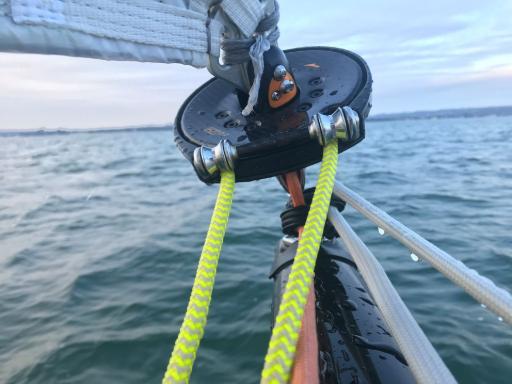
Continuous Furling Line
Continuous vs Single Furling Lines
Modern furling systems increasingly use continuous furling lines, particularly for Code Zero and asymmetric sails. These systems place additional demands on the rope:
- Uniform diameter along the full length
- High-quality splices with minimal profile change
- Exceptional abrasion resistance, as the same rope sections are repeatedly loaded
Single-ended furling lines, still common on headsail furlers, must integrate cleanly with clutches and jammers while maintaining good handling characteristics.
Typical Furling Line Applications
Used on jibs and genoas, furling lines must withstand frequent trimming and reefing cycles. Diameter selection is often dictated by furling drum geometry and existing deck hardware rather than load calculations alone.
Code Zero and Bottom-Up Furling
These systems generate higher torque loads, especially during unfurling. Furling lines must offer reliable grip and abrasion resistance to prevent sudden or uncontrolled sail deployment.
Dynamic loading and rapid furling cycles require furling lines with robust covers and predictable behaviour, particularly on performance cruisers and race-oriented yachts.
Key Brands and Technical Positioning
Kohlhoff
Kohlhoff is well regarded for technically refined rope constructions, particularly in applications where diameter stability and longevity are critical. Kohlhoff furling lines are often selected for larger yachts and custom rigging solutions where predictable performance under sustained load is required.
Gottifredi Maffioli
Gottifredi Maffioli furling lines draw heavily from the company’s racing and performance background, combining high-quality braided covers with carefully engineered cores. These ropes are commonly used on Code Zero and performance furling systems where grip, wear resistance, and consistency are essential.
Robline
Robline offers furling lines designed around abrasion resistance and controlled elasticity, making them suitable for continuous furling systems and high-use cruising applications. Their constructions focus on durable polyester covers that maintain grip over long service intervals.
Each manufacturer approaches furling line design differently, but all focus on durability, cover performance, and system compatibility, rather than marketing-driven strength claims.
Furling Line Construction Comparison
| Feature | Cruising-Oriented Furling Line | Performance / Code Zero Furling Line |
|---|---|---|
| Core material | Polyester or blended polyester | Polyester with Dyneema® reinforcement |
| Cover material | High-tenacity polyester | Polyester / aramid or reinforced blend |
| Stretch characteristics | Moderate, shock-absorbing | Low to moderate, torque-efficient |
| Abrasion resistance | High | Very high |
| Typical application | Headsail furlers, cruising boats | Code Zero, bottom-up furling, performance yachts |
Diameter Selection and System Compatibility
Correct diameter selection is essential to ensure efficient torque transmission and long service life. Key considerations include:
- Furling drum groove depth and width
- Lead angles through deck organisers
- Compatibility with clutches or jammers
- Sail size and expected furling loads
Oversized furling lines can increase friction and reduce drum efficiency, while undersized lines may slip or wear prematurely. Manufacturer recommendations for specific furling units should always be followed, particularly for continuous-line systems.
Installation, Inspection and Service Life
Furling line longevity depends heavily on correct installation and maintenance. Best practices include:
- Ensuring smooth, aligned lead paths
- Avoiding sharp edges and cross-loading
- Regular inspection for glazing, flattening, or cover breakdown
Even high-quality furling lines are wear components and should be inspected frequently on yachts that rely heavily on furling systems for sail handling.
Summary on Furling Lines
Furling lines are a specialised category of running rigging, engineered to deliver controlled torque, durability, and predictable sail handling. Cover construction, abrasion resistance, and diameter compatibility are more important than raw breaking strength figures. For technically minded boat owners, selecting a furling line matched to the specific furling system and sailing profile is essential for reliable and safe operation.

To install this Web App in your iPhone/iPad press
 and then Add to Home Screen.
