Hampidjan
DynIce furling rope is Hampidjan's torsional rope for furling code zeros, gennakers and asymmetric spinnakers on small and medium-sized yachts. Its heat-set Dyneema SK75 strength member carries the luff load and transmits the twist from the drum to the head. We sell it by the metre in 7 to 15 mm for terminating yourself; choose the diameter by length and by top-down or bottom-up furling. Read more below.
|
|
DynIce furling rope: how it is built
A torsional furling rope has two jobs: carry the luff tension of the sail, and pass the rotation of the furling drum up to the head without winding up along its length. The DynIce rope does the first with a strength member of Dyneema SK75, which Hampidjan heat-sets and stretches so that the constructional elongation is taken out in production. It does the second with a construction that resists twisting, so the sail rolls up progressively from the drum.
It comes off the roll and is cut to length, which is what separates a torsion rope from a made-to-measure torsional cable. You form the end terminations yourself, typically around a furling thimble. Thimbles and clamps are not included.
Choosing DynIce furling rope by diameter
Choose the diameter from the finished length and the type of furling. Top-down furling, where the sail rolls from the head down, puts much more torsion through the rope than bottom-up furling of a code zero with a luff rope. For the same length, top-down therefore needs a larger diameter.
| Diameter | Weight | Breaking strength (spliced) | Top-down length | Bottom-up length |
|---|---|---|---|---|
| 7 mm | 35 g/m | 1.5 t | 7.0–9.0 m | 7.0–11.5 m |
| 9 mm | 58 g/m | 3.3 t | 9.0–11.5 m | 11.0–14.0 m |
| 11 mm | 87 g/m | 5.5 t | 10.5–13.0 m | 12.5–15.5 m |
| 13 mm | 122 g/m | 8.7 t | 12.0–14.5 m | 14.0–17.0 m |
| 15 mm | 162 g/m | 11.4 t | 13.5–16.0 m | 15.5–19.0 m |
Top-down DynIce furling rope: go up a size
Where two diameters cover your length, take the larger for top-down furling: it is stiffer in torsion, so the head turns with the drum instead of lagging behind it. Above 16.5 m top-down, a torsion rope is not the right solution and a purpose-built torsional cable is.
Bottom-up furling: go down a size
For a code zero or other bottom-up furling sail, take the smallest diameter that covers the length. The rope sits in the sail's luff pocket, so a thinner rope means a smaller pocket and less weight aloft. Above 19 m, seek a cable designed for the length.
Strength and terminations
The figures in the table are Hampidjan's breaking strengths, not working loads. A finished furling line is only as strong as its terminations and fittings, and a clamped or doubled-back end is usually the weak point. Check that each thimble suits the rope diameter and that it fits the jaw and pin of your top-down furler or code zero drum.
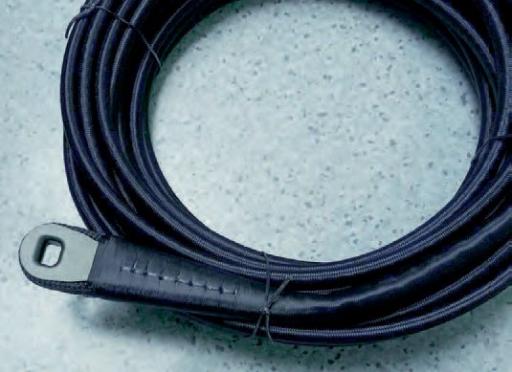
Hampidjan DynIce torsional furling rope
About Hampidjan
Hampidjan was founded in Reykjavik in 1934 and makes fishing gear, trawls, netting and ropes, including ropes for mooring, seismic work and leisure use. Its DynIce ropes use Dyneema fibre. For other makes of torsion rope and how they compare, see our torsion rope range. For background, read our blog post Torsional cable vs torsion rope.
DynIce furling rope FAQ
What is the difference between a torsion rope and a torsional cable?
A torsion rope is made to a generic specification, sold off the roll and terminated by the user. A torsional cable is built to the exact length for one sail, with terminations fitted by the maker.
What diameter do I need for a 12 m top-down furler?
11 mm and 13 mm both cover 12 m top-down; take 13 mm, the larger, for better torsional stiffness.
Are thimbles included?
No. The rope is supplied as a cut length; thimbles, clamps and other termination parts are sold separately.

To install this Web App in your iPhone/iPad press
 and then Add to Home Screen.
